
SBI auction property is one of the most searched topics among Indian home buyers, and for good reason. State Bank of India is the country’s largest lender, so it also has the largest pool of repossessed homes, flats, plots and commercial units that go under the hammer every month. An SBI auction property can be a smart way to buy below market value, provided you understand how the bank lists, prices and sells these assets. This guide explains the process in 10 practical steps, from finding a genuine listing to registering the sale certificate in your name.
Why SBI auction property attracts so many buyers
State Bank of India lends to millions of home buyers and businesses. When a small share of those loans turns bad, the bank enforces its security under the SARFAESI Act, 2002. Because the loan book is so large, the number of properties available at any time is also large, spread across metros, tier-2 cities and small towns. This variety means you can usually find an SBI auction property in almost any district of India.
Three things make an SBI auction property appealing:
- Pricing: the reserve price is based on the bank’s valuation and is often below prevailing market rates.
- Transparency: the sale happens through an online auction with a published notice and open bidding.
- Financing: SBI and other banks can lend against auction property once title is verified.
What kinds of assets does SBI auction?
Most listings are residential flats and independent houses, followed by plots, shops, office units, industrial sheds and occasionally hotels or hospitals. Movable assets such as vehicles and machinery are auctioned separately. On eBankAuctions you can browse all State Bank of India auction listings in one place and filter them by category and city.
Step 1: Find genuine SBI auction property listings
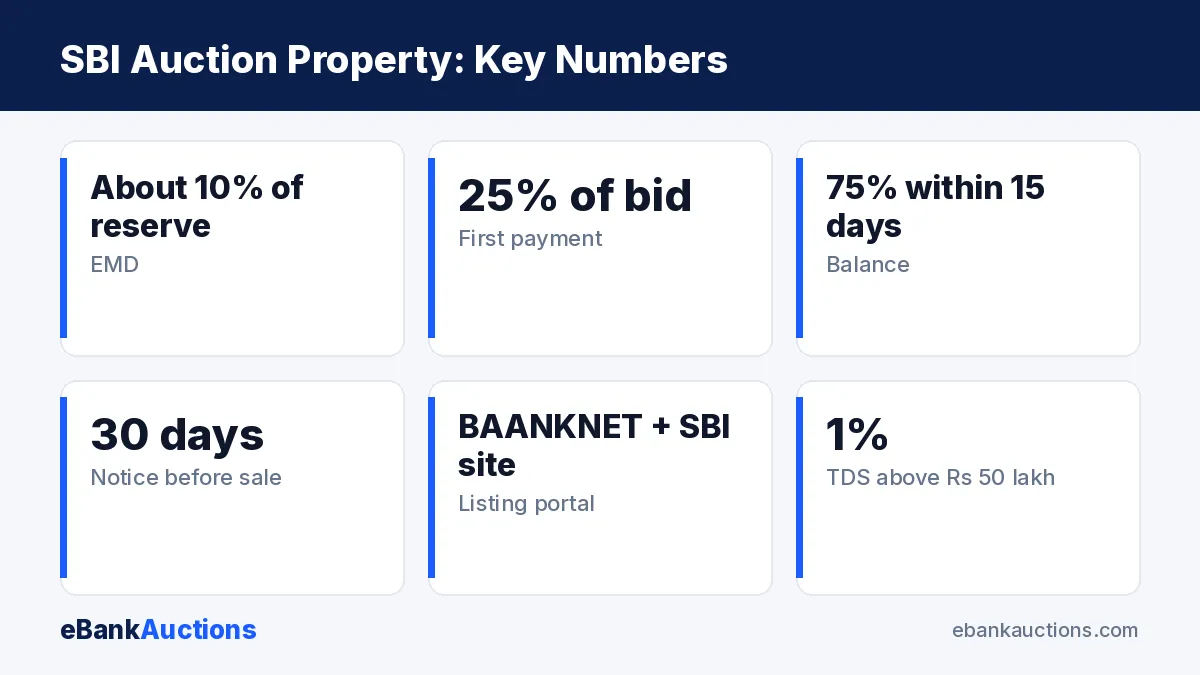
SBI publishes auction notices in newspapers, on its official website and on BAANKNET, the e-auction portal run by PSB Alliance for public sector banks. Each notice carries a property ID, the branch or regional office details, and the name of the authorised officer.
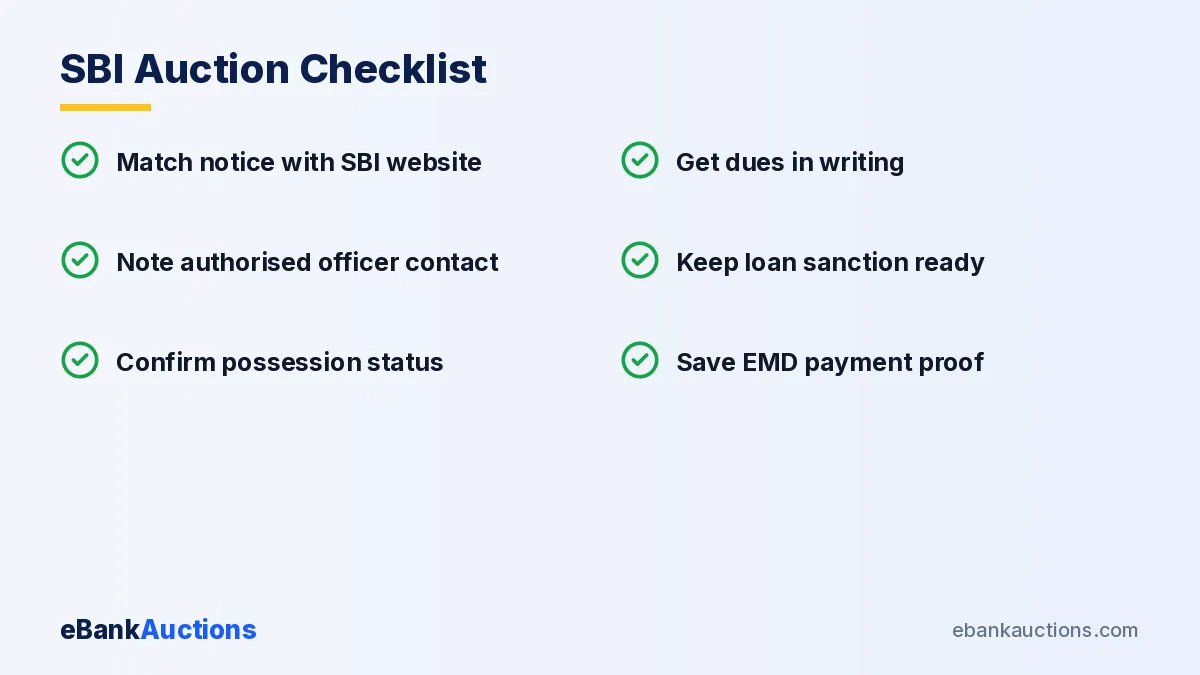
Directories like eBankAuctions collect these notices so you do not have to search newspaper archives. However, you should always match the listing with the bank’s own notice before paying anything. A genuine SBI auction property will never require payment to a private individual or an agent.
Step 2: Read the sale notice line by line
The sale notice is the legal document that governs the auction. For each SBI auction property, look for:
- Reserve price and EMD amount.
- Bid increment amount.
- Inspection dates and contact numbers.
- Last date and time for EMD submission.
- Auction date, start time and duration.
- Known encumbrances, dues and litigation, if any.
- Type of possession held by the bank.
If something is unclear, write to the authorised officer. Their reply in writing is useful evidence later.
Step 3: Check the possession status
Possession is the most important question with any SBI auction property. If the bank has physical possession, it holds the keys and can hand over a vacant property. If it has only symbolic possession, the borrower or an occupant may still be inside, and the bank may need to approach the District Magistrate under Section 14 of the SARFAESI Act to get physical possession. That can take months. Our guide on symbolic vs physical possession explains the difference in detail.
Step 4: Inspect the property on the given dates
SBI sets inspection dates in the notice. Use them. Take photographs, check the structure, water supply, electricity connection and parking. For a flat, meet the society secretary and ask about pending maintenance. For a house or plot, walk the boundaries and compare them with the notice. Many buyers skip inspection for an SBI auction property because photos look good online; that is a costly mistake.
What to look for during inspection
- Cracks, seepage and dampness in walls and ceilings.
- Missing fittings, doors, windows or sanitary ware.
- Encroachment on boundaries or common areas.
- Road access and distance to schools, hospitals and transport.
- Whether anyone is living in or using the property.
Step 5: Verify title and dues
Even though SBI is a reputed lender, it sells on an “as is where is” basis. Ask the branch for copies of the title documents it holds, and get an advocate to check the chain of ownership. Obtain an encumbrance certificate from the sub-registrar for at least 30 years. Collect written statements of property tax, water charges, electricity arrears and society maintenance. Add all of these to your budget. Our full auction property due diligence checklist lists every document you should see.
Step 6: Arrange your finance before bidding
Payment timelines for an SBI auction property are tight. The successful bidder usually pays 25% of the bid amount, including EMD, on the same or next working day, and the balance 75% within 15 days. The bank may extend the balance period in writing, but you cannot count on it.
If you need a loan, apply for in-principle approval as soon as you shortlist a property. Many buyers approach SBI itself because the branch already holds the title papers, which can speed up legal scrutiny. Read our guide to the auction property loan process for eligibility, margins and documents.
Step 7: Register on the e-auction portal
To bid on an SBI auction property, register on the portal named in the sale notice. You will need:
- PAN card and address proof.
- An active email ID and mobile number.
- A bank account for EMD refund.
- A digital signature certificate if the portal requires one.
Complete KYC at least a week before the auction. Verification can take a few days, and you cannot bid until it is approved.
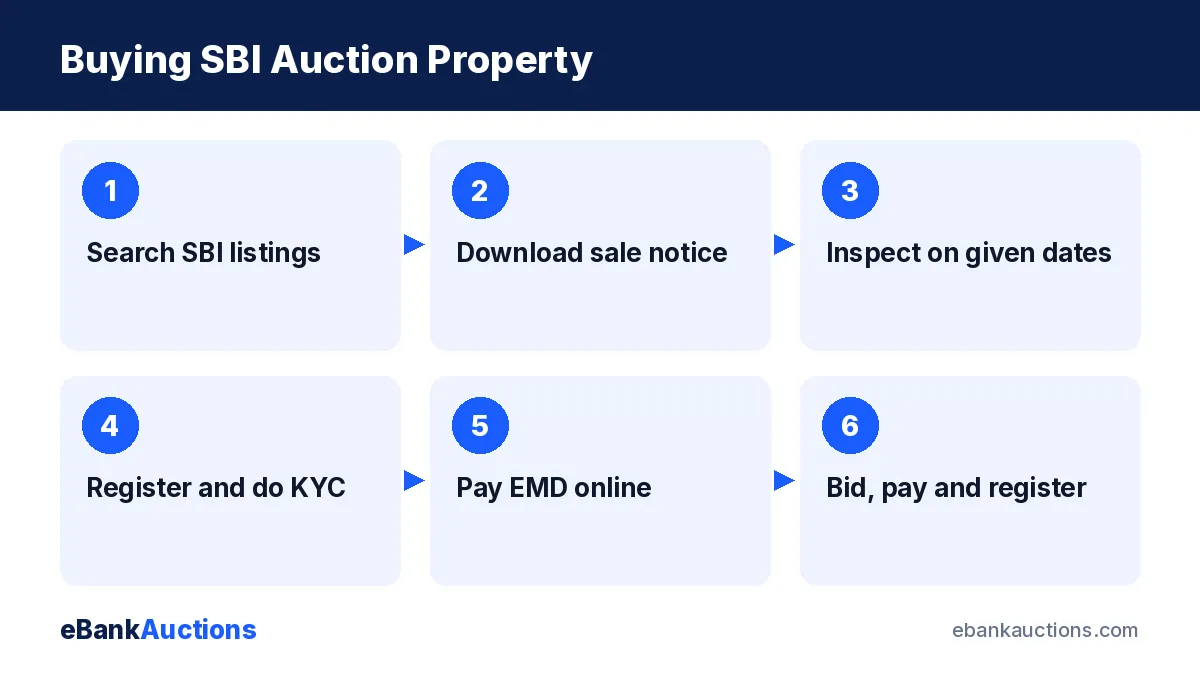
Step 8: Pay the EMD correctly
The earnest money deposit is typically about 10% of the reserve price. Pay it only through the method specified in the notice, usually through the portal’s payment gateway, NEFT or RTGS to a designated account. Keep the transaction reference number and upload proof if asked. If you do not win the SBI auction property, the EMD is refunded without interest to your registered account.
Step 9: Bid with a clear limit
E-auctions run for a fixed time, with automatic extensions if bids arrive in the last few minutes. Decide your maximum price before the auction starts, based on:
- Market value of similar properties in the area.
- Pending dues and repair costs.
- Stamp duty and registration charges.
- Your loan eligibility and own contribution.
Stick to your limit. It is easy to get carried away when another bidder keeps topping your offer. An SBI auction property is attractive only if the final price leaves a margin.
Step 10: Pay the balance and register the sale certificate
After you pay the full amount, SBI issues a sale certificate. Register it with the sub-registrar and pay stamp duty to complete the transfer. If the price is ₹50 lakh or more, deduct 1% TDS under section 194-IA and file Form 26QB on the Income Tax e-filing portal. Then apply for mutation of property tax records, transfer the electricity and water connections, and update society membership. Our guide to sale certificate registration covers each step.
Typical costs of an SBI auction property
| Cost head | What to expect |
|---|---|
| Reserve price | Fixed by the bank from valuation; may drop in re-auctions |
| EMD | About 10% of reserve price, refundable if you lose |
| Stamp duty | State rate on the sale certificate value |
| Registration fee | Usually around 1% (varies by state) |
| Pending dues | Society, tax and utility arrears if stated |
| Legal verification | A few thousand rupees for an advocate |
| Repairs | Depends on condition seen at inspection |
How SBI auction property prices move across rounds
If no one bids in the first round, the bank can re-auction the same SBI auction property at a lower reserve price. Reductions of 10% per round are common, though the exact cut is at the bank’s discretion and depends on fresh valuation. Serious buyers track a property for two or three rounds, especially if the location is strong but the first reserve price looked high. Save listings on eBankAuctions to follow them.
When to bid early and when to wait
- Bid early when the property is in a high-demand locality, the bank has physical possession and dues are low. Competition will only rise.
- Consider waiting when the property has symbolic possession, high dues or pending litigation, because fewer buyers participate and the next reserve price may be lower.
How the bank fixes the reserve price
Before announcing a sale, the bank obtains a valuation from an approved valuer. The report usually gives two figures: a fair market value and a realisable or distress value that reflects a quick sale. The reserve price for an SBI auction property is normally set with reference to these numbers and the bank’s recovery needs. It is not an arbitrary discount, and it is not a promise that the market value is higher by any fixed percentage.
This matters because buyers sometimes assume every listing is a bargain. Do your own comparison. Check recent registered sale prices in the same building or street, talk to two local brokers about asking prices, and look at government guideline values. If the reserve price is close to the real market price, the property may still be worth buying for convenience or location, but you should not overpay in the heat of bidding.
Reading the valuation signals in the notice
- A reserve price far below guideline value can indicate problems such as occupation, litigation or structural issues.
- A reserve price that has already been cut in two earlier rounds suggests low demand; ask why.
- A newly listed property in a prime area with physical possession will usually attract strong competition.
A realistic example from start to finish
Consider a family in Coimbatore that shortlists a three-bedroom independent house. The reserve price is ₹62 lakh and the EMD is ₹6.2 lakh. Here is how a typical timeline might look:
| Day | Event |
|---|---|
| Day 0 | Sale notice published in newspapers and online |
| Day 5 | Family visits during the first inspection slot |
| Day 7 | Advocate starts title verification; loan application filed |
| Day 18 | In-principle loan sanction received |
| Day 22 | Portal registration and KYC approved |
| Day 26 | EMD paid online before the deadline |
| Day 30 | E-auction held; family wins at ₹66.5 lakh |
| Day 31 | 25% of the bid paid, including EMD |
| Day 45 | Balance paid through loan disbursement and savings |
| Day 55 | Sale certificate issued and registered |
The family pays about ₹4.5 lakh above the reserve price but still saves on the market rate for a comparable house in that area. More importantly, they do not miss a single deadline because they started the loan and legal work early. That is the pattern successful SBI auction property buyers follow.
What happens if the auction fails or you back out
If nobody bids, the bank will announce a fresh sale, often with a revised reserve price, and publish a new notice. If the highest bidder does not pay the 25% instalment or the balance on time, the deposit can be forfeited and the property re-auctioned. Rule 9 of the Security Interest (Enforcement) Rules, 2002 governs these timelines, and banks apply them strictly. Never place a bid you are not ready to complete.
Can the borrower stop the sale?
A borrower can clear the entire dues, including costs, before the auction notice is published and keep the property. After publication, the redemption right is generally lost following the 2016 amendment to Section 13(8). The borrower may still approach the Debts Recovery Tribunal under Section 17, so ask the authorised officer whether any case is pending before you commit to an SBI auction property.
Mistakes to avoid with SBI auction property
- Paying EMD without reading the full notice.
- Assuming SBI will clear society or tax dues.
- Not checking whether a DRT case is pending on the property.
- Relying on an agent who claims inside influence at the branch.
- Missing the balance payment deadline and forfeiting the EMD.
To stay safe, read our guide on how to avoid bank auction scams.
Documents SBI may ask from the winning bidder
Besides KYC, the authorised officer may request a declaration that you are not a defaulter or connected to the borrower, a copy of the EMD payment, and your acceptance of the terms and conditions of sale. Companies need board resolutions and authorised signatory proof. Having these ready means the confirmation of your SBI auction property is not delayed.
Buying as an NRI, company or joint bidder
NRIs can buy residential and commercial property in India and may bid through the portal, paying EMD and the balance from NRE or NRO accounts in line with FEMA rules. Because inspection and registration need physical presence, many appoint a relative under a registered power of attorney. Companies and partnership firms can also bid, but the portal registration must be in the entity’s name with its PAN, and the signatory must be authorised by a board or partner resolution.
Joint bidding is possible when the notice permits it. Spouses often bid together so that both names appear on the sale certificate and both incomes count for the loan. Decide the ownership structure before you register, because changing names after the auction is difficult. Read our detailed guide for NRIs buying bank auction property.
Is an SBI auction property a good investment?
For buyers who plan to live in the home, an SBI auction property can offer a meaningful discount in a locality they already know. For investors, the return depends on the purchase price, rental yield and the time taken to get possession. The best deals usually combine physical possession, clear title, low dues and a location with steady demand. If a property meets these tests, bidding makes sense; if it fails two or more, it is usually better to wait for the next listing.
Frequently asked questions
Where can I see the latest SBI auction property list?
SBI lists properties on its website and on BAANKNET, and notices appear in newspapers. eBankAuctions groups current listings by bank, state and category so you can browse them quickly.
Can I get a loan for an SBI auction property from another bank?
Yes. Any bank or housing finance company can lend, subject to its own title verification and credit checks. Apply early because the balance payment window is short.
Is the EMD refundable?
Yes. If you are not the highest bidder, the EMD is refunded without interest. If you win and fail to pay the balance on time, the EMD can be forfeited.
Does SBI give a warranty on the property?
No. The sale is on an “as is where is” basis. The buyer must verify title, dues and physical condition before bidding.
Can I inspect an SBI auction property outside the given dates?
Usually not. The bank arranges inspection on specific dates. Contact the authorised officer if you have a genuine difficulty; they may accommodate a request, but it is not guaranteed.
Conclusion
An SBI auction property can be one of the best-value ways to buy a home or commercial space in India, as long as you follow a disciplined process. Find the listing, read the notice, inspect, verify title and dues, arrange finance and bid within your limit. Browse the latest bank auctions across India on eBankAuctions, subscribe to alerts for your city, and visit our Help Center whenever you need clarity on a step.