A hotel property auction is one of the rarest and most complex opportunities in the Indian bank auction market. Hotels and resorts are capital-intensive businesses, and when owners fail to repay loans, lenders sell the property through SARFAESI or other recovery processes. For hospitality operators, investors who partner with operators, or buyers looking to convert a building to another use, a hotel property auction can offer an asset at a fraction of what it would cost to build.
Hotels are not just buildings. Their value depends on the destination, the brand, the operating team, licences and a long list of furniture and equipment. This guide covers 10 expert checks before you bid.
Why hotels come up for auction
Hotels need heavy upfront investment and take years to stabilise. Seasonal demand, competition, interest costs and events such as pandemics can push owners into default. When that happens, lenders enforce their security. Some hotels are sold as going concerns, but many are sold as property with or without movable assets, after operations have stopped.
In a hotel property auction, the reserve price is set from a valuation that may consider land, building replacement cost, income potential and condition. A closed hotel often sells for far less than its construction cost, which is where the opportunity lies.
Ten expert checks for a hotel property auction
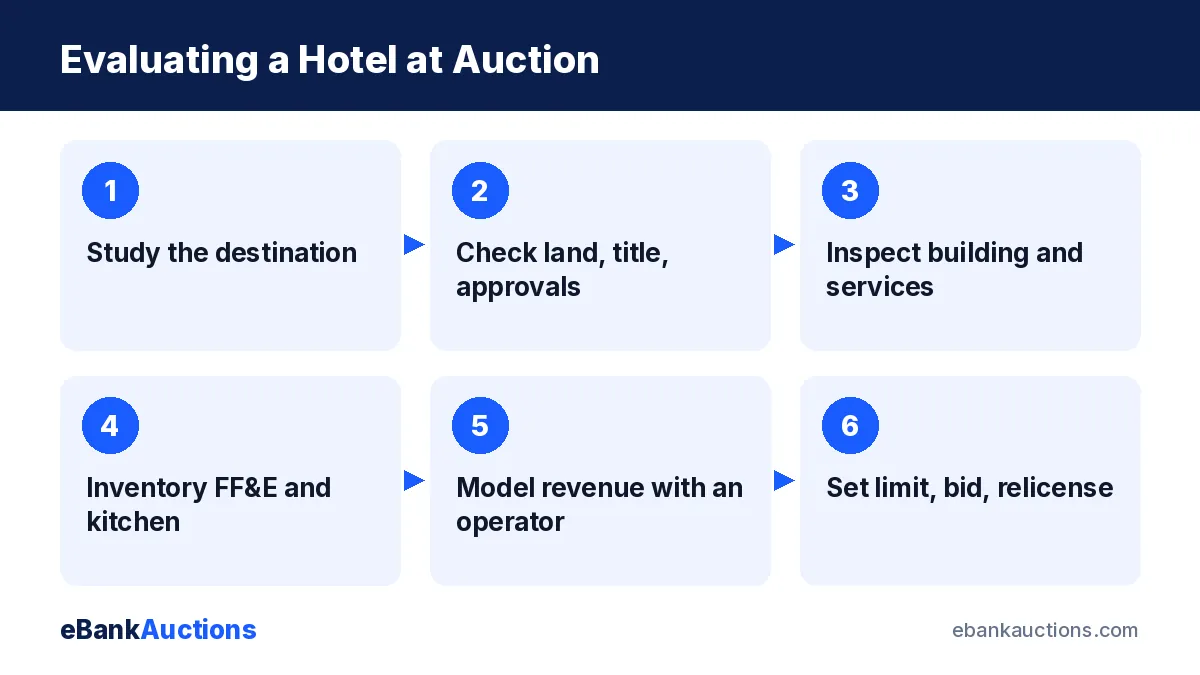
The checks below move from the big picture to the building and then to the numbers. Treat every hotel property auction as a business acquisition, not just a real estate purchase.
Check 1: The destination and demand
Start with the market, not the building. Ask:
- Who visits this location: tourists, pilgrims, business travellers, wedding guests?
- How seasonal is demand?
- What are occupancy rates and room rates at comparable hotels?
- Are new airports, highways or attractions coming up?
- How many new hotels are planned nearby?
Talk to local hoteliers and travel agents. A beautiful hotel in a place with weak demand will struggle regardless of price.
Check 2: Land, title and zoning
Your advocate should trace title, check land records and obtain encumbrance certificates. Hotels in hill stations, beaches and forests often face special rules: coastal regulation zones, eco-sensitive zones, forest land, or height restrictions. Leasehold land from a tourism or development authority may carry use restrictions and transfer conditions. Check whether hotel use is permitted in the master plan.
Check 3: Building approvals
Get the approved plan, occupancy certificate and any approvals for additions such as banquet halls or extra rooms. Unapproved extensions are common in hotels. They affect licences, insurance and financing.
Check 4: Licences and their transferability
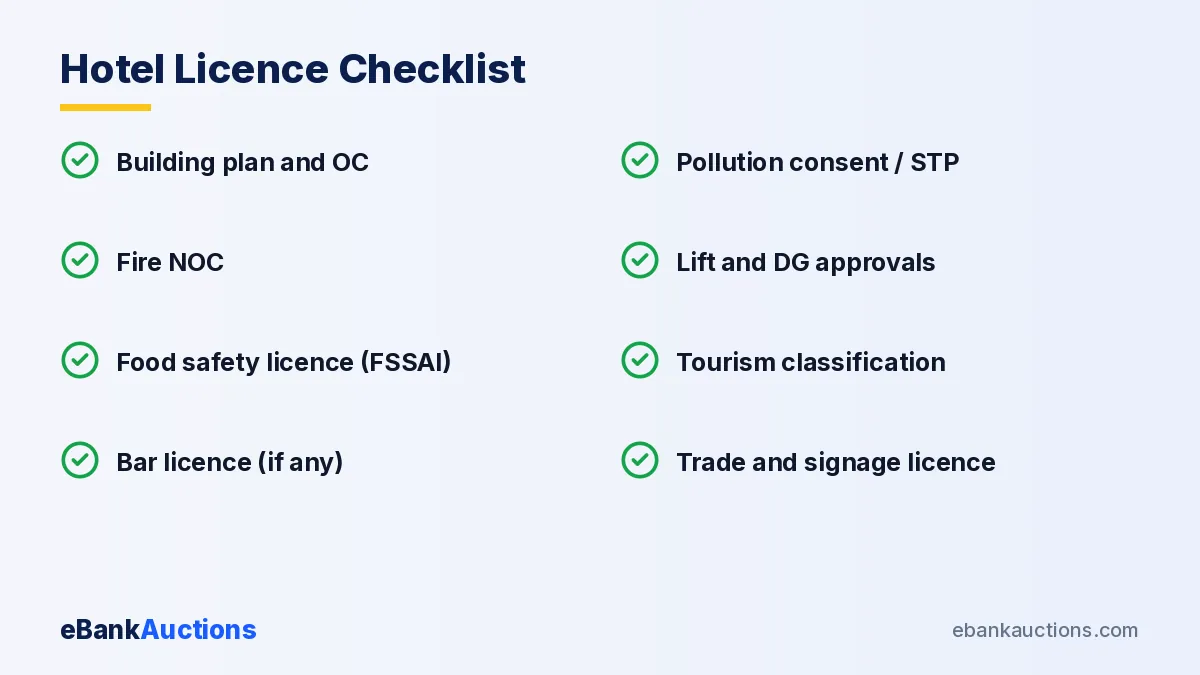
A hotel operates on many licences: fire NOC, food safety registration or licence from the Food Safety and Standards Authority of India, bar licence if applicable, pollution control consent for sewage treatment and diesel generators, lift licences, trade licences, and tourism department classification. Most of these are issued to the operator, not the property, and do not automatically transfer to a buyer. After a hotel property auction, you or your operator will need to apply afresh. Some, like a bar licence, may be difficult or expensive to obtain. Budget time and money for relicensing.
Check 5: What exactly is being sold
Read the notice carefully. It may cover:
- Land and building only.
- Land, building and fixed fittings.
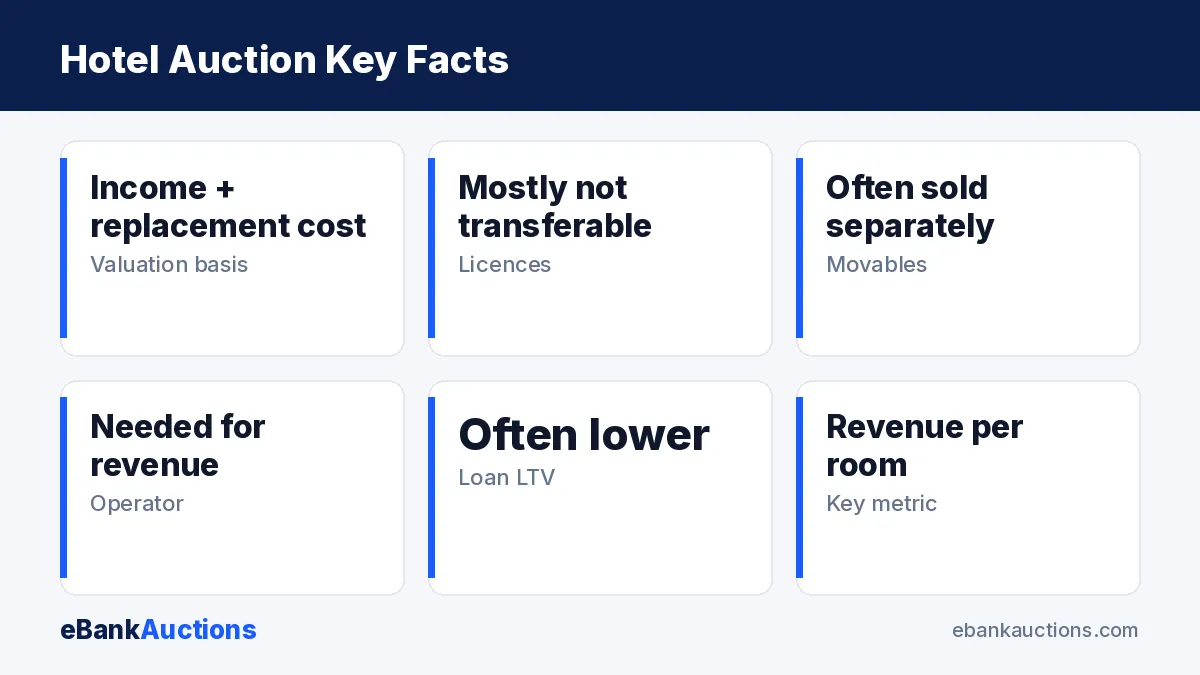
- Movable assets such as furniture, fixtures and equipment (FF&E), kitchen equipment, linen and vehicles, sometimes in a separate auction.
- Brand rights or franchise agreements, which usually do not transfer.
If movables are excluded, they may be removed before handover, leaving an empty shell. If included, inventory them and check condition.
Check 6: Physical condition and services
Hotels that have been closed deteriorate quickly: damp, fungus, pest damage, rusted equipment and failed plumbing. Hire an engineer and a hospitality services consultant to inspect structure, roofs, waterproofing, HVAC, lifts, electrical systems, water treatment, sewage treatment plant, kitchen exhaust and fire systems. Repair and renovation costs can be large.
Check 7: Staff and employee liabilities
If the hotel was operating recently, there may be unpaid salaries, provident fund dues or employee claims. Usually, a buyer of assets in a SARFAESI sale is not liable for the borrower’s employee dues, but claims can create practical complications. Ask the bank for details and take legal advice.
Check 8: Revenue model and operator
Unless you are a hotelier, you will need an operator: a brand under a management contract or franchise, or an independent management company. Speak to potential operators before bidding. They can estimate occupancy, room rates, food and beverage revenue and costs, and tell you what renovation is needed to meet their standards. Base your valuation on realistic net operating income under a named operator.
Check 9: Alternative uses
If a hotel’s prospects are weak, consider alternative uses: serviced apartments, student housing, hospital, office, or redevelopment. Check whether zoning permits the change. Sometimes the best value in a hotel property auction lies in conversion, not in running a hotel.
Check 10: Valuation, finance and bid limit
Value the property in two ways: income value under your operator’s plan, and replacement or conversion value. Your bid should be comfortably below the lower of these after deducting renovation, relicensing, working capital for reopening, stamp duty and contingencies. Lenders are cautious about hotels; expect lower loan-to-value ratios and detailed scrutiny. See our commercial auction loan guide.
Types of hotels you will see at auction
Each hotel property auction falls into one of a few broad types, and each needs a different lens.
Business hotels in cities
Located near offices, hospitals or transport hubs, these depend on weekday corporate demand. Check corporate tie-ups in the area, competition from branded mid-scale hotels and parking availability.
Leisure resorts
Hill stations, beaches, backwaters and wildlife destinations attract weekend and holiday travellers. Seasonality is higher, and access roads, views and activities matter. Environmental rules are stricter.
Budget hotels and lodges
Near railway stations, bus stands and pilgrim centres, these rely on volume and low costs. They can work well with online travel agencies and lean staffing.
Heritage and boutique properties
Old palaces, bungalows and plantation houses converted to hotels. Heritage rules may restrict renovation, but the upside can be significant with the right positioning.
Banquet-led hotels
Some hotels earn more from weddings and events than from rooms. Check banquet hall approvals, parking and noise restrictions.
Understanding hotel economics before a hotel property auction
Hotels are valued on performance. A few key terms help you read any business plan:
- Occupancy: percentage of available rooms sold.
- Average daily rate (ADR): average room revenue per room sold.
- RevPAR: revenue per available room, equal to occupancy multiplied by ADR.
- F&B revenue: food and beverage, often 30–50% of total revenue in full-service hotels.
- GOP: gross operating profit after departmental and undistributed costs.
- Management and franchise fees: paid to brands or operators.
A 40-room hotel at 60% occupancy and ₹4,500 ADR earns about ₹39 lakh a year in room revenue per 10 rooms, or roughly ₹1.58 crore in total from rooms. Add F&B and other income, then deduct staff, utilities, supplies, maintenance, marketing and fees. Your bid in a hotel property auction should be based on the resulting net operating income, not on the cost of the building.
Bringing in an operator before you bid
Most buyers should speak to operators early. A branded operator will send a team to inspect the property, assess the market, prepare a feasibility estimate and specify renovation to meet brand standards. Independent operators may be more flexible on standards and fees. Either way, their view helps you decide whether the hotel property auction makes sense. Many operators will sign a letter of intent before you bid, subject to your winning the auction.
Typical operator arrangements
| Arrangement | Who runs it | Fees | Owner control |
|---|---|---|---|
| Management contract | Brand’s team | Base + incentive fee | Moderate |
| Franchise | Owner’s team under brand | Franchise and reservation fees | High |
| Lease | Operator pays fixed or revenue-linked rent | Rent to owner | Low |
| Self-operated | Owner | None | Full |
A lease to an operator converts a hotel into something closer to a commercial rental, with more predictable income. That can make financing easier after the purchase.
Renovation planning
Closed hotels usually need a significant refresh. Plan in phases: first safety and statutory items (fire systems, lifts, electrical), then back-of-house (kitchen, laundry, water and sewage), then guest areas (rooms, lobby, restaurant). Get cost estimates per room and for public areas. Reopening a few floors first can bring in revenue while work continues elsewhere.
Taxes and GST
The purchase of land and building in a hotel property auction is generally not subject to GST, but movable assets bought separately may attract GST. Hotel operations attract GST on room tariffs and F&B at applicable rates. Deduct 1% TDS under section 194-IA on the immovable property if the price is ₹50 lakh or more. Read our auction property tax guide.
A hotel property auction timeline
| Stage | What to do | Time |
|---|---|---|
| Discovery | Read notice, visit destination, list comparable hotels | Week 1 |
| Legal | Title, zoning, environmental rules, approvals | Weeks 1–3 |
| Technical | Engineer and services consultant inspection | Inspection dates |
| Operator | Share information, get feasibility and LOI | Weeks 2–4 |
| Finance | Lender discussions, equity partners | Weeks 2–4 |
| Decision | Valuation and maximum bid | Before EMD deadline |
| Post-auction | Payments, registration, relicensing, renovation | Months 1–9 |
Because a hotel property auction involves so many moving parts, it is common for serious buyers to skip the first round and bid in a re-auction after completing their homework. That can also mean a lower reserve price.
Red flags in a hotel property auction
- The hotel sits on land classified as forest, wetland or inside a no-development zone.
- A large portion of rooms or the banquet hall is unapproved.
- Key movables have been removed and the notice is silent about them.
- The destination has lost its main demand driver, such as a closed industrial project or a diverted highway.
- Former employees or suppliers have filed claims that affect access to the premises.
- Water supply or sewage disposal is inadequate for full operation.
Any one of these can change the economics of a hotel property auction dramatically. Investigate thoroughly or walk away.
Life after winning a hotel property auction
Reopening a hotel is a project in itself. Typical steps include registering the sale certificate, securing the premises, appointing the operator, completing statutory repairs, applying for licences, recruiting and training staff, ordering supplies, setting up online distribution, and launching marketing. A soft opening with limited rooms helps test systems. Most buyers of a hotel property auction should allow six to twelve months from purchase to full operation, depending on renovation scope.
Sustainability and guest expectations
Today’s guests and corporate clients increasingly look for sustainable practices: efficient water use, solar power, waste management and reduced plastic. When you renovate after a hotel property auction, these upgrades can cut operating costs and support your marketing. Sewage treatment plants and rainwater harvesting are often mandatory for larger properties anyway. Build them into the renovation budget rather than treating them as optional extras.
Insurance and security during the transition
Between winning the auction and reopening, the hotel is vulnerable to theft, vandalism and weather damage. Arrange security from the day you receive possession, insure the building immediately, and document the condition with photographs and an inventory. If movable assets were included, tag and list them before any contractor enters.
Financing structures that work for hotels
Because lenders are cautious, many buyers of a hotel property auction use a mix of equity from partners, a term loan secured on the property, and later refinancing once the hotel shows stable income. Some operators co-invest in renovation in exchange for a longer contract. A lease to an operator with fixed rent can also make a later loan easier, because lenders value predictable income.
Using online distribution from day one
Modern hotels earn a large share of bookings through online travel agencies and their own websites. Before reopening, set up listings with accurate photographs, room descriptions and policies, connect a channel manager so rates and availability stay consistent across sites, and create a simple booking engine on your website to reduce commission costs. Encourage early guests to leave reviews; a strong review score in the first months can lift occupancy faster than any advertising. Operators usually handle this, but owners should understand the costs and the commission structure because they affect net income directly.
Hotel property auction vs other commercial assets
| Factor | Hotel | Office | Shop |
|---|---|---|---|
| Revenue source | Daily guests | Lease rent | Lease rent |
| Management intensity | Very high | Low to moderate | Low |
| Licences | Many, operator-specific | Few | Few |
| Renovation needs | High | Moderate | Low to moderate |
| Valuation driver | Operations | Lease and location | Location |
| Upside | High if turned around | Moderate | Moderate |
Going-concern sales
Occasionally, a hotel is sold as a going concern, especially under insolvency proceedings through a liquidator or resolution process. The buyer takes over a functioning business, staff and contracts. This needs specialised advice. Our going concern sale guide explains how these differ from asset auctions.
Worked example
A Kerala-based hospitality group evaluates a hotel property auction for a 40-room hotel in a hill station, closed for two years. The reserve price is ₹9.5 crore; replacement cost of the building alone is estimated at ₹18 crore. Movables are excluded. The group estimates ₹3.5 crore for renovation and new FF&E, ₹40 lakh for relicensing and ₹60 lakh for reopening working capital. With realistic occupancy of 55% at an average rate of ₹5,500, net operating income after stabilisation is about ₹2.2 crore a year.
At a 14% required return on total investment, the maximum total investment is about ₹15.7 crore. After deducting renovation, licensing, working capital, stamp duty and contingency, the maximum bid is about ₹10.6 crore. They win at ₹10.1 crore and reopen within nine months under their own brand.
Frequently asked questions
Can I lease an auctioned hotel to an operator instead of running it?
Yes. Many owners lease the hotel to an operator for a fixed or revenue-linked rent. This reduces management effort and makes income more predictable, although it limits your share of any upside.
Do hotel licences transfer with the property?
Most operational licences are issued to the operator and must be obtained afresh. Building-related approvals stay with the property.
Is furniture included in a hotel property auction?
Only if the notice says so. Often movables are sold separately or excluded.
Can I convert an auctioned hotel to apartments?
Only if zoning and building rules allow the change of use. Check with the local authority before bidding.
How long does it take to reopen after a hotel property auction?
Typically six to twelve months, depending on renovation scope and how quickly licences are granted.
Who should consider a hotel property auction?
Hospitality operators, investors partnering with operators, and developers considering conversion. It is rarely suitable for first-time investors without expert support.
Conclusion
A hotel property auction can offer a building far below replacement cost, but its true value depends on location, licences, condition and an operator’s ability to generate revenue. Complete the 10 checks, involve an operator early, and bid well within your income and replacement value. Browse commercial auctions on eBankAuctions and read our commercial building auction due diligence guide before bidding.