Auction property tax questions trip up many buyers who have done everything else right. You found a good property, checked the title, won the auction and paid on time, and then discovered a TDS obligation you missed, a stamp duty bill higher than expected, or a notice about the difference between the price you paid and the government’s valuation. Tax is not the most exciting part of buying at auction, but it affects your real cost and your future returns.

This guide explains nine important rules covering TDS, stamp duty, Section 56(2)(x), GST, property tax and capital gains. It is general information, not tax advice; always confirm the latest provisions with a chartered accountant.
The nine auction property tax rules
The auction property tax rules below are arranged in the order you meet them: at payment, at registration, while you own the property, and when you sell.
Rule 1: Deduct 1% TDS under section 194-IA when applicable
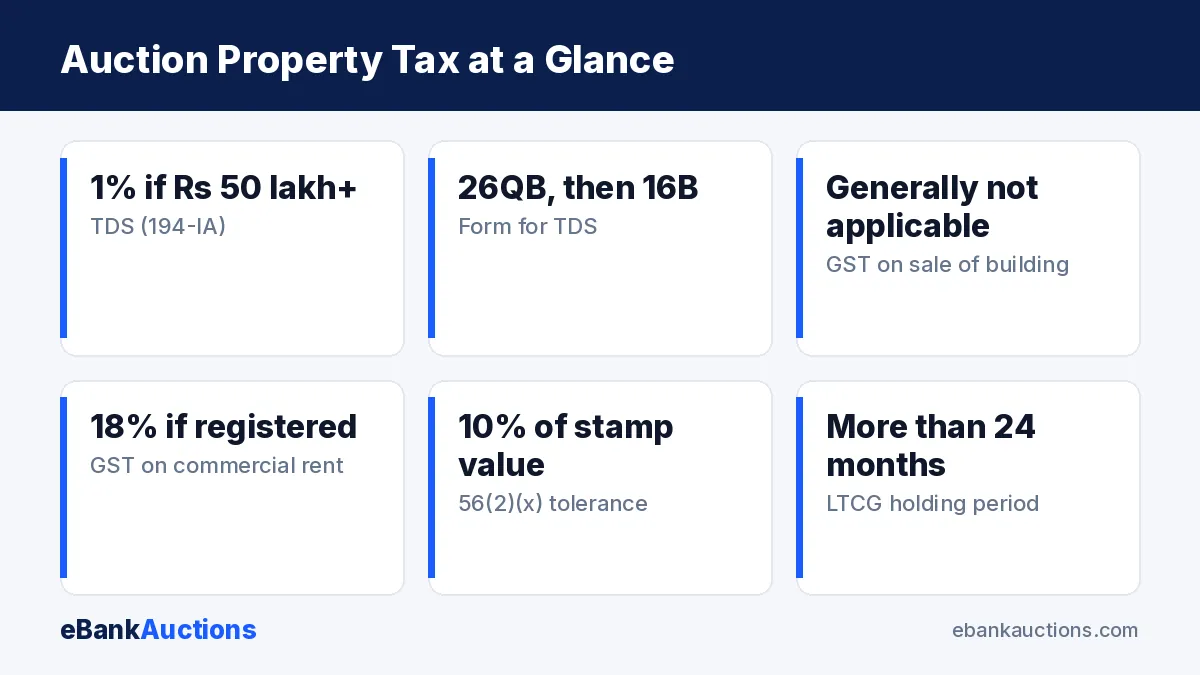
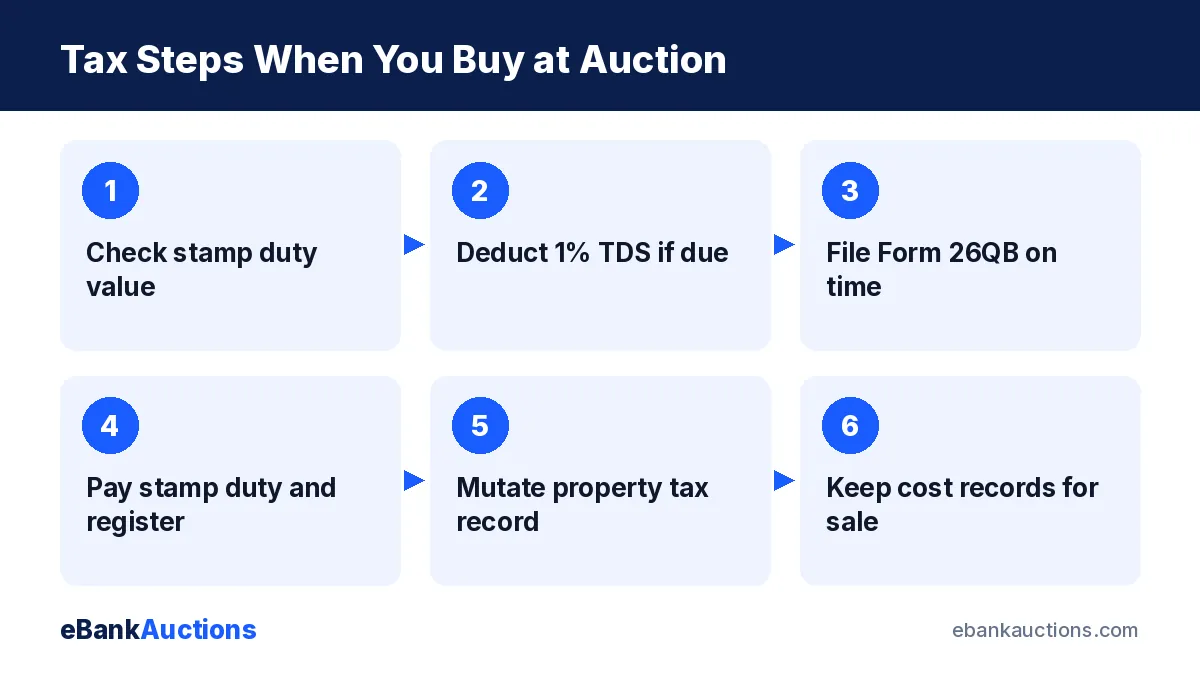
When you buy immovable property other than agricultural land for a consideration of ₹50 lakh or more, you must deduct TDS at 1% under section 194-IA of the Income-tax Act and deposit it with the government. This applies to auction purchases too. The deduction is made at the time of payment, including instalments.
In a bank auction, the property belongs to the borrower even though the bank sells it. The TDS is therefore deducted on behalf of the owner, and the owner’s PAN is usually required for Form 26QB. Ask the authorised officer which PAN to use and how the bank wants TDS handled, because practices vary. Deposit TDS by filing Form 26QB on the Income Tax e-filing portal and download Form 16B to give to the seller’s side.
What if you miss it?
Late deduction or deposit attracts interest and possibly penalties. If you did not deduct at all, you may be treated as an assessee in default. Include the TDS workflow in your payment plan from the start.
Rule 2: Stamp duty is payable on the sale certificate
Stamp duty is a state levy. In most states, it is charged on the sale certificate issued by the bank, calculated on the higher of the auction price or the guideline value notified by the state. Registration fees are extra. This is a real cost, often 5–8% or more of the price, and it must be paid by the buyer unless the sale terms say otherwise. See our guide to sale certificate registration.
Rule 3: Understand Section 56(2)(x)
Section 56(2)(x) taxes a buyer who acquires immovable property for less than its stamp duty value, if the difference exceeds the higher of ₹50,000 and 10% of the consideration. The difference is taxed as income from other sources in the buyer’s hands.
Auction prices are often below guideline values, especially in re-auctions. Whether Section 56(2)(x) applies to purchases in public auctions under SARFAESI has been debated, and tax tribunals have not always taken the same view.
Some decisions have considered that a price discovered in a transparent public auction reflects fair value; others have applied the provision strictly. Because the outcome depends on facts and the current legal position, discuss this auction property tax risk with your chartered accountant before bidding significantly below guideline value.
Rule 4: GST does not usually apply to the purchase of land and buildings
Under GST law, the sale of land and, subject to conditions, the sale of a completed building is not treated as a supply of goods or services. So buying a completed flat, house, shop or office at a bank auction generally does not attract GST on the price. Movable assets bought separately, such as furniture, machinery or vehicles, may attract GST, and the notice will usually state whether GST is extra.
Rule 5: GST applies to commercial rent above the threshold
If you lease out commercial property and your aggregate turnover from taxable supplies crosses the registration threshold, you must register for GST and charge GST on rent, generally at 18%. Residential property rented for residence is generally exempt when rented to individuals for residential use, although rules for renting to registered businesses have changed in recent years. Check the current rules on the GST portal. This is an ongoing auction property tax point for commercial investors.
Rule 6: Property tax and arrears
Local bodies levy property tax annually. After purchase, apply to transfer the property tax account to your name. Many auction properties carry arrears because owners stop paying during financial trouble. The sale notice may state that such dues are payable by the buyer. Some local bodies will not mutate the record until arrears are cleared. Budget for arrears as part of your purchase cost.
Rule 7: Tax on rental income
Rent from property is taxed under “income from house property” for individuals. The calculation starts with the annual value, deducts municipal taxes paid, then allows a 30% standard deduction and interest on borrowed capital within the rules. Tenants that are companies or certain businesses deduct TDS on rent under section 194-I or 194-IB and issue certificates. Keep rent agreements, receipts and TDS certificates for your returns.
Rule 8: Capital gains when you sell
When you later sell the property, capital gains tax applies. Property held for more than 24 months is a long-term capital asset. Your cost of acquisition generally includes the auction price plus stamp duty, registration and other acquisition costs, and the cost of improvement includes documented renovation. The rates and indexation rules for long-term gains have changed in recent budgets, so check the provisions applicable in the year of sale. Exemptions under sections such as 54 or 54EC may be available if conditions are met.
Rule 9: Interest deductions and ownership structure
If you take a loan, interest may be deductible against rental income or, for self-occupied homes, within limits under the old tax regime. Businesses buying premises can usually deduct interest as a business expense and claim depreciation on buildings. The right structure—individual, joint, company or LLP—depends on your plans; choose it before you register on the auction portal because the sale certificate will be issued in the bidder’s name.
Auction property tax for home buyers
If you are buying a home to live in, your auction property tax checklist is short but important. Deduct TDS if the price is ₹50 lakh or more, pay stamp duty and registration on the correct value, transfer the property tax account, and keep all receipts. If you take a home loan, interest and principal deductions may be available under the old regime, within limits. Home buyers also need to watch the Section 56(2)(x) issue when the auction price is well below guideline value, because a tax demand on the difference could reduce the benefit of the discount.
Auction property tax for investors
Investors face more moving parts. Beyond the purchase-stage items, auction property tax for investors includes tax on rental income, GST registration for commercial rent above the threshold, TDS deducted by corporate tenants, and capital gains planning on exit. Many investors consider holding commercial property through an LLP or company for easier expense claims and depreciation, but this changes the tax on eventual sale and on distributions. Model both options with a chartered accountant.
Auction property tax for NRIs
NRIs can buy residential and commercial property at bank auctions. On purchase, their auction property tax obligations are similar to residents’: TDS if applicable, stamp duty and registration. When NRIs earn rent, tenants may need to deduct TDS at higher rates applicable to payments to non-residents, and NRIs file Indian tax returns. On sale, the buyer of an NRI’s property deducts TDS on capital gains under a different section, and repatriation of sale proceeds follows FEMA rules. Read our NRI bank auction guide.
Common auction property tax mistakes
- Forgetting TDS because “the bank is the seller”.
- Using the wrong PAN in Form 26QB, leading to mismatch notices.
- Budgeting stamp duty on the bid instead of the higher guideline value.
- Ignoring Section 56(2)(x) when buying far below guideline value.
- Leasing commercial property without checking GST registration.
- Throwing away renovation bills that would reduce capital gains later.
- Not transferring the property tax account, so notices go to the old owner.
Each mistake costs money or time. A short meeting with a tax adviser before the auction usually prevents all of them.
Auction property tax timeline
| When | Action |
|---|---|
| Before bidding | Check guideline value; discuss 56(2)(x) and structure with CA |
| On each payment | Deduct TDS if applicable; file Form 26QB within the due date |
| After full payment | Pay stamp duty and registration on sale certificate |
| Within weeks | Apply for property tax mutation; clear arrears as required |
| On leasing | Draft lease with tax clauses; check GST registration |
| Every year | Report rental income; pay property tax; file GST returns if registered |
| On sale | Compute capital gains using full acquisition and improvement costs |
Documents that support your auction property tax position
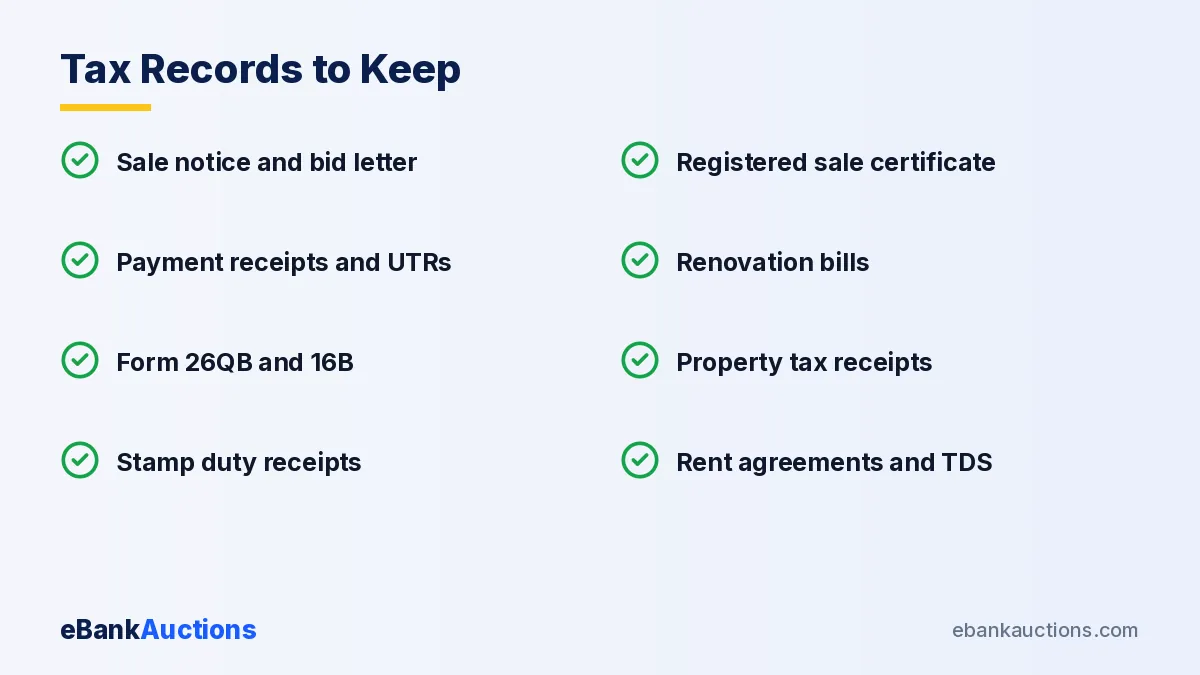
Keep a dedicated file with the sale notice, valuation or reserve price details, bid confirmation, payment proofs, Form 26QB acknowledgements, Form 16B, stamp duty challans, the registered sale certificate, mutation orders, lease deeds, rent receipts, GST returns and renovation invoices. If the tax department ever asks why you paid less than guideline value, documents showing a transparent public auction and the bank’s valuation are your best support.
How auction property tax changes your bid
Tax is not just paperwork after the auction; it should shape your maximum bid. Build these auction property tax items into your calculation:
- Stamp duty on guideline value: if guideline value is higher than your expected price, use it for the stamp duty estimate.
- Possible 56(2)(x) exposure: if the gap between price and guideline value is large, discuss a contingency with your adviser.
- TDS: not an extra cost, but a cash-flow item—part of your payment goes to the government instead of the bank.
- GST on movable items: add it if the notice says GST is extra on furniture, machinery or vehicles included in the lot.
- Property tax arrears: treat them as part of the price if the notice places them on you.
Once these are included, compare your all-in cost with the market value. Many buyers find that the real discount is smaller than it looked, which is exactly why auction property tax planning belongs before the EMD, not after the sale certificate.
Auction property tax for company and LLP buyers
When a company or LLP buys at auction, the purchase-stage auction property tax items are similar: TDS if applicable, stamp duty and registration. The entity then accounts for the building as a fixed asset, claims depreciation on the building component (not land), and deducts interest on loans used for business premises. Rental income earned by a company is usually taxed as business income or income from house property depending on the facts. On eventual sale, the tax treatment depends on whether the asset is a capital asset or stock-in-trade. Structure matters, so decide it early with your adviser.
Questions to ask your chartered accountant
- Should I buy in my own name, jointly, or through a company or LLP?
- How should I handle TDS and which PAN should appear in Form 26QB?
- What is the guideline value, and is there a Section 56(2)(x) risk at my likely price?
- Will I need GST registration if I lease the property?
- How will rental income and loan interest be taxed under my regime?
- What records should I keep to minimise capital gains later?
A one-hour meeting that covers these points can save far more than it costs and turns auction property tax from a worry into a plan.
Auction property tax when you sell after a short holding
Some investors buy at auction, refurbish and resell within two years. In that case, the gain is short-term and taxed at your applicable slab rate, and there is no long-term exemption. If buying and selling properties is frequent and organised, the tax department may even treat it as a business, with profits taxed as business income. Plan your holding period with this auction property tax outcome in mind; a few extra months can move a gain from short-term to long-term.
State-level variations to watch
Stamp duty, registration fees, concessions for women buyers, surcharges and metro cess vary from state to state, and some states levy additional charges in municipal areas. Property tax methods also differ between municipal corporations. Before you bid in a new state, ask a local advocate for a written estimate of these costs. Treat them as part of your auction property tax budget.
Auction property tax summary table
| Item | Who pays | When |
|---|---|---|
| TDS 1% (194-IA) | Buyer deducts and deposits | At payment, Form 26QB |
| Stamp duty | Buyer | Before registration |
| Registration fee | Buyer | At registration |
| GST on building purchase | Generally not applicable | — |
| GST on movable assets | Buyer, if applicable | With purchase |
| Property tax | Owner | Annually; arrears as per notice |
| Tax on rent | Owner | Annual income tax return |
| GST on commercial rent | Owner, if registered | Monthly/quarterly |
| Capital gains | Owner | On sale |
Worked example
Ravi buys a shop at auction for ₹80 lakh. The guideline value is ₹92 lakh. He deducts ₹80,000 TDS and files Form 26QB. Stamp duty is charged on ₹92 lakh, not ₹80 lakh. Because the difference of ₹12 lakh exceeds 10% of the consideration, his chartered accountant advises him about the possible application of Section 56(2)(x) and documents the auction process, valuation and reserve price in case of scrutiny.
Ravi leases the shop for ₹60,000 a month to a company, registers for GST once his rent turnover crosses the threshold, and charges GST on rent. When he sells seven years later, his cost includes the auction price, stamp duty, registration and renovation bills.
Frequently asked questions
Is TDS required for every auction property?
Only when the consideration is ₹50 lakh or more and the property is not agricultural land. Below that, section 194-IA does not apply.
Which PAN do I use in Form 26QB?
Typically the owner’s (borrower’s) PAN, since the bank sells on the owner’s behalf. Confirm with the authorised officer.
Is stamp duty charged on the auction price?
Usually on the higher of the auction price and guideline value. State rules vary.
Can auction property tax planning reduce stamp duty?
Not legitimately below the state’s rules. Some states offer concessions, for example for women buyers, which you can use if eligible. Otherwise, stamp duty follows the prescribed rates and values.
Do I pay GST when buying a flat at auction?
Generally no, for completed buildings. Movable items may attract GST.
Conclusion
Auction property tax affects your real cost from day one and your returns for years. Deduct TDS correctly, budget for stamp duty on the right value, understand the Section 56(2)(x) risk, handle GST on rent if you lease commercially, and keep records for capital gains. Consult a chartered accountant before large purchases. Browse bank auctions on eBankAuctions and read our TDS on auction property guide for a step-by-step walkthrough of Form 26QB.