A commercial auction loan is the finance you use to buy a shop, office, warehouse or commercial building sold by a bank through a public auction. Unlike a home loan, commercial finance comes in several forms, each with different eligibility rules, loan-to-value ratios and processing times. Choosing the wrong one can leave you short of funds on the day the balance payment is due.

This guide explains seven smart finance options, how lenders evaluate commercial property bought at auction, and how to line up a commercial auction loan before you bid.
Why commercial finance is different
Lenders see commercial property as riskier than homes. Rents can fall, units can stay vacant, and commercial property is less liquid. As a result:
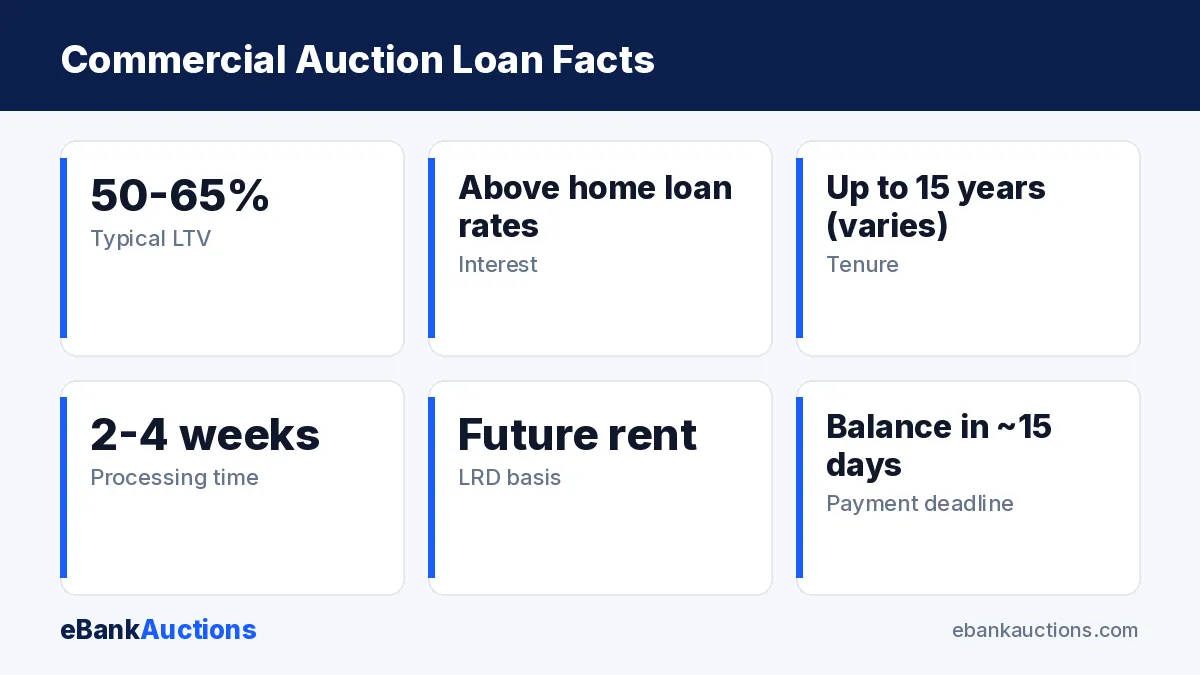
- Loan-to-value ratios are lower, often 50–65% of the lender’s valuation.
- Interest rates are higher than home loan rates.
- Eligibility depends on business income or rental income, not just salary.
- Legal and technical checks are more detailed, especially for approvals and tenancy.
At the same time, the auction timeline does not change. Under the rules that govern SARFAESI sales, the successful bidder typically pays 25% of the bid immediately and the balance within about 15 days, extendable only by written agreement. So speed matters as much as cost when you choose a commercial auction loan.
Seven commercial auction loan options
There is no single best commercial auction loan. Each of the seven options below suits a different buyer, and many buyers combine two of them.
Option 1: Loan against property (LAP) on another asset
If you own a home or other property, you can take a loan against it and use the funds to buy the auctioned commercial unit. LAP is often the quickest route because the lender evaluates a property you already own, without waiting for the auction to finish. LTV on residential collateral may be higher than on commercial property. The downside is that you pledge your existing asset.
Option 2: Commercial property purchase loan
Many banks and housing finance companies offer loans specifically to buy commercial property. The purchased property becomes the security. LTV is typically lower than home loans, and the lender will check approvals, occupancy certificate, fire NOC and zoning. For a commercial auction loan of this type, share the sale notice with the lender as soon as you shortlist the property, so that legal scrutiny can start before the auction.
Option 3: Business term loan for own use
Businesses buying premises for their own operations can use a term loan from their banker, sometimes under schemes for MSMEs. Registering your enterprise on the government’s Udyam registration portal can help you access such schemes. The lender considers the business’s cash flows, existing relationship and the property as collateral. If your business already banks with a lender, this route can be efficient because the lender understands your financials.
Option 4: Lease rental discounting (LRD)
LRD is a loan against future rent from a lease with a creditworthy tenant. The lender typically finances a percentage of the discounted value of rent receivable over the remaining lease period and collects rent directly through an escrow account. LRD is powerful for investors buying a leased unit in a pre-leased property auction. However, LRD usually requires the property to be registered in your name and the lease assigned to the lender, so it is more often used to refinance after purchase than to fund the purchase itself.
Option 5: Overdraft or working capital limits
Some businesses use existing overdraft or cash credit limits to pay the 25% instalment quickly and then replace it with a term loan. This works only if you have large unused limits and your banker agrees; using working capital for long-term assets for a long period is not sound practice.
Option 6: Joint purchase or partnership
Investors sometimes pool funds with partners to buy larger commercial assets. A partnership firm or LLP can bid and take a commercial auction loan in its own name. Structure ownership, contribution and exit terms clearly in writing before bidding.
Option 7: Own funds with later refinance
If you have the cash, buying outright avoids the loan timeline risk entirely. You can then take LAP or LRD on the purchased property after registration to release capital. This is common among experienced investors who prefer to bid without finance conditions.
Comparing commercial auction loan options
| Option | Security | Typical LTV | Speed | Best for |
|---|---|---|---|---|
| LAP on existing home | Your other property | Higher | Fast | Owners with equity |
| Commercial purchase loan | Auctioned property | 50–65% | Moderate | Investors, users |
| Business term loan | Business + property | Varies | Moderate | Own-use businesses |
| LRD | Rent receivable | Based on rent | Slow for purchase | Refinance of leased assets |
| Overdraft bridge | Business assets | Within limit | Very fast | Short bridge only |
| Own funds + refinance | None at purchase | N/A | Fastest | Cash-rich buyers |
How lenders evaluate an auctioned commercial property
Lenders look at:
- Title: chain of documents, encumbrance certificate and the bank’s power of sale.
- Approvals: building plan, occupancy certificate, fire NOC and commercial use permission.
- Valuation: market value based on sale and rent comparables.
- Tenancy: lease terms if leased; vacancy risk if not.
- Possession: physical possession is preferred.
- Borrower strength: income, credit score, existing debt and business stability.
Properties with missing approvals, symbolic possession or doubtful tenancy may get a lower LTV or no loan. Ask your lender to review the specific property before you pay EMD. See our commercial building due diligence guide.
Steps to line up a commercial auction loan
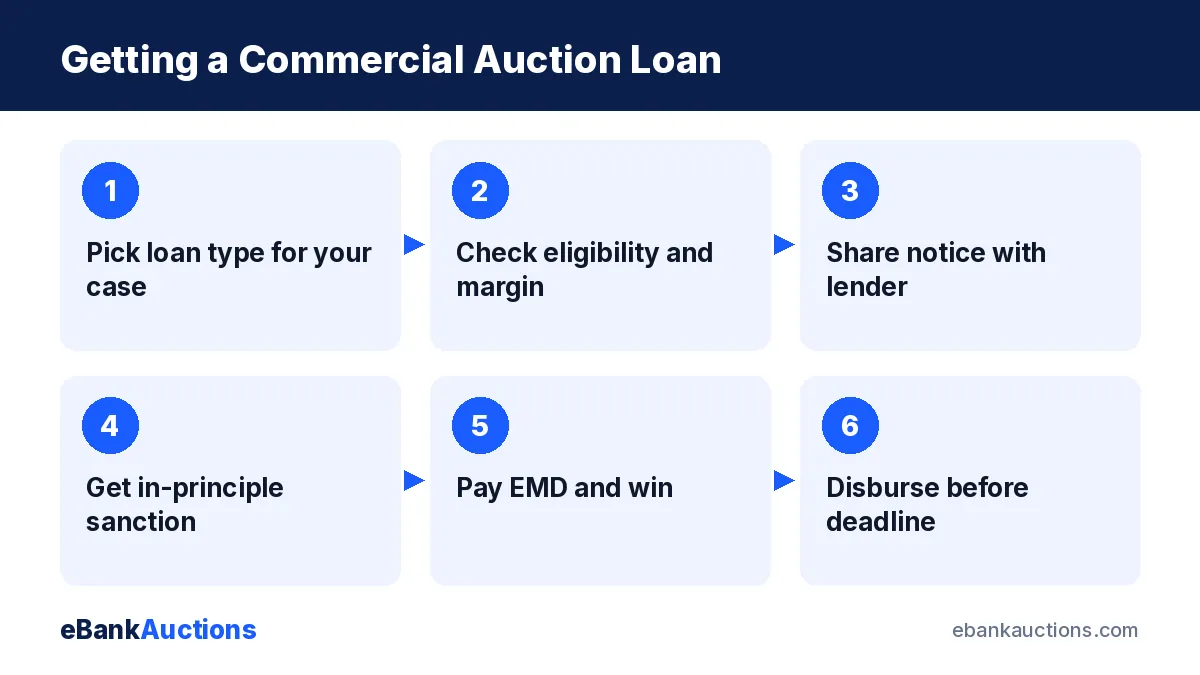
- Decide the loan type based on your collateral, income and purpose.
- Check your credit score and clear small debts if needed.
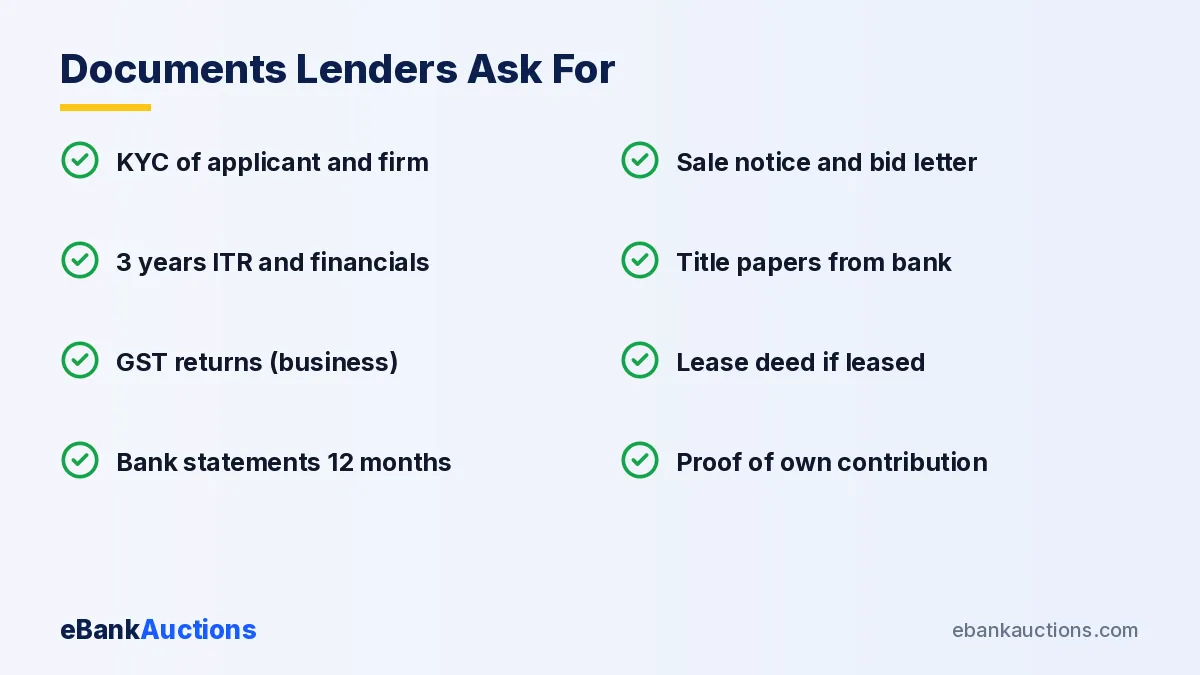
- Gather KYC, income tax returns, financial statements, GST returns and bank statements.
- Share the sale notice and property details with two or three lenders.
- Obtain in-principle sanction letters with the maximum amount and conditions.
- Keep your own contribution ready: EMD, margin, stamp duty and costs.
- Bid within the amount you can fund.
- After winning, submit the bid confirmation letter and complete documentation quickly.
- Coordinate disbursement directly to the auctioning bank before the deadline.
Calculating how much your commercial auction loan must cover
Consider a commercial unit with a reserve price of ₹1 crore that you win at ₹1.08 crore. If your lender funds 60% of the lower of price and valuation (say ₹1.05 crore), the loan is ₹63 lakh. You need ₹45 lakh of your own for the price, plus about ₹8 lakh for stamp duty, registration, dues and legal costs—about ₹53 lakh in total. Many buyers underestimate this margin, which is the most common reason a commercial auction loan fails to close in time.
Choosing the right commercial auction loan for your situation
The best option depends on who you are and what you are buying. Use these profiles as a starting point.
Salaried investor buying a small shop
If you earn a salary and want rental income, your eligibility for a commercial auction loan will be judged on salary plus expected rent. Many lenders count only a portion of expected rent. LAP on your home, if it is loan-free, is often the fastest and cheapest route. Otherwise, a commercial purchase loan with a 40–50% own contribution is typical.
Business owner buying own premises
A business with steady turnover and a banking relationship can often get a term loan quickly. Lenders like own-use purchases because the business has a strong reason to keep paying. Keep audited financials, GST returns and bank statements ready, and involve your relationship manager from the day you shortlist.
Investor buying a leased unit
For a strong tenant on a registered lease, plan a two-step approach: fund the purchase through LAP or own funds, then refinance through LRD once the sale certificate is registered. The first commercial auction loan gets you through the deadline; the LRD releases capital for your next purchase.
Group of investors buying a large asset
Form an LLP or partnership before bidding, open a bank account in its name, and approach lenders as an entity. Lenders will look at the partners’ net worth and the asset’s income. Document each partner’s contribution and exit rights clearly.
Questions to ask lenders before choosing
When you speak to banks and NBFCs about a commercial auction loan, ask:
- What is the maximum LTV for this property type and location?
- Will you value on the auction price, your valuation, or the lower of the two?
- Can you issue an in-principle sanction before the auction?
- How many days do you need from the bid confirmation letter to disbursement?
- Will you disburse directly to the auctioning bank’s account?
- What documents do you need from the auctioning bank?
- What are the processing, legal, valuation and prepayment charges?
- Do you have concerns about the approvals, possession or tenancy of this property?
Written answers let you compare lenders fairly and choose one who can deliver on time.
What the auctioning bank must provide to your lender
Your lender will usually ask the auctioning bank for:
- A letter confirming you as the successful bidder, with amounts received and balance due.
- Copies of title documents it holds.
- Confirmation that original documents will be handed over on full payment.
- The account details for disbursement.
Request these as soon as you win. Delays in getting such letters are a common reason a commercial auction loan slips past the deadline. If a delay looks likely, write to the authorised officer early and ask for an extension in writing.
Commercial auction loan for NBFC and co-operative bank auctions
Auctions by NBFCs and co-operative banks follow similar payment rules under SARFAESI where applicable, but documentation practices vary. Some lenders are more cautious about financing properties sold by smaller institutions. Check with your lender whether they have financed purchases from that seller before, and allow extra time for legal review.
Refinancing after purchase
Once you own the property, you can improve your commercial auction loan terms. After registration and a few months of rent, you may refinance with LRD, move to a lender offering a lower rate, or restructure repayment. Compare the savings with fees for foreclosure and fresh processing before switching.
Timeline: fitting a commercial auction loan into the auction calendar
| Day | Action |
|---|---|
| Shortlisting (day 0–3) | Share notice with 2–3 lenders |
| Day 3–10 | Submit documents; lender’s legal and technical review |
| Day 10–20 | In-principle sanction received |
| Before EMD deadline | Confirm final amount and your margin |
| Auction day | Bid within sanctioned limits |
| Next working day | Pay 25% from own funds; get confirmation letter |
| Days 2–12 | Sign loan documents; final checks |
| Before day 15 | Lender disburses to auctioning bank |
If your lender cannot commit to this calendar, look for another lender or keep enough own funds to close without the loan.
Interest rates and costs
Commercial loans are usually priced above home loans and linked to the lender’s benchmark rate. Expect processing fees, legal and valuation charges and sometimes prepayment charges on business loans. Compare the total cost across lenders, but prioritise lenders who can meet the auction timeline.
Improving your eligibility before you apply
Small steps can raise the amount a lender will sanction:
- Clean up your credit report: close unused credit cards, clear overdue EMIs and correct errors with the credit bureau.
- Show all income: include rental income, business income and a co-applicant’s income where allowed.
- Reduce existing EMIs: prepaying a small personal or vehicle loan can increase eligibility significantly.
- Keep financials current: file income tax returns and GST returns on time; lenders dislike gaps.
- Offer additional collateral: a fixed deposit or another property can improve the lender’s comfort.
- Choose a longer tenure: a longer repayment period lowers the EMI and increases eligible amount, though total interest rises.
These steps take weeks, not days, so start them when you begin looking at auctions, not when you find a specific property.
Insurance and loan protection
Lenders usually require property insurance against fire and allied perils for the tenure of the loan, with the lender named as a loss payee. Some also offer credit life insurance for the borrower. Compare premiums and coverage rather than accepting the default policy, and ensure the sum insured reflects the rebuilding cost of the structure.
Tax benefits
For businesses, interest on a commercial auction loan used to buy business premises is generally deductible as a business expense, and the building can be depreciated. Individuals earning rent can deduct interest on borrowed capital from income from house property as per the Income-tax Act. Consult a chartered accountant and read our guide on auction property tax.
Common commercial auction loan mistakes
- Applying for finance after winning the auction.
- Assuming residential LTVs apply to commercial property.
- Ignoring the lender’s view on approvals or tenancy.
- Using expensive short-term borrowing without a clear refinance plan.
- Not budgeting for stamp duty and dues.
Commercial auction loan checklist
Before you pay EMD, confirm each of these points. You know which commercial auction loan type you are using and why. You have an in-principle sanction for this specific property. You know the lender’s LTV and valuation basis. Your own contribution covers EMD, margin, stamp duty, registration, dues and a contingency. The lender has confirmed its disbursement timeline in writing. You have asked the auctioning bank what letters it will issue. When all of these are true, your commercial auction loan is ready and you can bid with confidence.
Worked example
A Hyderabad restaurant owner wants to buy the ground-floor unit he has rented for eight years, which the bank is auctioning after the landlord’s default. The reserve price is ₹1.4 crore. His bank, which knows his business, offers a term loan of 60% of value under an MSME scheme and in-principle sanction within ten days. He arranges ₹60 lakh from savings and a partner, pays EMD, wins at ₹1.46 crore, and receives disbursement on day 12. His EMI is only slightly higher than his old rent, and he now owns his premises.
Frequently asked questions
What LTV can I get on a commercial auction loan?
Usually 50–65% of the lower of purchase price and valuation, depending on lender, property and borrower profile.
Can I use a home loan to buy a shop?
No. Home loans are for residential property. Use a commercial purchase loan, LAP or business loan instead.
Is lease rental discounting available immediately after purchase?
Usually only after the sale certificate is registered and the lease is assigned to the lender. Many investors use it to refinance.
How fast can a commercial auction loan be disbursed?
With pre-approval and complete documents, many lenders can disburse within 7–10 working days of the bid confirmation letter. Without pre-approval, it can take several weeks.
Will the auctioning bank finance its own commercial auction?
Some do, since they already hold the title documents. It is still a separate credit decision.
Conclusion
A commercial auction loan must be planned before you bid. Choose the option that fits your collateral, income and purpose, get in-principle sanction, keep a larger margin than you would for a home, and coordinate disbursement within the auction deadline. Browse commercial property auctions on eBankAuctions and read our commercial property auction guide before your next bid.