A commercial property auction lets you buy shops, office floors, showrooms and even whole buildings from banks at prices that can be well below the open market. When businesses default on loans secured against their premises, lenders enforce their security under the SARFAESI Act and sell these assets through public e-auctions. For investors seeking rental income and for business owners who want to stop paying rent, a commercial property auction can be a powerful opportunity.
It also carries risks that residential buyers rarely face: existing tenants, missing fire and trade approvals, heavy maintenance dues, and lower loan-to-value ratios. This guide explains 12 proven steps to buy commercial property from banks safely and profitably.
Why a commercial property auction can be attractive
Commercial real estate in India is typically priced on rental yield. A shop that earns ₹50,000 a month might sell for ₹1 crore in the open market, implying a 6% gross yield. In a commercial property auction, the reserve price is driven by the bank’s valuation and recovery needs, not by the seller’s expectations. If you can buy the same shop for ₹75 lakh, your yield jumps to 8%, and your capital gain potential improves too.
Other reasons buyers look at commercial auctions:
- Own use: businesses buy their own premises and convert rent into EMI.
- Scarce locations: prime high-street shops rarely come up for sale otherwise.
- Portfolio diversification: investors add income-producing assets.
- Value-add: a vacant, poorly managed unit can be refurbished and leased at market rent.
What is typically sold
Listings include ground-floor shops, office units in business parks, showrooms on main roads, godowns, small hotels, hospitals, schools and mixed-use buildings. Browse current commercial property auctions on eBankAuctions and filter by city and budget.
The 12-step commercial property auction process
The steps below follow the order in which experienced buyers approach a commercial property auction, from strategy to leasing.
Step 1: Decide whether you are buying for use or for income
Your purpose drives everything else. A business buying for own use cares about layout, access, parking and approvals for its specific trade. An investor cares about tenant demand, achievable rent and ease of leasing. Write down your purpose, your target location and your budget before you look at listings.
Step 2: Shortlist by micro-market
Commercial value is intensely local. A shop on the main road can be worth twice a similar shop one lane behind. Study footfall, visibility, parking, public transport and competing properties. Talk to local brokers about rents and vacancy. For office units, check the building’s occupancy and the quality of its management.
Step 3: Read the sale notice and terms of sale carefully
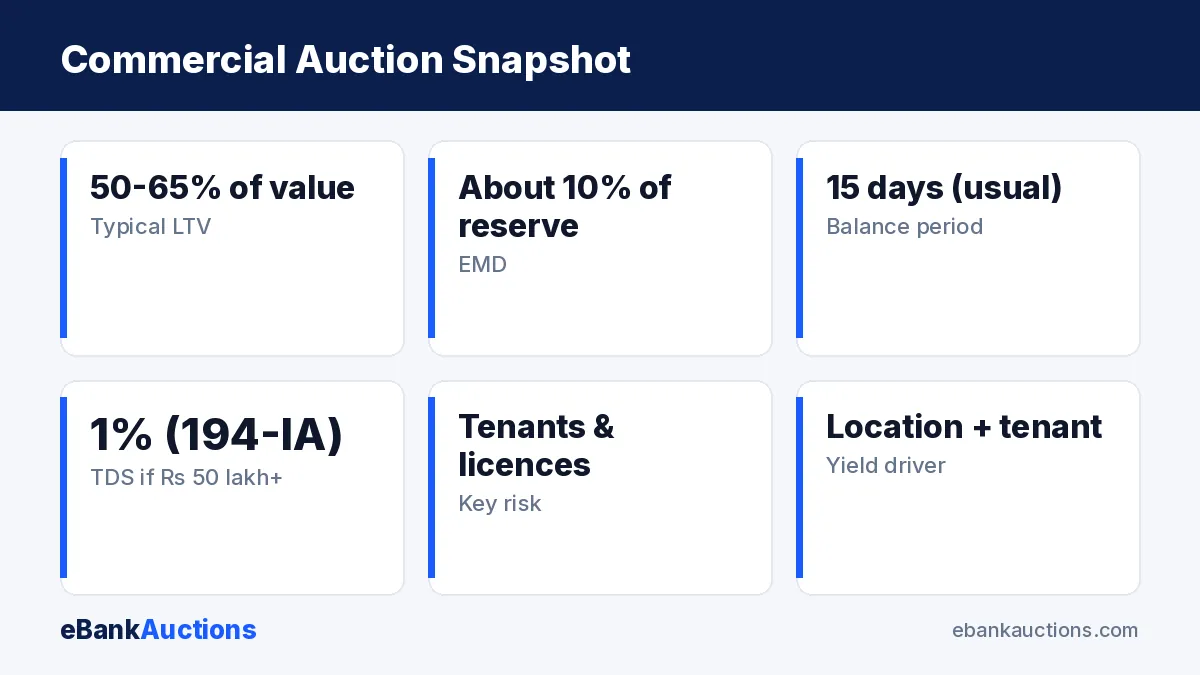
The notice for a commercial property auction describes the unit, its area, the floor, any car parks and the undivided share of land. It lists the reserve price, EMD, increment and dates. Look especially for statements about tenancy, dues and possession. Terms like “sold with existing tenancy” or “dues to be borne by purchaser” change your economics completely.
Step 4: Verify title and building approvals
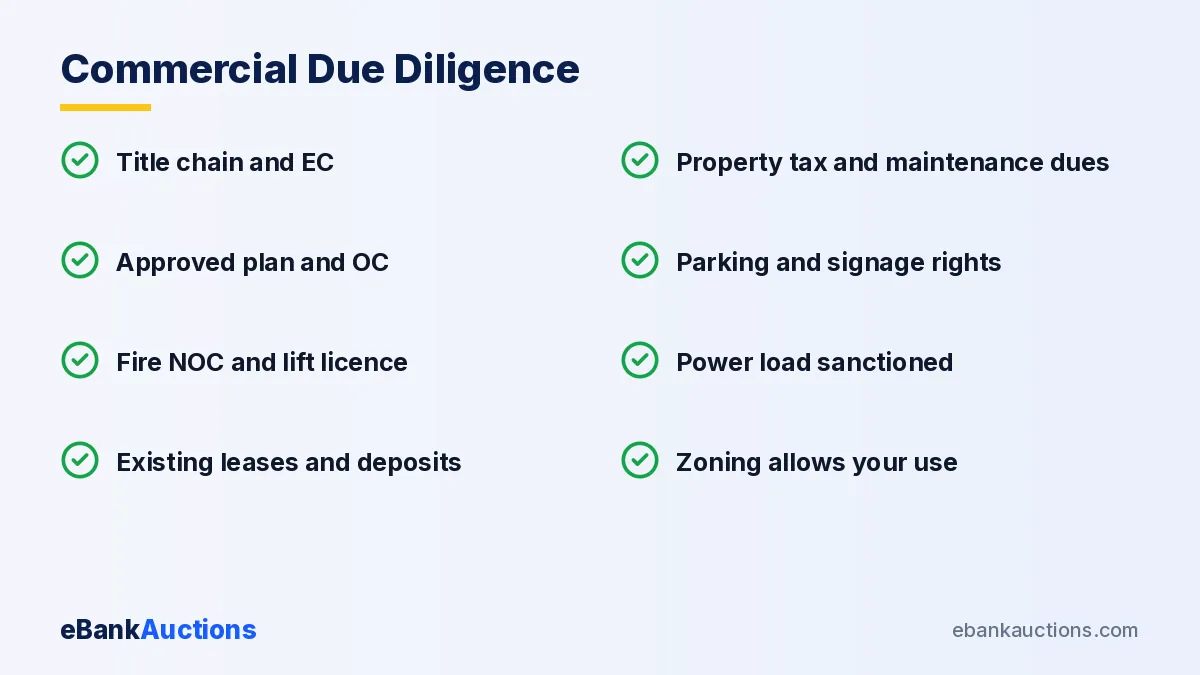
Get your advocate to trace title for at least 30 years and obtain an encumbrance certificate. For commercial buildings, also verify:
- Approved building plan and whether the unit’s use matches the sanction.
- Occupancy or completion certificate.
- Fire safety NOC from the fire department for the building.
- Lift licence where applicable.
- Trade or shops-and-establishments licences if the unit was operating.
Unapproved commercial use of a residential building is a common problem that can lead to sealing by authorities. Our commercial building due diligence guide covers this in detail.
Step 5: Investigate existing tenants
This is the defining issue in any commercial property auction. If the unit is leased, find out:
- Who the tenant is and whether a lease deed exists.
- Whether the lease is registered and when it was created relative to the mortgage.
- Rent, deposit, lock-in and renewal terms.
- Whether the tenant is paying and to whom.
A genuine tenant can be an asset, giving you income from day one. A doubtful tenancy created to block the sale can be a long legal fight. Under Section 17(4A) of the SARFAESI Act, 2002, tenancy claims can be adjudicated by the Debts Recovery Tribunal. Read our guide to pre-leased property auctions.
Step 6: Collect all dues
Commercial units often carry large arrears: property tax at commercial rates, building maintenance, common area electricity, water and sometimes GST on maintenance. Obtain written statements from the local body, the association or facility manager, and utilities. Add these to your cost.
Step 7: Check possession
As with homes, find out whether the bank has symbolic or physical possession. A running business inside a unit can take a long time to remove. Visit the property, observe whether it is operating, and ask the authorised officer about the handover plan.
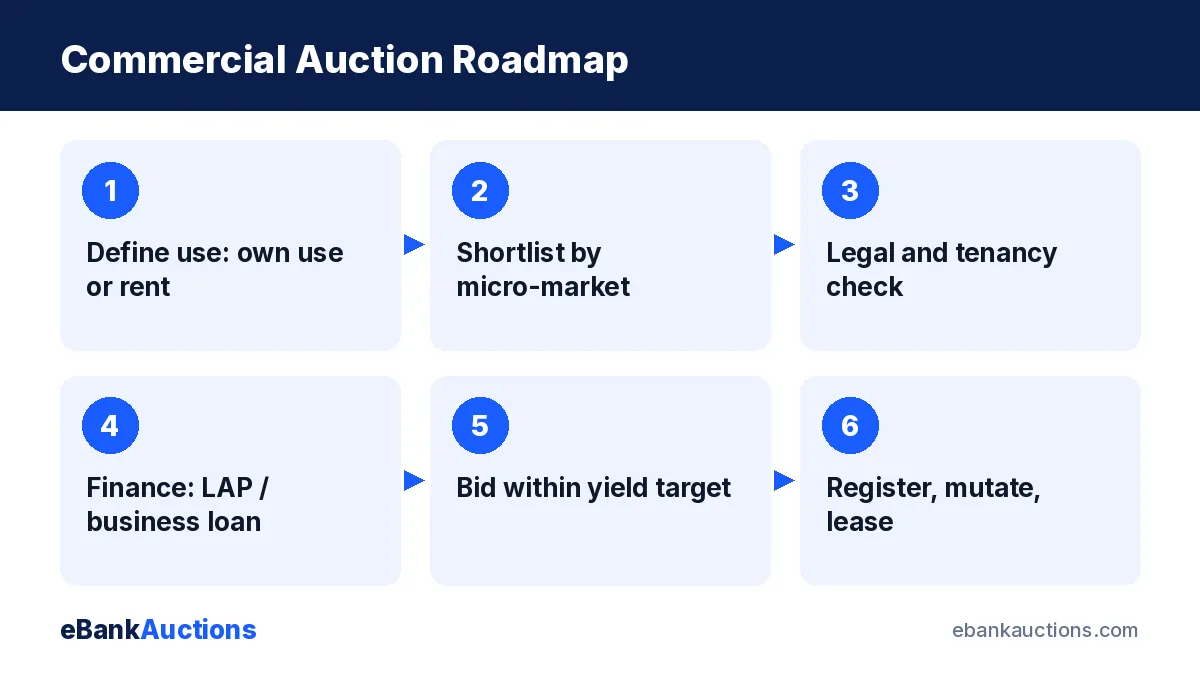
Step 8: Arrange finance early
Loans for commercial property are more conservative than home loans. Lenders often fund 50–65% of value through a loan against property or a commercial purchase loan, at higher interest rates. Businesses may use term loans. Get in-principle approval before paying EMD, because the payment schedule of 25% immediately and the balance in about 15 days still applies. Our commercial auction loan guide explains the options.
Step 9: Build a yield-based bid limit
Calculate your maximum bid using income, not emotion:
- Estimate achievable monthly rent from brokers and comparable listings.
- Deduct property tax, maintenance, insurance and vacancy allowance to get net rent.
- Decide your target net yield, for example 7%.
- Maximum all-in cost = annual net rent ÷ target yield.
- Subtract stamp duty, registration, dues, repairs and legal costs to get your maximum bid.
This approach keeps a commercial property auction purchase grounded in returns. Our guide to auction property rental yield walks through an example.
Step 10: Understand the tax angle
If the price is ₹50 lakh or more, deduct 1% TDS under section 194-IA. Sale of immovable property as such does not attract GST, but you may pay GST on maintenance and, if you lease the property, you may need to charge GST on commercial rent once your turnover crosses the threshold. Rental income is taxed under “income from house property” for individuals. See our guide on auction property tax and consult a chartered accountant.
Step 11: Bid with discipline
Register on the portal early, pay EMD correctly, and log in on time. Stick to your yield-based limit. Commercial auctions sometimes see professional investors who bid aggressively; let them overpay if they choose to.
Step 12: Take over, register and lease
After paying in full, register the sale certificate, pay stamp duty and apply for mutation of property tax records. Transfer electricity and water connections, apply for trade licences in your name if using the unit, and update the association records. If leasing, sign a registered lease with a reliable tenant, collect a security deposit and set up rent collection. Our guide to sale certificate registration explains the paperwork.
Types of assets you will find in a commercial property auction
Not every commercial listing is a shop. Understanding the main types helps you match the asset to your plan.
High-street shops and showrooms
Ground-floor retail on main roads is the most liquid type of commercial property auction asset. Tenants such as pharmacies, banks, mobile stores and food chains look for visibility and parking. Rents are strong but so is competition among bidders.
Office units and floors
Office space in business districts and IT corridors suits investors seeking corporate tenants. Check building management, power backup, lifts and the building’s overall occupancy. A vacant office in a half-empty building can take a long time to lease.
Warehouses and godowns
Logistics demand has grown quickly. Warehouses near highways and industrial areas can earn stable rent from e-commerce and distribution companies. See our warehouse auction guide.
Hotels, hospitals and schools
These special-purpose assets appear less often. They need specialist valuation and licences, and are usually suitable only for experienced operators or investors partnering with operators. Our guide to hotel property auctions explains the extra checks.
Mixed-use buildings
A building with shops below and offices or homes above can be attractive, but check that each use is approved and that you understand the tenancy of every unit.
How banks value a commercial property auction asset
Valuers look at comparable sales, rental income capitalisation and replacement cost. For income-producing assets, the income method is important: the valuer estimates market rent, deducts outgoings, and capitalises the net income at a market yield. If the unit is vacant or poorly leased, the valuation may be lower. This is one reason a commercial property auction can offer genuine value: a vacant unit valued conservatively can be leased at market rent after purchase.
Commercial property auction checklist for business owners
If you are buying for your own business, add these checks to the general list:
- Confirm that zoning and the building sanction permit your specific trade.
- Check whether you need a change-of-use approval, pollution consent or health licence.
- Confirm the power load sanctioned and whether it can be increased.
- Check signage rights on the facade and any association rules.
- Plan fit-out costs and time before you can open.
- Compare the EMI with your current rent to see the real saving.
Commercial property auction checklist for investors
Investors should focus on income and exit:
- Get at least two broker estimates of achievable rent.
- Check typical lease terms in the area: lock-in, escalation and deposit.
- Understand who pays maintenance and property tax in local leases.
- Estimate a realistic vacancy period before the first tenant.
- Consider how easily the unit could be sold later, and to whom.
Common mistakes in a commercial property auction
Buyers new to commercial auctions often repeat the same errors:
- Treating a doubtful tenancy as income without checking whether the lease will survive the sale.
- Ignoring years of unpaid maintenance in a large complex.
- Assuming a residential-zone shop can continue operating commercially.
- Borrowing on residential assumptions and finding the lender will fund only half.
- Bidding on a location they have not studied because the reserve price looked low.
Each mistake is avoidable with the steps in this guide. A disciplined commercial property auction buyer checks tenancy, approvals, dues and finance before paying EMD.
A realistic commercial property auction timeline
| Stage | Typical timing |
|---|---|
| Notice published | Day 0 |
| Broker rent survey and site visit | Days 1–7 |
| Advocate title, tenancy and approvals check | Days 3–15 |
| Lender in-principle approval | Days 5–20 |
| Inspection on notified dates | As per notice |
| EMD payment | Before deadline, usually 1–3 days pre-auction |
| E-auction | Around day 30 |
| 25% payment | Same or next working day |
| Balance payment | Within about 15 days |
| Registration and mutation | 2–8 weeks after payment |
| Leasing or fit-out | 1–3 months after handover |
Plan backwards from the auction date. Commercial checks take longer than residential ones because there are more approvals and often a tenant to investigate.
Dealing with the building association
Most commercial complexes have an association or a facility management company that controls common areas, lifts, security and power backup. Before bidding, meet them. Ask for the unit’s maintenance history, any pending special levies, rules on signage and working hours, and the process for transferring the membership. An association that is well run adds value to your unit; one that is in dispute with owners can make leasing difficult.
Exit options after a commercial property auction purchase
Think about how you will eventually exit before you buy. Commercial property is less liquid than homes, so plan for one of these routes:
- Hold for income: keep the unit leased for many years and let rent escalations raise your yield.
- Sell leased: a unit with a strong tenant on a long registered lease can be sold to another investor at a premium.
- Sell to a user: a business owner may pay more than an investor for a unit that suits their trade.
- Redevelop: for older standalone buildings, land value may justify redevelopment in future.
Knowing your exit helps you decide how much to spend on refurbishment and what kind of tenant to prefer. A commercial property auction bought at a sound price with a quality tenant gives you the widest choice of exits.
Commercial vs residential auctions
| Factor | Commercial property auction | Residential auction |
|---|---|---|
| Buyer pool | Investors and businesses | End users and investors |
| Loan LTV | Lower, often 50–65% | Higher, up to 75–90% |
| Key risk | Tenants, licences, dues | Occupants, society dues |
| Returns | Rental yield focus | Own use or appreciation |
| Approvals | Fire NOC, trade licence, zoning | OC, plan |
| Competition | Moderate | Higher for good flats |
Red flags in a commercial property auction
- The building operates without a fire NOC or occupancy certificate.
- A tenant claims a long lease at very low rent created after the mortgage.
- Property tax and maintenance arrears are unknown.
- The unit is in a residential zone used commercially without approval.
- Access, parking or signage rights are disputed.
Worked example
An investor in Bengaluru shortlists a 900 sq ft ground-floor shop on a busy road. The reserve price is ₹92 lakh. Similar shops rent for about ₹75,000 a month. Net of tax, maintenance and a one-month vacancy allowance, annual net rent is about ₹7.6 lakh. Targeting a 7.5% net yield, his all-in limit is about ₹1.01 crore. After deducting ₹8 lakh of stamp duty, registration, dues and legal fees, his maximum bid is ₹93 lakh. He wins at ₹92.5 lakh, leases the shop within two months to a pharmacy chain on a nine-year registered lease, and earns a yield well above what he could get buying in the open market.
Frequently asked questions
Can individuals buy in a commercial property auction?
Yes. Individuals, firms and companies can all bid. Companies need board resolutions and authorised signatories.
Is GST payable on commercial property bought at auction?
Sale of land and completed buildings is generally outside GST. However, rent from commercial leasing may attract GST, and maintenance charges usually carry GST.
What if the tenant refuses to pay rent to me?
After registration, notify the tenant in writing of the change in ownership. If the lease is valid, rent becomes payable to you. Disputes may need legal action.
How is a commercial property auction advertised?
Banks publish notices in newspapers, on their websites and on e-auction portals. eBankAuctions lists them by category so you can browse shops, offices and warehouses in one place.
Can I inspect a leased unit before bidding?
Usually yes, during the notified inspection dates, but the tenant’s cooperation matters. Ask the authorised officer to arrange access and to share any lease documents available with the bank.
Are commercial auctions riskier than residential ones?
They involve different risks, mainly tenants and approvals. With proper due diligence, a commercial property auction can offer better returns than residential property.
Conclusion
A commercial property auction can turn a bank’s distressed asset into your steady income or your business’s permanent home. Focus on location, tenancy, approvals, dues and a yield-based bid limit, and arrange finance early. Browse commercial listings on eBankAuctions, read our guide to bank auction shops, and bid only when the numbers work.