A warehouse auction is one of the most interesting opportunities in the Indian bank auction market today. E-commerce, organised retail, pharmaceuticals and manufacturing have created strong demand for storage and distribution space near cities and highways. At the same time, many small warehouse owners borrowed to build godowns and later defaulted, so banks regularly sell these assets through SARFAESI e-auctions.
For investors, a warehouse auction can deliver rental yields higher than offices or shops, with tenants who sign multi-year leases. For businesses, buying your own godown can cut costs and secure your supply chain. This guide gives 10 proven tips to evaluate and bid on warehouses and godowns sold by banks.
Why warehouses are in demand
Logistics real estate has grown quickly as companies move from scattered small godowns to larger, better-located facilities. Tenants now look for good road access, adequate height, strong floors, fire safety and space for trucks to move. Older godowns that meet some of these needs still rent well in the right locations, and modern ones are highly sought after.
In a warehouse auction, the reserve price is based on the bank’s valuation of land and structure. Because the buyer pool is narrower than for homes, prices can be attractive for those who understand the asset.
Types of properties you will see
- Small godowns of 2,000–10,000 sq ft near city markets.
- Mid-sized warehouses of 10,000–50,000 sq ft on highways.
- Cold storage units for food and pharmaceuticals.
- Industrial sheds used as warehouses.
- Land parcels with partially built warehouses.
Browse commercial property auctions and industrial asset auctions on eBankAuctions to find current listings.
10 proven warehouse auction tips
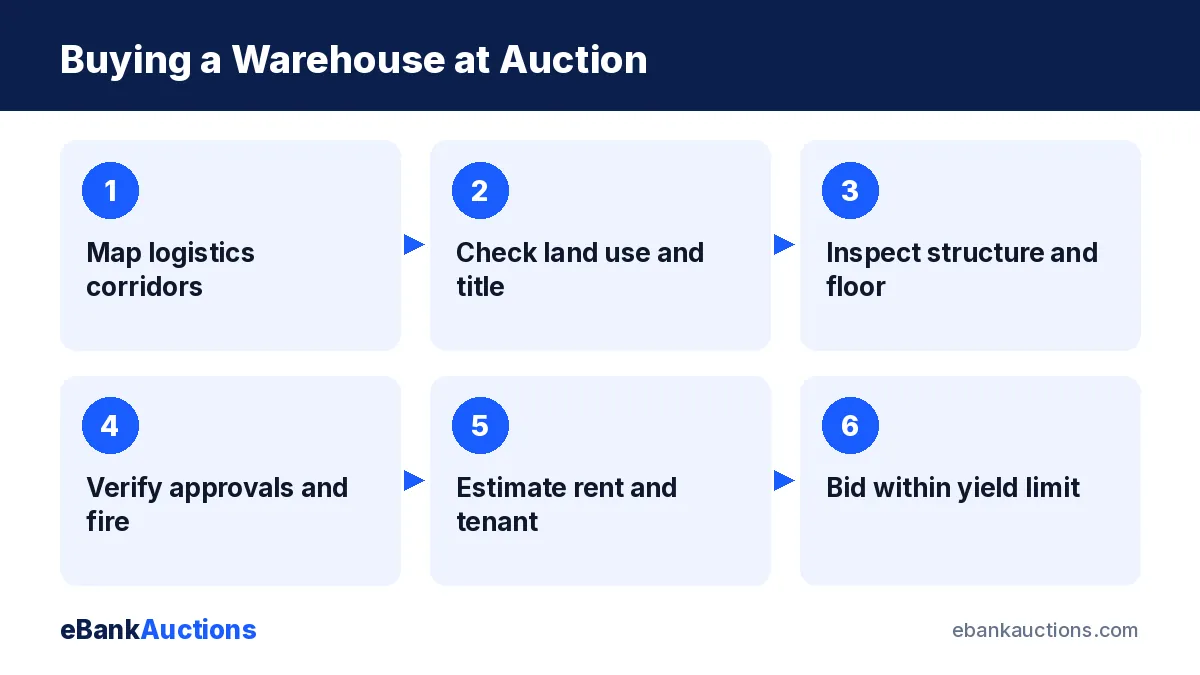
These tips follow the order in which experienced logistics investors evaluate a warehouse auction, starting outside the gate and ending with a signed lease.
Tip 1: Location is about trucks, not people
For shops, footfall matters. For a warehouse auction, what matters is how easily trucks can reach the property and how quickly goods can reach customers. Check:
- Distance to national or state highways and ring roads.
- Road width and condition leading to the gate.
- Whether heavy vehicles are allowed on the approach roads at all hours.
- Distance to the city’s consumption centres, ports, rail yards or industrial clusters.
- Availability of labour nearby.
A warehouse on a narrow village road may be cheap but hard to lease to organised tenants.
Tip 2: Verify land use and title
Many godowns are built on agricultural land without conversion, or in zones where warehousing is not permitted. Check the land use in revenue records and the master plan, and whether conversion or change-of-land-use approval was obtained. Your advocate should trace title for 30 years and get an encumbrance certificate. Land issues are the most common hidden problem in a warehouse auction. Read our guide on land use conversion.
Tip 3: Check building approvals and fire safety
Ask for the approved building plan, completion certificate and fire NOC. Warehouses store goods that can burn, so fire safety matters to tenants and insurers. Organised tenants often require hydrants, sprinklers or at least adequate extinguishers and fire exits. A godown without fire approval may rent only to small local tenants.
Tip 4: Inspect structure, height and floor
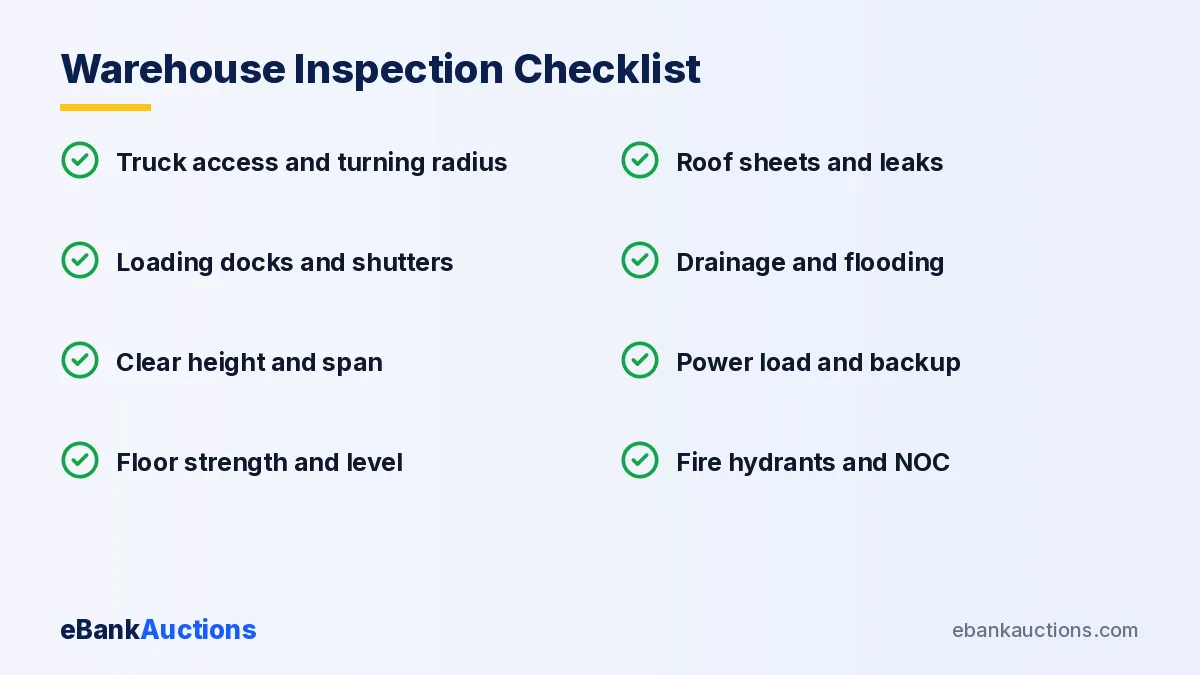
Bring an engineer who understands industrial buildings. Check:
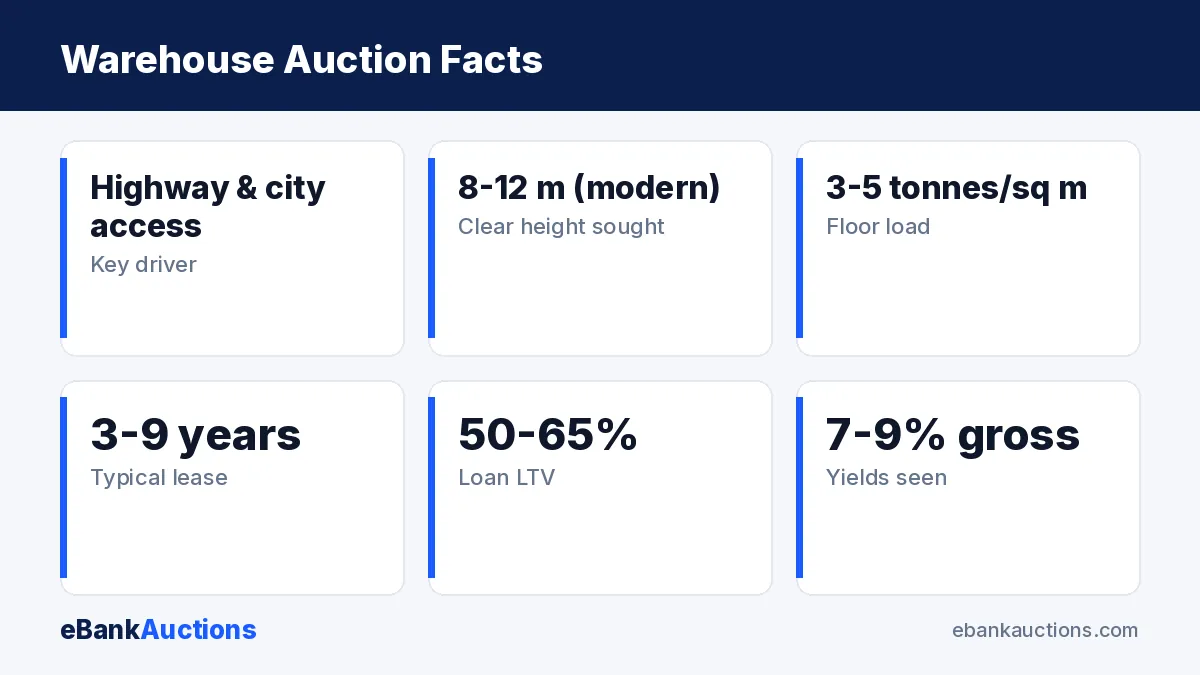
- Clear height from floor to the lowest roof member: modern tenants want 8 metres or more; older godowns may have 5–6 metres.
- Column spacing and span: wide spans allow flexible racking.
- Floor strength and levelness: heavy racks need strong, flat floors.
- Roof sheets, gutters and leaks.
- Loading docks, dock levellers and shutters.
- Drainage and flood history, especially in low-lying areas.
Repairs to roofs and floors can be expensive; estimate them before bidding.
Tip 5: Check power, water and utilities
Tenants need sanctioned electrical load for lighting, cold storage or light processing. Check the meter, sanctioned load and arrears. Confirm water supply, toilets for staff, and a security cabin. For cold storage, check the condition of refrigeration equipment separately, as it may not be included in the sale.
Tip 6: Understand what is included in the sale
A warehouse auction notice may cover only land and building, or it may include plant, racks, cold storage equipment and generators. Check the notice carefully. If equipment is excluded, it may have been removed or may be sold separately. If included, inspect its condition and value it separately.
Tip 7: Investigate tenants and possession
If the warehouse is leased, ask for the lease deed and check registration, rent, deposit and term. A strong logistics tenant on a valid lease is valuable. A doubtful tenancy may lead to disputes. If the borrower’s own business occupies the godown, possession may take time. Read our pre-leased property auction guide.
Tip 8: Estimate rent and build a yield-based limit
Warehouse rents are quoted per square foot per month and vary by location, height and quality. Ask logistics brokers and nearby warehouse owners for recent deals. Then:
- Calculate annual rent minus property tax, insurance, repairs and vacancy allowance.
- Choose a target net yield, for example 8%.
- Divide net rent by target yield to get your maximum all-in cost.
- Deduct stamp duty, registration, dues, repairs and legal costs to get your maximum bid.
Our auction property rental yield guide explains this method.
Tip 9: Plan finance
Lenders treat warehouses as commercial or industrial property, with loan-to-value ratios often around 50–65%. If a tenant is in place, lease rental discounting may be possible later. Get in-principle approval before paying EMD, because payment timelines remain tight. Our commercial auction loan guide covers options.
Tip 10: Bid, register and lease
Register on the portal early, pay the EMD through the approved method, and bid within your limit. After winning, pay the balance on time, register the sale certificate, and apply for mutation of revenue and tax records. Transfer electricity and water connections. Then market the warehouse to logistics companies, distributors and manufacturers through specialised brokers.
Who rents warehouses, and what they need
Knowing the tenant pool helps you judge any warehouse auction listing.
- E-commerce and quick-commerce operators: want locations close to dense residential areas for fast delivery, with good truck and two-wheeler access, and often operate at night.
- Third-party logistics (3PL) firms: manage storage for many clients and prefer larger, modern sheds on highways with docks and fire safety.
- FMCG and consumer durable distributors: need medium-sized godowns near city markets and good access for small trucks.
- Pharmaceutical and food companies: may need temperature control, hygiene standards and specific licences.
- Manufacturers: use warehouses near factories for raw materials and finished goods.
- Local traders: rent small godowns for seasonal stock at modest rents.
A godown that suits several of these groups will lease faster and stay occupied longer. A warehouse auction property that suits only one niche needs a bigger discount.
Grade A vs Grade B warehouses
| Feature | Grade A (modern) | Grade B (older) |
|---|---|---|
| Clear height | 9–12 m | 5–7 m |
| Floor | FM2-grade, high load | Basic concrete |
| Docks | Dock levellers, canopies | Ground-level shutters |
| Fire safety | Hydrants, sprinklers | Extinguishers |
| Tenant | 3PL, e-commerce, MNCs | Local distributors, traders |
| Rent | Higher | Lower |
Most bank listings are Grade B or small godowns. A warehouse auction for such a property can still be very profitable if the price reflects its grade and the location has steady local demand.
Upgrading a Grade B godown after purchase
Some buyers win a warehouse auction for an older godown and upgrade it to attract better tenants. Common improvements are:
- Replacing roof sheets with insulated or turbo-ventilated roofing.
- Resurfacing the floor to improve levelness and load capacity.
- Adding a loading dock or ramp.
- Installing fire hydrants, extinguishers and alarm systems, and obtaining a fire NOC.
- Improving yard paving, lighting and security fencing.
- Adding staff toilets, a rest area and a security cabin.
Each improvement should pay back through higher rent or faster leasing. Get quotes before bidding so that your maximum bid leaves room for the upgrade budget.
Due diligence documents for a warehouse auction
- Title deeds, encumbrance certificate and revenue records.
- Land use certificate and any conversion order.
- Approved building plan and completion certificate.
- Fire NOC and any safety audit reports.
- Electricity connection details and sanctioned load.
- Property tax receipts and any panchayat or municipal licences.
- Existing lease deeds and rent receipts, if leased.
- Pollution control consent if the premises were used for processing.
Warehouse auction timeline
Allow at least three weeks for checks. Land use and conversion questions can take time to answer, especially in peri-urban areas where records are held at the taluk office. Start with the land records on day one, and book the engineer for the first inspection date. If the answers are not clear by the EMD deadline, skip the round and track the property for re-auction.
Warehouse auction mistakes that cost investors money
- Judging by photographs: a wide shot hides roof leaks, uneven floors and a narrow gate.
- Ignoring land conversion: fines and regularisation fees can run high in peri-urban areas.
- Assuming any tenant will do: a single small tenant at a low rent can block a better lease for years.
- Skipping the fire NOC: insurers and organised tenants may refuse the premises.
- Forgetting yard space: without room for trucks to wait and turn, operations suffer and rent falls.
- Buying equipment you do not need: included cold rooms or racks add value only if a tenant will use them.
Avoiding these mistakes is often worth more than winning a warehouse auction at the lowest possible price.
How to market an auctioned warehouse
Leasing logistics space is a specialised market. After you take possession, list the property with brokers who deal in industrial and warehousing assets, not residential agents. Prepare a one-page profile with the location, distance to the highway, built-up area, clear height, floor load, number of shutters or docks, power load, fire safety features and available date. Good photographs of the approach road, yard, interior and docks help tenants shortlist quickly. Flexible terms, such as a short rent-free period for racking, can attract larger tenants who sign longer leases.
Is a warehouse auction right for you?
A warehouse auction suits investors who want higher yields and can handle land and structural due diligence, and businesses that need their own storage near key markets. It is less suitable if you want a hands-off investment in a location you cannot visit, or if you are uncomfortable with the possibility of a few months’ vacancy. Match the asset to your temperament and resources before bidding.
Warehouse auction vs other commercial assets
| Factor | Warehouse | Shop | Office |
|---|---|---|---|
| Tenant type | Logistics, distributors | Retail brands | Corporates, SMEs |
| Typical yields | Often higher | Moderate to high | Moderate |
| Maintenance | Low to moderate | Low | High (CAM) |
| Key risk | Land use, access | Footfall, tenancy | Building quality |
| Liquidity | Moderate | Good in prime | Moderate |
Common problems in a warehouse auction
Agricultural land without conversion
Godowns built on unconverted agricultural land may face penalties or restrictions. Check conversion status and costs.
Inadequate access
If trucks cannot turn or park, organised tenants will not lease. Verify access at the gate and on the approach road.
Old structures with low height
Older godowns may suit only small local tenants. Price them accordingly.
Flooding
Low-lying warehouses near rivers or drains may flood in heavy rain. Ask neighbours and look for water marks on walls.
Cold storage auctions
Cold storage facilities have extra considerations: refrigeration machinery, insulation panels, power load, licences under food safety rules and the specific crops or products they serve. Machinery condition largely determines value. Get a refrigeration expert to inspect before bidding in a cold storage warehouse auction.
Insurance and security
Once you own the warehouse, insure the building against fire, flood and other perils, and ask tenants to insure their goods. Install perimeter lighting and CCTV at the gate, and appoint a watchman if the property stays vacant. Vacant warehouses attract theft of roof sheets, cables and fittings, which can quickly add to your repair bill.
Tax points
Deduct 1% TDS under section 194-IA if the price of land and building is ₹50 lakh or more. Rent from warehouses may attract GST if you cross the threshold; check the GST portal. Rent for agricultural produce storage may have different treatment, so consult a tax adviser. Read our guide on auction property tax.
Worked example
An investor near Hosur finds a 20,000 sq ft warehouse on two acres, 3 km from the national highway, with 7-metre clear height and a fire NOC. The reserve price is ₹3.1 crore. Similar warehouses rent for ₹22 per sq ft per month. Annual rent is ₹52.8 lakh; after tax, insurance, repairs and a two-month vacancy allowance, net rent is about ₹42 lakh.
At a 9% target net yield, his all-in limit is ₹4.67 crore. After deducting ₹30 lakh for stamp duty, registration, roof repairs and legal costs, his maximum bid is about ₹4.3 crore. He wins at ₹3.45 crore, repairs the roof and leases to a third-party logistics company within three months. His net yield on total cost exceeds 11%.
Warehouse auction quick summary
Before you place your first bid, run through this summary. A good warehouse auction candidate has legal land use, clean title, easy truck access, adequate clear height, a sound roof and floor, fire safety or a clear path to it, and a realistic tenant market. If a warehouse auction property fails more than one of these tests, lower your bid sharply or wait for the next opportunity. With patience, a well-chosen warehouse auction purchase can become one of the best-yielding assets in your portfolio.
Frequently asked questions
Is a warehouse auction a good investment for beginners?
It can be, but warehouses need careful checks on land use, access and structure. Beginners should work with experienced brokers and engineers.
What rent can I expect from an auctioned warehouse?
It depends on location, height, floor, access and fire safety. Rates vary widely by city and corridor; get local broker estimates.
Can I use an auctioned warehouse for my own business?
Yes, if the land use and approvals allow your activity. Check pollution and fire requirements for your specific goods.
How long does it take to lease a warehouse after purchase?
In active logistics corridors, a few weeks to three months. In weaker locations or for older godowns, it can take longer, so keep a vacancy allowance in your numbers.
Do I need a pollution control consent to lease a warehouse?
Pure storage usually needs fewer approvals than manufacturing, but some goods and activities need consents. The tenant generally obtains licences for its own operations; you must ensure the building and land use permit them.
Can I split a large warehouse among tenants?
Yes, if the structure, access and fire exits allow it. Separate meters and clear lease boundaries make multi-tenant leasing easier.
Are racks and equipment included?
Only if the notice says so. Many notices cover land and building alone.
Conclusion
A warehouse auction can offer strong yields and long leases when you focus on truck access, land use, structure and fire safety. Check what is included, estimate realistic rent and bid within a yield-based limit. Browse commercial auctions on eBankAuctions, read our commercial property auction guide, and subscribe to alerts for warehouses in your region.