A pre-leased property auction offers something most bank auctions cannot: a tenant already paying rent. For investors, that can mean income from the first month, an easier loan through lease rental discounting and a property that is valued on a proven cash flow. When the tenant is a strong brand on a genuine lease, a pre-leased property auction can be one of the best deals in the commercial market.
It can also be a trap. Some borrowers create leases after default to make the property hard to sell, charge tiny rents against large deposits, or let related parties occupy the premises. This guide explains the law on tenants in SARFAESI auctions and eight critical checks to tell a valuable lease from a problem.
What is a pre-leased property auction?
It is an auction of a property, usually commercial, that is occupied by a tenant under a lease or rental agreement at the time of sale. The bank sells the borrower’s interest, and the buyer may take the property subject to the tenancy, depending on whether the lease is valid against the bank.
Common examples include a shop leased to a pharmacy, an office floor leased to a company, a warehouse leased to a logistics firm, or a building leased to a bank branch.
The legal position on tenants
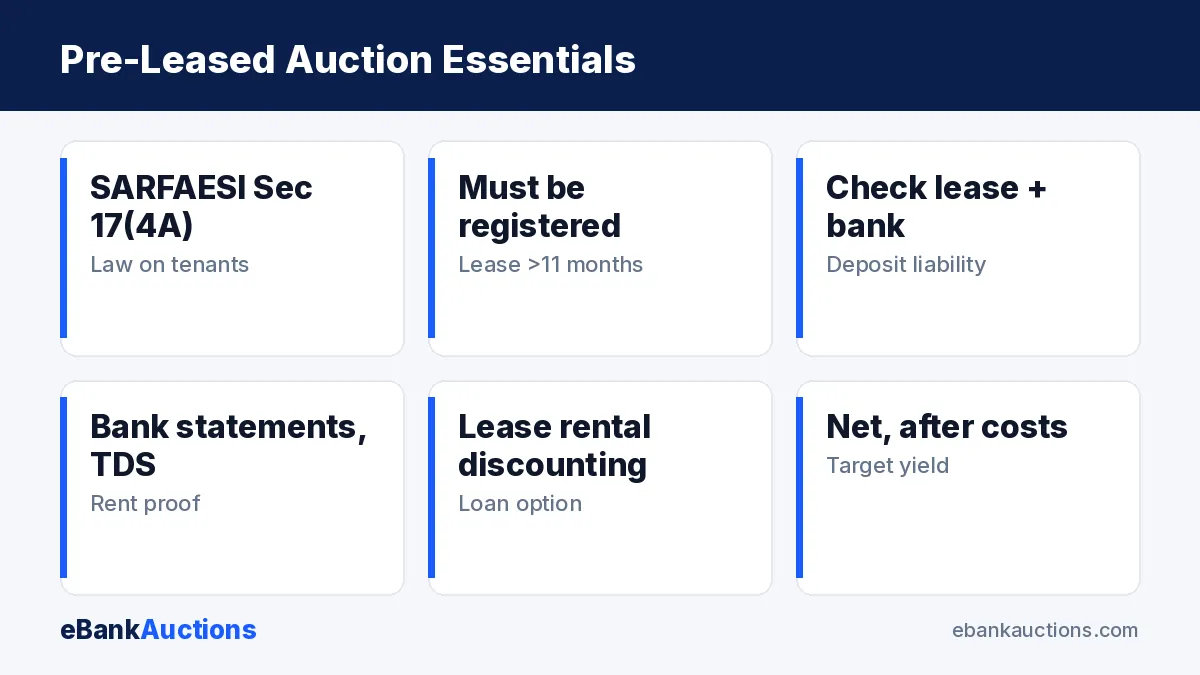
The SARFAESI Act, 2002 was amended in 2016 to address tenancy claims. Under Section 17(4A), a person claiming a tenancy or lease can raise it before the Debts Recovery Tribunal, which decides whether the lease is valid. Broadly, tribunals and courts look at:
- Whether the lease was created before the mortgage or with the bank’s consent.
- Whether a lease longer than one year was registered as required by law.
- Whether the lease is genuine or a sham arranged to defeat the bank.
- The rent, deposit and other terms compared with the market.
Section 65A of the Transfer of Property Act also limits a mortgagor’s power to lease mortgaged property in ways that harm the mortgagee. The outcome in any case depends on facts, so you need a lawyer’s view on each pre-leased property auction you consider.
Eight critical checks for any pre-leased property auction
The checks below apply whether the pre-leased property auction involves a small shop, an office floor or a warehouse. Work through them before you pay EMD.
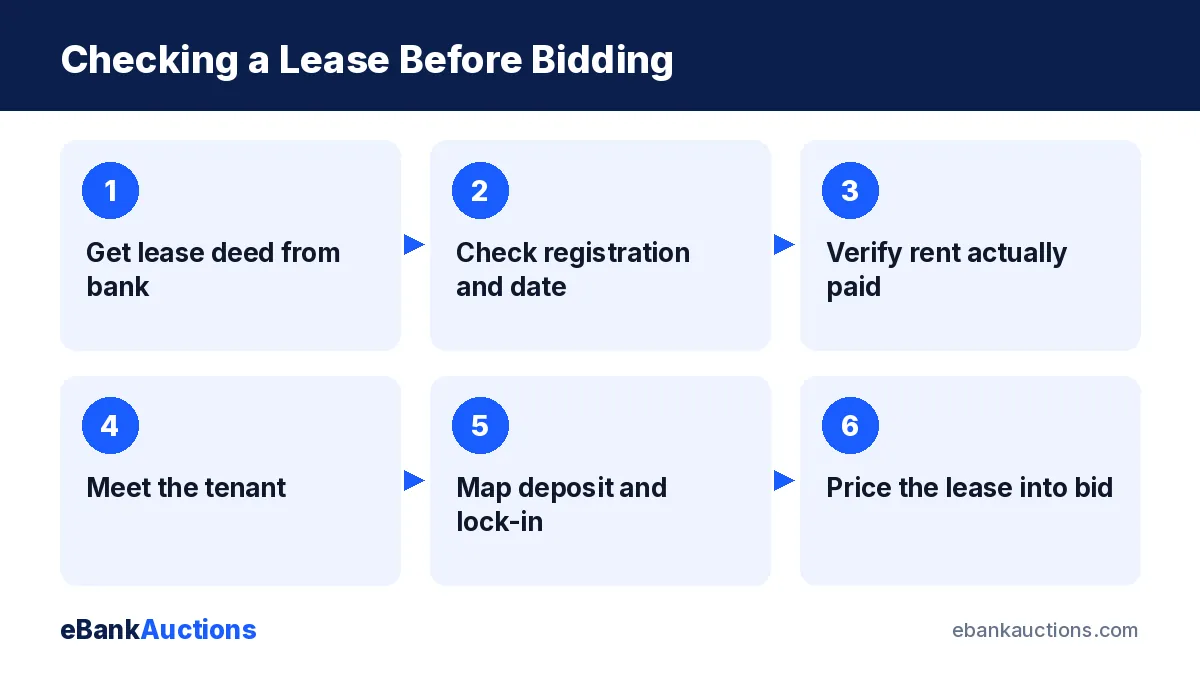
Check 1: Get the lease deed and all amendments
Ask the authorised officer for a copy of the lease or rent agreement and any renewals or addenda. If the bank does not have it, ask the tenant during inspection. No document at all is a red flag.
Check 2: Check registration and dates
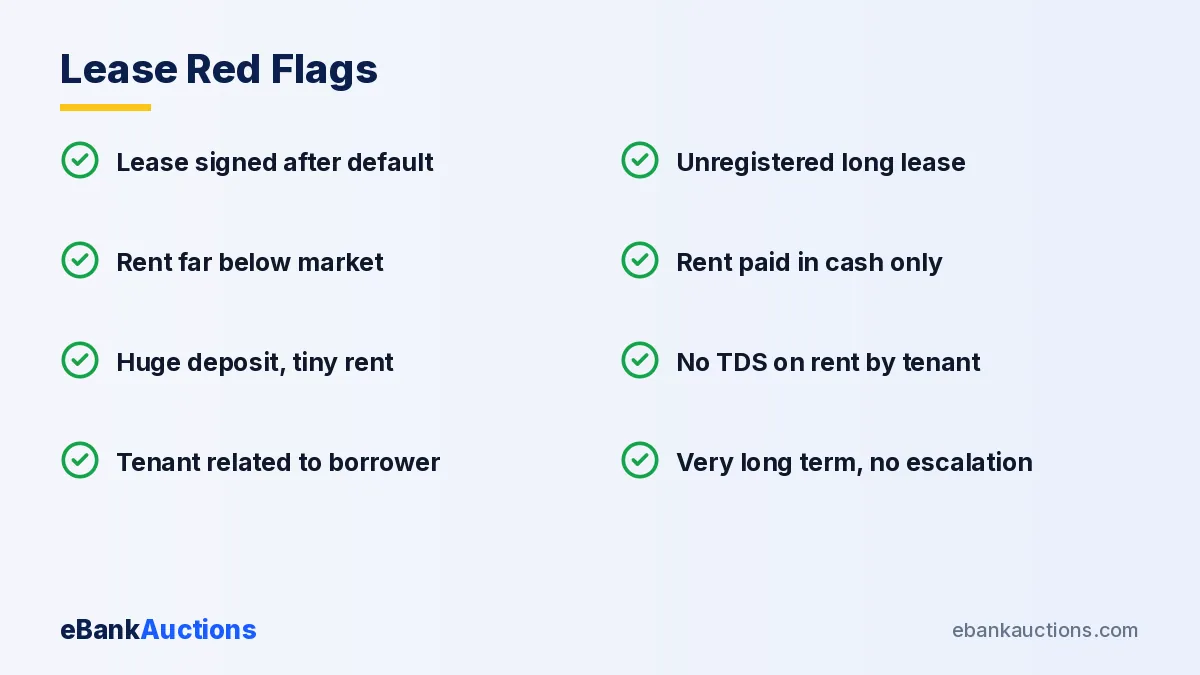
A lease for more than one year must be registered under the Registration Act. Check the registration details, the date of execution and the lease start date. Compare these with the date of the mortgage and the date the account became an NPA. A lease signed after the default notice deserves close scrutiny.
Check 3: Verify that rent is actually being paid
Ask for proof: bank statements showing rent credits, TDS certificates issued by the tenant (companies deduct TDS on rent under section 194-I), and GST invoices if applicable. A genuine corporate tenant leaves a clear paper trail. Rent paid only in cash, with no records, is a warning sign in any pre-leased property auction.
Check 4: Compare rent and deposit with the market
A lease at market rent with a normal deposit (say three to six months for shops, more in some cities) is typical. A lease with a very low rent and a very high deposit is suspicious; it can transfer value to the tenant and leave you with a large deposit to refund. Get broker estimates for market rent to compare.
Check 5: Understand the deposit liability
If the lease is valid and continues after the sale, you may become liable to refund the security deposit when the lease ends, even though you never received it. Ask the bank whether any deposit was assigned to it or is held by it, and read the terms of sale. Treat the deposit as a cost when setting your bid.
Check 6: Identify the tenant and their business
A well-known brand, bank or listed company is a strong tenant. A small, unknown entity related to the borrower is not. Search the tenant’s company details on the Ministry of Corporate Affairs portal, check its directors, and see whether they overlap with the borrower’s family or business. Meet the tenant during inspection and ask about their plans.
Check 7: Review lock-in, escalation and renewal terms
Key terms decide your returns:
- Lock-in: a period when the tenant cannot leave, protecting your income.
- Escalation: periodic rent increases, often 5–15% every few years.
- Renewal: options for the tenant to renew, and at what rent.
- Maintenance and taxes: who pays property tax, maintenance and repairs.
A long lease without escalation at below-market rent can reduce the property’s value for years.
Check 8: Price the lease into your bid
Value the property on its actual lease, not on hopes of re-leasing at market rent. If the lease is strong, you may justify a higher bid because of secure income and easier financing. If it is weak or doubtful, add legal costs and time for a possible DRT process, or skip the auction. Our guide to auction property rental yield explains how to calculate yield.
Why investors actively seek a pre-leased property auction
Experienced investors often prefer a pre-leased property auction over a vacant one, even at a slightly higher price. The reasons are practical. A vacant commercial unit may take months to lease, and during that time you pay EMIs, maintenance and property tax with no income. A leased unit starts paying from the day the tenant begins remitting rent to you. The rent history also proves demand for the location, and lenders are more comfortable financing an income-producing asset.
That said, a pre-leased property auction is only as good as its lease. The same features that make a genuine lease valuable—long term, secure rent, a committed tenant—become liabilities when the lease is below market or was created to protect the borrower.
How banks describe tenancy in the notice
Read the notice for phrases such as “property is under tenancy”, “sold subject to existing tenancy”, “tenant in occupation” or “vacant”. Some banks attach the lease or summarise its terms. Others simply note that the property is occupied. If the notice for a pre-leased property auction does not describe the tenancy clearly, write to the authorised officer and ask for:
- The tenant’s name and the premises occupied.
- A copy of the lease and any renewals.
- Whether the bank consented to the lease.
- Whether any deposit is with the bank.
- Whether any DRT or court proceeding involves the tenant.
Talking to the tenant
The tenant is often the best source of truth in a pre-leased property auction. During inspection, introduce yourself as a prospective buyer and ask polite, factual questions: how long they have occupied the premises, whether they intend to stay, what rent they pay and to whom, and whether they have a registered lease. A professional tenant will usually cooperate, because a smooth change of landlord suits them. Evasive answers, or an occupant who refuses to show the lease, tell you to be cautious.
Pre-leased property auction for different asset types
| Asset | Typical tenant | Special check |
|---|---|---|
| Shop | Pharmacy, bank, retail chain | Signage rights, trade licence |
| Office | Company, co-working operator | CAM responsibility, fit-out ownership |
| Warehouse | Logistics or distribution firm | Racking, fire NOC, yard use |
| Residential building | Families, students | Rent control rules, short leases |
| Hotel or hospital | Operator under a management lease | Operating licences, revenue share terms |
Each asset type carries its own lease norms. A pre-leased property auction of a hotel operated under a revenue-sharing arrangement, for example, needs a specialist’s view of the operating agreement, not just a standard rent check.
Financing a pre-leased property auction
Lease rental discounting (LRD) lets banks lend a percentage of the future rent receivable under a lease, usually for strong tenants on registered leases with enough remaining term. LRD can release capital after you buy. For the purchase itself, most buyers still use a loan against property or own funds, because LRD requires the lease to be assigned to the lender and the property to be registered in your name first. Plan a two-step finance: buy with LAP or funds, then refinance with LRD. Read our commercial auction loan guide.
Tax points on rent after purchase
Once rent flows to you, it is taxed as income from house property for individuals, with a 30% standard deduction on net annual value and deduction of interest on borrowed capital as per the Income-tax Act. If you exceed the GST threshold for commercial rent, you must register and charge GST. Corporate tenants will deduct TDS on rent and issue certificates. Keep records from the start. Our guide on auction property tax covers these points.
When to walk away from a pre-leased property auction
Walk away if the lease was executed after the demand notice, the rent is a fraction of the market, the deposit is several years’ rent, the tenant is connected to the borrower, or there is a pending DRT case without clarity on timelines. In these situations, the risk of years of low income and litigation usually outweighs the discount. There will be other opportunities.
Due diligence documents for a pre-leased property auction
Collect and review these before bidding:
- Registered lease deed, renewals and any side letters.
- Rent receipts or bank statements for at least 12 months.
- TDS certificates (Form 16A) issued by the tenant.
- GST invoices raised for rent, if the owner was registered.
- Correspondence between the bank and the tenant.
- Title documents, encumbrance certificate and approvals, as for any property.
- Property tax, maintenance and utility statements.
If most of these are available and consistent, you are looking at a genuine pre-leased property auction. If only a photocopy of an unregistered agreement exists, treat the property as occupied, not leased.
A simple scoring method
Give the lease one point each for: registration, pre-mortgage date, market rent, normal deposit, paper trail of payments, strong tenant, and at least three years remaining. A score of six or seven means the lease adds value. Four or five means the lease is neutral, so value the property as if vacant. Three or less means the lease is a liability, and you should either bid very low or skip this pre-leased property auction.
Benefits of a genuine pre-leased property auction
- Rent from day one after you take over.
- Lower vacancy risk.
- Access to lease rental discounting loans based on the rent.
- Easier resale to investors who value leased assets.
Risks to manage
Every pre-leased property auction carries some of the following risks, and your job is to measure how much of each applies.
- Sham leases created to block the sale.
- Deposits that become your liability.
- Below-market rent locked in for years.
- Tenant defaults after the sale.
- Litigation before the DRT.
Managing the landlord–tenant relationship after purchase
Good tenant relations protect your income. Soon after taking over, meet the tenant, share your contact details and bank account for rent, and agree on a simple process for repairs and communication. Keep a file of rent receipts, TDS certificates and correspondence. Review escalation dates in advance and send polite written reminders. If the tenant has a renewal option, discuss their plans at least six months before the lease ends. A tenant who feels respected is more likely to renew, which keeps your pre-leased property auction purchase delivering steady returns for years.
Resale value of a leased asset
When you eventually sell, investors will value the property largely on its remaining lease. A long, registered lease with a strong tenant and regular escalations can command a premium over a vacant unit. Keep the lease documentation in order and negotiate renewals early to protect this value.
Strong lease vs weak lease
| Feature | Strong lease | Weak or doubtful lease |
|---|---|---|
| Tenant | Brand, bank, listed company | Unknown or related party |
| Registration | Registered, pre-mortgage | Unregistered or post-default |
| Rent | At market | Far below market |
| Deposit | Normal | Very high |
| Payment trail | Bank transfers, TDS | Cash only |
| Term | Reasonable with escalation | Very long, no escalation |
After you win
The first weeks after a pre-leased property auction set the tone with your tenant, so handle the transition formally and quickly.
Once you complete payment and register the sale certificate, write to the tenant formally, enclosing a copy of the registered document, and ask them to pay rent to your account from a specified date. Update GST registration if you need to charge GST on rent. Agree on how the security deposit will be handled. If the tenant disputes the change, take legal advice promptly. Read our guide to sale certificate registration.
Worked example
A Mumbai investor considers a pre-leased property auction of a 600 sq ft shop leased to a national pharmacy chain. The lease was registered five years before the mortgage, with nine years remaining, rent at ₹1.2 lakh a month and 5% annual escalation. TDS certificates confirm payment. The deposit of ₹7.2 lakh is held by the borrower, not the bank.
The reserve price is ₹1.55 crore. Net annual rent after tax and maintenance is about ₹13 lakh. Treating the deposit as a cost and targeting a 7.5% net yield, his all-in limit is about ₹1.73 crore; after stamp duty, registration and the deposit, his maximum bid is ₹1.57 crore. He wins at ₹1.56 crore and refinances through lease rental discounting six months later.
Frequently asked questions
Can the buyer evict the tenant after a pre-leased property auction?
Only if the lease is invalid against the bank or has ended. A valid lease generally binds the buyer. Legal advice is essential.
Who refunds the tenant’s deposit?
If the lease continues, the obligation may pass to the buyer. Clarify with the bank and your lawyer before bidding.
What is lease rental discounting?
A loan against future rent from a lease, offered by banks to owners of leased commercial property.
Does a pre-leased property auction always sell at a premium?
Not always. A strong lease can attract more bidders and a higher price, while a doubtful lease can scare buyers away and lead to re-auctions at lower reserve prices. The quality of the lease decides.
Can the tenant buy the property in the auction?
Yes, a tenant can bid like any other buyer if eligible. Tenants sometimes do, because they value the location and want to avoid relocation.
Is a residential tenant treated the same way?
The same SARFAESI provisions apply to tenancy claims, but residential rents and leases are usually shorter. Rent control laws in some states may also be relevant.
Conclusion
A pre-leased property auction can give you income and financing advantages from day one, but only when the lease is genuine, registered, at fair rent and paid through a clear trail. Follow the eight checks, get legal advice, and price the lease honestly into your bid. Browse commercial auctions on eBankAuctions and read our commercial property auction guide.