A commercial building auction is a different league from buying a single shop or flat. You are buying land, a full structure, its services, its approvals and often several tenants at once. When a business defaults on a large loan secured by its building, the lender sells the whole property through a SARFAESI e-auction. For experienced investors and growing businesses, a commercial building auction can deliver scale, control and value that is hard to find in the open market.
The stakes are also higher. One missing approval, a structural weakness or a set of doubtful leases can wipe out the discount. This guide sets out 14 essential due diligence checks, grouped by legal, technical and financial areas.
Why a commercial building auction appeals to investors
Owning an entire building gives you control over tenants, maintenance, signage and future redevelopment. In the open market, owners of well-located commercial buildings rarely sell at a discount. In a commercial building auction, the bank’s valuation and recovery needs set the reserve price, and the pool of buyers who can fund and evaluate a whole building is small. Less competition can mean better prices for those who do their homework.
Typical buildings include small office blocks, shopping complexes, mixed-use buildings with shops and offices, hotels, hospitals, schools and institutional buildings. Browse commercial auctions and industrial auctions on eBankAuctions.
Legal checks in a commercial building auction
Legal checks confirm that you will own what you pay for and can use it as intended. In a commercial building auction, legal problems are usually larger and slower to fix than in a flat purchase, because more parties and approvals are involved.
Check 1: Title and land records
Your advocate should trace title for at least 30 years, confirm the land is correctly described with survey numbers and extent, and obtain encumbrance certificates. Verify revenue records and mutation. For buildings on leasehold land allotted by a development authority or industrial body, read the lease or allotment terms, including restrictions on use, transfer fees and consent requirements.
Check 2: Sanctioned plan vs actual construction
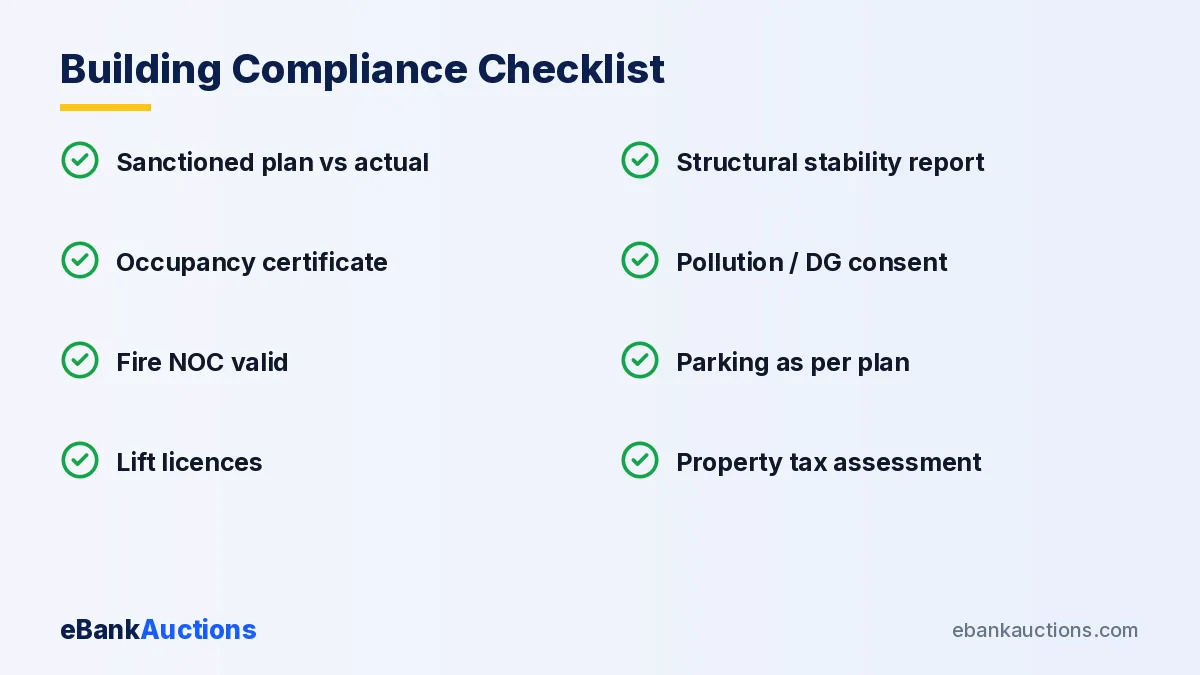
Get the approved building plan and compare it with what exists. Extra floors, enclosed balconies, converted parking and basements used for shops are common deviations. Some deviations can be regularised; others cannot. Unauthorised floors can lead to demolition orders or block occupancy certificates.
Check 3: Occupancy certificate
An occupancy or completion certificate confirms the building was completed as per approval and is fit for use. Many lenders and corporate tenants insist on it. Without it, utilities and licences may also be affected.
Check 4: Fire NOC and safety compliance
Commercial buildings above certain heights or occupancy loads need a fire NOC from the state fire service, renewed periodically. Check the NOC’s validity, fire exits, hydrants, sprinklers, alarms and extinguishers. A non-compliant building may face sealing and will struggle to attract quality tenants.

Check 5: Other licences and consents
Depending on use, check lift licences, diesel generator permissions, pollution control consent for large buildings, trade licences, and specific licences for hotels, hospitals, restaurants or schools. For special-use buildings, many licences are personal to the operator and will not transfer; you or your tenant will need fresh approvals.
Check 6: Litigation and tenancy disputes
Ask the bank in writing about pending cases before the Debts Recovery Tribunal, civil courts or authorities. Tenants may raise claims under Section 17(4A) of the SARFAESI Act, 2002. Check court records for the building’s name, the borrower and major tenants.
Technical checks in a commercial building auction
Technical checks estimate what it will cost to keep the building safe, compliant and attractive to tenants. Budget surprises in a commercial building auction usually come from structure and services.
Check 7: Structural condition
Hire a qualified structural engineer. Older buildings, especially those that were poorly maintained during the borrower’s financial trouble, may have corrosion in reinforcement, cracks, water ingress and failing waterproofing. For large buildings, a structural stability certificate or non-destructive testing may be worthwhile.
Check 8: Building services
Assess lifts, electrical panels, transformers, DG sets, HVAC, plumbing, sewage treatment, water tanks and fire systems. Get estimates for repairs or replacement. Services are expensive, and a failing lift or HVAC can drive tenants away.
Check 9: Parking and access
Check whether parking matches the sanctioned plan and whether it is adequate for the building’s use. Look at access roads, entry and exit, and any road-widening proposals in the master plan that could cut frontage.

Financial checks in a commercial building auction
Financial checks turn your legal and technical findings into a number: the maximum you should bid.
Check 10: Rent roll and leases
List every tenant with area, rent, deposit, lease start, lock-in, escalation and expiry. Verify leases, registration and rent payment trails. Identify related-party tenants and below-market leases. A clear rent roll is the basis of your valuation. Our pre-leased property auction guide explains lease checks.
Check 11: Dues and liabilities
Collect property tax, water, electricity, lift maintenance contracts, security and housekeeping dues. Check whether tenants’ deposits are held by the borrower and whether you may inherit refund obligations.
Check 12: Operating costs
Estimate annual costs of running the building: maintenance staff, security, housekeeping, power for common areas, insurance, repairs and property tax. Deduct these from rent to find net operating income.
Check 13: Valuation and bid limit
Value the building using net operating income and a market capitalisation rate, cross-checked with land value and replacement cost. Then deduct stamp duty, registration, dues, repairs, compliance costs and a contingency to get your maximum bid. Read our auction property rental yield guide.
Check 14: Finance and structure
Large purchases may involve a commercial auction loan, lease rental discounting later, or joint investors. Decide the buying entity—individual, company or LLP—with tax advice. Our commercial auction loan guide covers options.
Assembling your commercial building auction team
A single advocate is not enough for a commercial building auction. Build a small team early:
- Property lawyer: title, land records, lease review, litigation searches.
- Structural engineer: stability, visible defects, need for testing.
- MEP consultant: lifts, electrical, HVAC, plumbing, fire systems.
- Architect or planning consultant: sanctioned plan comparison, regularisation options, fire compliance.
- Valuer or commercial broker: rents, capitalisation rates and comparable sales.
- Chartered accountant: buying entity, tax on rent and depreciation, GST on rent.
Each adviser should give a short written note with findings, estimated costs and a red-amber-green rating. Combine the notes into one decision sheet for the commercial building auction.
Reading the rent roll like a professional
A rent roll lists each tenant, but numbers alone can mislead. For each lease, ask:
- Is the rent at, above or below market?
- How many years remain, and is there a lock-in?
- Is the tenant financially strong?
- When is the next escalation?
- Who pays maintenance, and is it recovered in full?
- Is the deposit held by the borrower, and will you inherit the refund obligation?
Then calculate the weighted average lease expiry (WALE), a measure professional investors use: multiply each tenant’s remaining years by its share of total rent and add them up. A building with a WALE of five years is more secure than one with a WALE of one year. In a commercial building auction, a short WALE means you must budget for re-leasing soon.
Regularisation and compliance costs
Many buildings sold at auction have compliance gaps. Common ones are extra floors, change of use from residential to commercial, parking converted to shops, and lapsed fire NOCs. States offer regularisation schemes with fees based on area and location. Your architect can estimate the cost and time. Add these to your budget as firm costs, not hopeful savings. If a deviation cannot be regularised, value the building without that area.
Energy and operating efficiency
Older buildings often waste money on power and maintenance. After a commercial building auction, investors frequently upgrade lighting to LED, install efficient pumps and lifts, add rooftop solar and improve water management. These upgrades reduce common area charges, make the building more attractive to tenants and can increase rent. Get indicative quotes during due diligence and treat them as value-add opportunities, not immediate necessities.
Exit strategies for a whole building
Think about exit before you bid:
- Hold and lease: stabilise occupancy, raise rents over time, enjoy income.
- Strata sale: sell individual units or floors to users and investors, where the title and approvals allow.
- Sell to an institutional buyer: a fully leased, compliant building can attract larger investors.
- Redevelop: where land value exceeds building value, redevelopment can unlock value, subject to planning rules.
The best commercial building auction purchases keep several exits open. A building with clean title, full approvals and a strong rent roll can be sold as a whole or in parts.
A four-week plan for a commercial building auction
| Week | Focus | Output |
|---|---|---|
| Week 1 | Notice, title documents, site walk, broker rent survey | Initial go/no-go |
| Week 2 | Lawyer’s title and lease review; architect’s plan comparison | Legal and compliance notes |
| Week 3 | Engineer and MEP inspections; dues statements; lender meetings | Cost estimates, finance view |
| Week 4 | Valuation, bid limit, EMD, portal registration | Final decision |
If the commercial building auction is scheduled sooner than four weeks from when you find it, focus on the deal-breakers first—title, occupancy certificate, fire NOC and major leases—and skip the round if they cannot be cleared in time.
Negotiating with tenants after purchase
Once you own the building, meet every tenant individually. Share your contact details and bank account for rent, confirm lease terms, and note their concerns about maintenance or services. Where a tenant is paying well below market on a lease that is valid, plan for the long term: improve services and relationships so that renewal happens at a fair rent. Where a lease is doubtful, take legal advice before acting. A calm, professional transition protects income and reputation, which matters when you later lease vacant space.
Red flags that should end your interest
Some findings are serious enough to stop a commercial building auction purchase outright:
- The land is under acquisition or reserved for a public purpose.
- Large parts of the building are unauthorised and cannot be regularised.
- A structural engineer reports serious distress requiring major strengthening.
- The fire department has issued a sealing or prohibition order that cannot be resolved quickly.
- A court has stayed the sale, or title is disputed by third parties.
- Most of the rent comes from related-party tenants on long, below-market leases.
If you find one of these, record your findings, thank your advisers, and move on. The discipline to walk away is what protects capital in a commercial building auction.
Insurance and risk management after purchase
Insure the building for its reinstatement value against fire, earthquake, flood and allied perils, and take public liability cover if the building has heavy footfall. Ask tenants to insure their contents and fit-outs. Keep maintenance contracts for lifts, fire systems and DG sets active, and maintain logs. Insurers and fire inspectors look for documented maintenance, and tenants value a building that is clearly well run.
Working with the existing maintenance agency
Many buildings have a housekeeping, security or facility management agency already in place. Review their contracts during due diligence: some may be long-term, some may have unpaid invoices, and some may be linked to the borrower. After purchase, you can retain a good agency on fresh terms or replace it with notice as per the contract. Continuity of security and lift maintenance during the changeover is important, so plan the transition carefully.
Special-use buildings
Hotels, hospitals, schools and cinemas need operators and specific licences. Their value depends heavily on business performance, not just the building. Unless you are an operator or have one lined up, value them conservatively, perhaps as land plus convertible structure. See our hotel property auction guide.
Commercial building auction due diligence summary
| Area | Key document | Risk if missing |
|---|---|---|
| Title | Deeds, EC, land records | Ownership disputes |
| Plan | Sanctioned plan | Demolition, penalties |
| OC | Occupancy certificate | Loan and tenant issues |
| Fire | Fire NOC | Sealing, no insurance |
| Structure | Engineer’s report | Costly repairs |
| Leases | Rent roll, lease deeds | Lower income, disputes |
| Dues | Statements | Hidden costs |
Worked example
An investor group in Coimbatore evaluates a commercial building auction for a four-storey building with shops on the ground floor and offices above, on 12 cents of land near a main road. The reserve price is ₹6.2 crore. Due diligence shows a valid occupancy certificate for three floors; the fourth was added without approval but can be regularised for about ₹18 lakh. The fire NOC has expired and needs ₹12 lakh of upgrades. Rent roll shows ₹5.6 lakh per month from eight tenants, one related to the borrower at half market rent.
Adjusting for the related-party lease, operating costs and vacancy, net operating income is about ₹52 lakh a year. At an 8% capitalisation rate, the building is worth about ₹6.5 crore. After deducting stamp duty, registration, regularisation, fire upgrades and contingency, the group sets a maximum bid of ₹5.7 crore. The first auction fails at ₹6.2 crore; in the re-auction at ₹5.58 crore, they win at ₹5.65 crore.
Is a commercial building auction right for you?
A commercial building auction suits buyers with patience, capital, access to professional advice and a clear plan for leasing or use. It is less suitable for someone who wants a passive, low-maintenance investment. If you have handled single commercial units successfully, a small building is a natural next step. If this is your first commercial purchase, consider partnering with an experienced investor for your first commercial building auction and learn the process before taking on a larger asset alone.
Frequently asked questions
Can individuals buy in a commercial building auction?
Yes, but many investors use a company or LLP for larger buildings, for liability and tax reasons.
What if the building lacks an occupancy certificate?
Find out why and whether it can be obtained. Price in the cost and delay, or skip the auction.
Do licences transfer with the building?
Building-related approvals stay with the building, but many operational licences are personal to the operator and must be obtained afresh.
Is a commercial building auction suitable for first-time investors?
It can be, if you team up with experienced advisers or co-investors. The scale and complexity are higher than buying a single unit, so start with a smaller building if possible.
Can I sell individual floors after buying a whole building?
Only if the title, approvals and local rules allow strata sale. Check with your lawyer and architect before planning a break-up sale.
How long does due diligence take?
For a whole building, allow three to four weeks. If the auction is sooner, consider waiting for a re-auction.
Conclusion
A commercial building auction can deliver scale and value, but only after deep due diligence on title, approvals, fire safety, structure, leases and costs. Work with an advocate, engineer and valuer, build your bid from net operating income, and walk away when compliance gaps are too large. Browse commercial listings on eBankAuctions and read our commercial property auction guide.