Rental yield is the single most useful number for anyone buying a bank auction property to rent out. It tells you how much income the property produces relative to what you paid for it. Get the rental yield calculation right and you will bid confidently, knowing exactly where your returns come from. Get it wrong, by ignoring costs or using the wrong purchase price, and a property that looked like a bargain can turn into a poor investment.
This guide explains six simple formulas, from gross rental yield to cash-on-cash return, with worked examples based on typical Indian auction purchases.
Why rental yield matters so much in auctions
In the open market, property prices already reflect local yields. In a bank auction, the reserve price follows a valuation and the final price depends on competition. That gap creates opportunity: if you buy below the price implied by market rents, your rental yield will be higher than what other investors earn. The only way to know whether an auction price is attractive is to calculate the yield it will produce.
Yield also guides your bid. Instead of asking “how low can I buy?”, you ask “what is the highest price at which I still earn my target return?” That is the discipline that separates investors from speculators.
Formula 1: Gross rental yield
Gross rental yield = (Annual rent ÷ Purchase price) × 100
If a shop rents for ₹40,000 a month (₹4.8 lakh a year) and you buy it for ₹60 lakh, the gross yield is 8%. Gross yield is quick to calculate and useful for comparing listings, but it ignores costs and overstates your real return.
Formula 2: All-in cost
Your purchase price in an auction is not just the winning bid. All-in cost includes:
- Winning bid.
- Stamp duty and registration.
- Pending dues you must clear: property tax, maintenance, utilities.
- Repairs and refurbishment needed before leasing.
- Legal, valuation and broker fees.
- TDS is not a cost (it is part of the price paid to the government on the seller’s behalf), but include any interest or penalties if you pay late.
Always divide rent by all-in cost, not by the bid amount. In auctions, all-in cost can be 10–15% higher than the bid.

Formula 3: Net operating income
Net operating income (NOI) = Annual rent − Annual outgoings
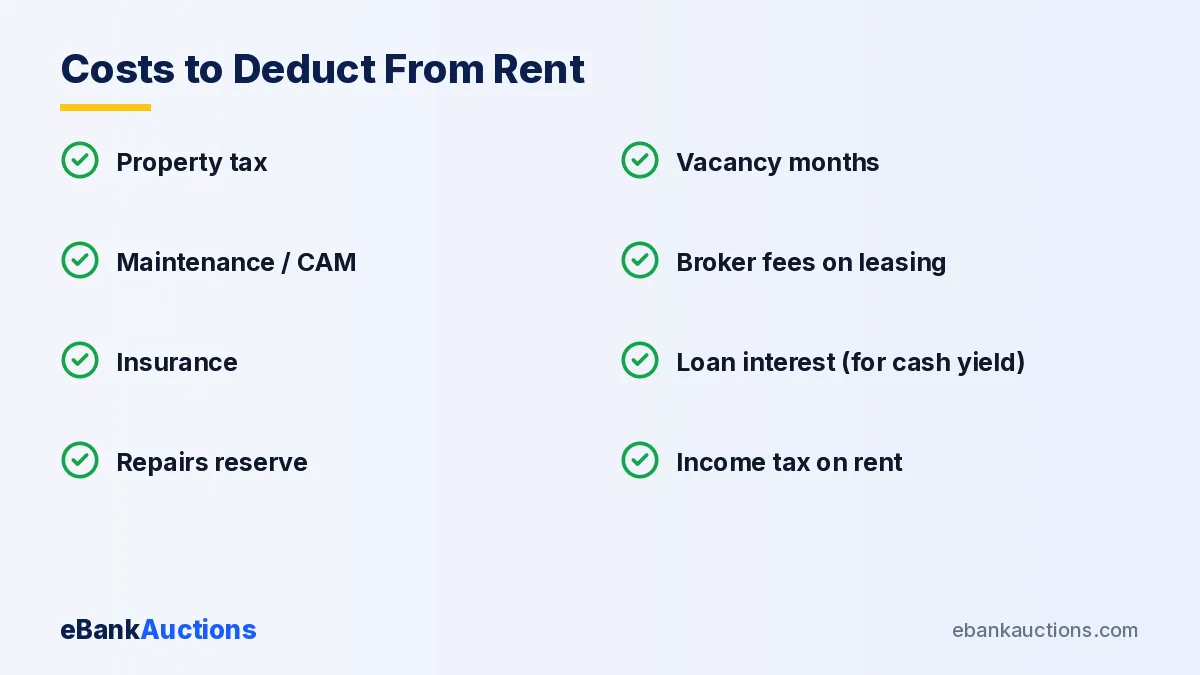
Outgoings that the owner typically bears include:
- Property tax.
- Maintenance or common area charges not recovered from the tenant.
- Building insurance.
- A repairs reserve, often 5–10% of rent for older properties.
- A vacancy allowance, such as one or two months’ rent a year.
- Leasing brokerage when tenants change.
Check your lease or local practice to see which costs tenants pay. In many commercial leases, tenants pay maintenance and utilities; in residential leases, owners usually pay property tax and society maintenance.
Formula 4: Net rental yield
Net rental yield = (NOI ÷ All-in cost) × 100
This is the number to compare with other investments such as fixed deposits, bonds or REIT yields. For the shop example, suppose outgoings are ₹60,000 a year and all-in cost is ₹67 lakh. NOI is ₹4.2 lakh and net yield is about 6.3%, noticeably lower than the 8% gross figure.
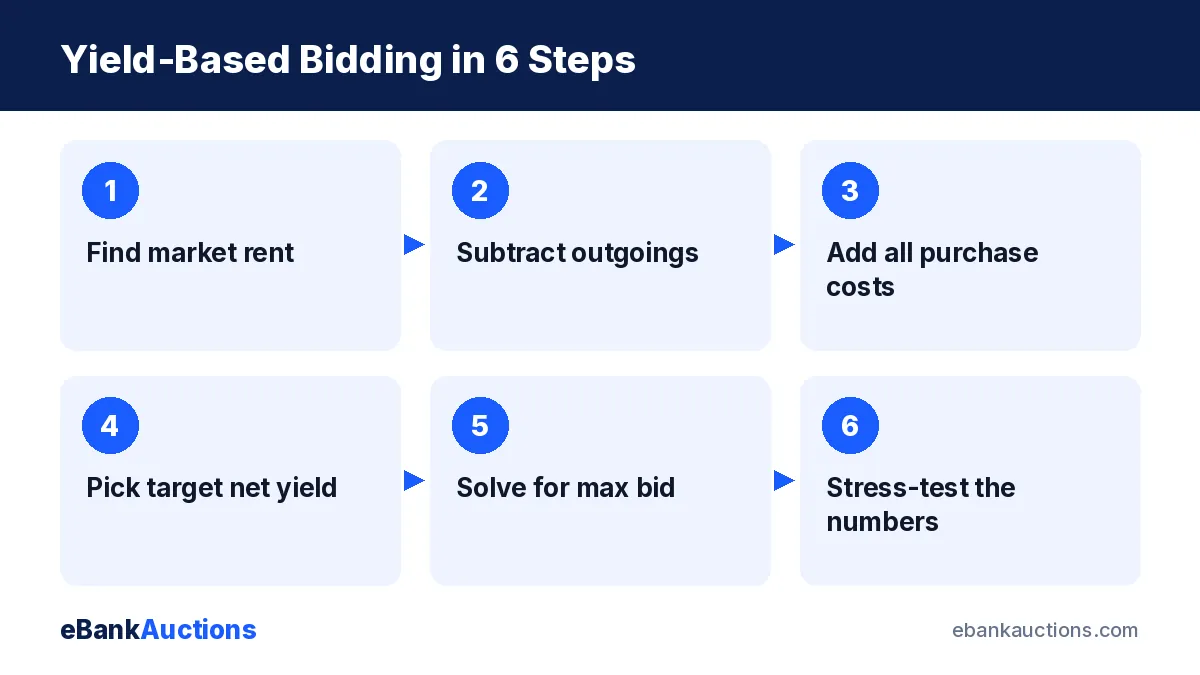
Formula 5: Maximum bid from a target yield
Maximum all-in cost = NOI ÷ Target net yield
Maximum bid = Maximum all-in cost − (Stamp duty + registration + dues + repairs + fees)
If you want a 7.5% net rental yield on the shop with NOI of ₹4.2 lakh, the maximum all-in cost is ₹56 lakh. If costs other than the bid total ₹7 lakh, your maximum bid is ₹49 lakh. If the reserve price is ₹55 lakh, this property does not meet your target, however cheap it looks compared with nearby asking prices.
Formula 6: Cash-on-cash return with a loan
If you use a loan, your return on the cash you invest is what matters.
Cash-on-cash return = (NOI − Annual interest) ÷ Your own cash invested × 100
Suppose you fund ₹30 lakh of the shop with a loan at 10% interest (₹3 lakh a year) and invest ₹37 lakh of your own. With NOI of ₹4.2 lakh, the pre-tax cash return is about ₹1.2 lakh, or 3.2% on your cash. Borrowing magnifies returns only when the property’s net yield exceeds the loan interest rate. Many commercial loans cost more than net yields, so leverage can actually reduce your cash-on-cash return. Read our commercial auction loan guide.
Indicative yields by asset type
| Asset | Typical gross rental yield (indicative) | Notes |
|---|---|---|
| Residential flat | 2–3.5% | Low yield, appreciation-led |
| Retail shop (ground floor) | 6–9% | Location-sensitive |
| Office unit | 6–8.5% | Building quality matters |
| Warehouse | 7–9% | Access and land use critical |
| Industrial shed | 7–10% | Tenant concentration risk |
These are broad ranges that vary by city and micro-market. Always use local broker data for your calculation.
Taxes and their effect on yield
Rental income for individuals is taxed under “income from house property”: municipal taxes paid are deducted, then a 30% standard deduction applies, and interest on borrowed capital may be deducted as per the rules. Commercial rent may also attract GST if your turnover crosses the registration threshold. After-tax yield depends on your tax slab and structure. See our guide on auction property tax and the Income Tax Department website for current rules.
Stress-testing your rental yield
Before bidding, test your numbers against realistic bad cases:
- Longer vacancy: what if it takes six months to find a tenant?
- Lower rent: what if rent is 10–15% below the broker’s estimate?
- Higher repairs: what if the roof or services need replacement?
- Higher interest: what if loan rates rise by 1%?
If your net rental yield stays acceptable in these scenarios, the property is robust. If it collapses, lower your bid or skip the auction.
Where to find reliable rent data
Your rental yield is only as good as your rent estimate. Build it from several sources:
- Local brokers: ask at least two for recent actual deals, not asking rents.
- Online listings: note asking rents for comparable units, then discount by 10–15% for negotiation.
- Existing tenants: in the same building or street, polite questions can reveal real rents.
- Lease registrations: in some states, registered lease details are searchable and show real rents.
- Facility managers: in office complexes, they often know recent transactions.
Adjust for differences in floor, frontage, size, condition and parking. A corner ground-floor shop and an interior first-floor shop in the same building can differ by 50% or more in rent.
Common mistakes in rental yield calculations
- Using asking rent: asking rents are optimistic; use achievable rent.
- Ignoring vacancy: even good properties are empty between tenants.
- Dividing by the bid, not all-in cost: stamp duty, repairs and dues are real money.
- Forgetting maintenance and tax: owner-paid costs can take 10–25% of rent.
- Assuming the existing lease will be renewed at a higher rent: plan for the lease you have.
- Mixing gross and net figures: compare like with like.
Fixing these mistakes often lowers the apparent rental yield by one to three percentage points. Better to discover that before bidding than after.
Rental yield on residential auction property
Residential property rarely earns high yields in India, but buyers still use yield to judge value. A flat bought at auction 20% below market with a gross rental yield of 3.5% may still be a good buy if the locality is growing. Residential outgoings include society maintenance, property tax and repairs, and vacancy between tenants is common. For many buyers, the real reason to buy a residential auction property is a combination of modest rental yield today and appreciation over time, or eventual own use.
Improving rental yield after purchase
Once you own the property, you can lift your rental yield in several ways:
- Refurbish smartly: fresh paint, good lighting, clean washrooms and a working air-conditioner often justify higher rent.
- Target the right tenant: a pharmacy or bank pays more for a ground-floor corner than a small trader.
- Negotiate escalations: build 5–15% increases into leases at fixed intervals.
- Shift outgoings to tenants: in commercial leases, tenants often pay maintenance and utilities.
- Reduce vacancy: start marketing before the current lease ends.
- Cut costs: energy-efficient lighting and pumps reduce common area charges.
Yield compression and capital gains
When a property’s rent rises or the market’s required yield falls, its value increases. Investors call this yield compression. Suppose you buy a shop earning ₹5 lakh net a year for ₹70 lakh, a 7.1% net rental yield. Three years later, with escalations, net rent is ₹5.75 lakh. If buyers in that market accept a 6.5% yield, the shop is worth about ₹88 lakh. Your gain comes from both rising rent and lower required yield. Buying at an auction discount gives you a head start on both.
Using rental yield to compare auctions with other investments
It is useful to compare the net rental yield of an auction property with alternatives such as fixed deposits, debt funds or listed REITs. Property yields should be higher to compensate for illiquidity, management effort and concentration risk. If a commercial auction property offers a net rental yield no better than a safe deposit, the case rests entirely on appreciation, and you should be sure about the location’s growth before bidding.
Building a simple spreadsheet for auction decisions
You do not need specialist software. A one-page spreadsheet with the following rows will handle most decisions:
- Expected winning bid.
- Stamp duty and registration (use your state’s rates).
- Pending dues stated in the notice or collected from the local body and association.
- Repairs and refurbishment estimate.
- Legal, valuation, survey and brokerage costs.
- All-in cost (sum of the above).
- Achievable monthly rent and annual rent.
- Owner-paid property tax, maintenance, insurance and repairs reserve.
- Vacancy allowance in months.
- Net operating income.
- Net return on all-in cost.
- Loan amount, interest rate and annual interest.
- Own cash invested and cash-on-cash return.
Create one column per listing. Change the bid in row 1 until the net return in row 11 reaches your target; that bid is your ceiling. Keep the sheet after the auction—the actual winning prices you record become valuable market data.
Ten-year view: income plus growth
Short-term income is only part of the picture. Consider two purchases held for ten years, each bought at an auction discount of 15% to market:
| Item | Ground-floor shop | Two-bedroom flat |
|---|---|---|
| All-in cost | ₹70 lakh | ₹60 lakh |
| Year-1 net income | ₹5.0 lakh | ₹1.3 lakh |
| Income growth per year (assumed) | 5% | 5% |
| Value growth per year (assumed) | 5% | 6% |
| Total net income over 10 years (approx.) | ₹63 lakh | ₹16 lakh |
| Value after 10 years (approx.) | ₹1.14 crore | ₹1.07 crore |
These are illustrative assumptions, not forecasts, but they show why commercial investors focus on income while home buyers focus on value growth and own use. Your own assumptions should come from local data and a realistic view of the market.
Special situations
Pre-leased units
When a unit is already leased, use the actual lease terms for the first years and your market assumptions after expiry. A strong tenant on a long lease justifies a lower required return because the income is more certain. Read our pre-leased property auction guide.
Units needing heavy refurbishment
If a unit needs major work, include the full refurbishment cost in all-in cost and add the months of work to your vacancy allowance. The payoff is often a higher rent than the building’s average.
Mixed-use buildings
For a building with shops and offices, calculate income separately for each use, because rents, vacancy and outgoings differ. Then add them for a combined figure.
Questions to ask before trusting any income figure
Before you rely on a number from a broker, a seller or even a sale notice, ask a few questions. Is the rent quoted per month or per year, and on carpet or super built-up area? Does it include maintenance, parking or GST? When was the last deal at this level, and for what kind of tenant? Is there a rent-free period or fit-out contribution hidden in the deal? How long did the unit stay empty before that lease? Honest answers to these questions often reduce the headline figure, and that is exactly why you should ask them.
Reading the market cycle
Returns also depend on timing. When many offices or shops in an area are vacant, rents stagnate and tenants negotiate hard. When vacancy is low, rents rise and landlords have leverage. Ask brokers about current vacancy in the micro-market and how it has changed over the last two years. Buying at auction when vacancy is high can be a smart contrarian move, but only if you can afford a longer wait for a tenant.
Rental yield vs capital appreciation
Yield is only part of the return. Residential property in India often has low yields but can appreciate over time, especially in growing localities. Commercial property usually offers higher yields with moderate appreciation. Your total return is roughly yield plus appreciation minus costs. Buying at auction improves both components: a lower price raises yield and leaves room for appreciation.
Worked example: comparing three auction listings
| Listing | All-in cost | Annual rent | Outgoings | NOI | Net yield |
|---|---|---|---|---|---|
| Shop, Pune | ₹72 lakh | ₹6.0 lakh | ₹0.7 lakh | ₹5.3 lakh | 7.4% |
| Office, Kochi | ₹95 lakh | ₹7.8 lakh | ₹1.6 lakh | ₹6.2 lakh | 6.5% |
| Flat, Chennai | ₹58 lakh | ₹1.8 lakh | ₹0.5 lakh | ₹1.3 lakh | 2.2% |
The shop offers the best net rental yield. The flat offers little income but may suit a buyer planning to live there later or betting on appreciation. The office sits in between; its value depends heavily on the building’s occupancy.
Frequently asked questions
What is a good rental yield for auction property in India?
For commercial property, net yields of 7% or more are generally considered attractive; for residential, even 3% is good in many cities. Compare with your cost of funds and risk.
How often should I recalculate returns after buying?
Review your numbers once a year, and whenever a lease is renewed, a tenant leaves or a major repair is needed. Tracking actual income and costs against your original plan improves your next auction decision.
Should I use the reserve price or my bid to calculate yield?
Use your expected all-in cost, which includes the winning bid and all purchase costs. The reserve price is only the starting point.
Does rental yield include appreciation?
No. Yield measures income only. Consider appreciation separately.
Is a higher gross figure always better?
Not necessarily. A very high gross return can signal risks such as a weak tenant, a short lease, a poor building or a declining area. Always check the reason behind unusually high numbers.
How can I improve rental yield after buying?
Refurbish to attract better tenants, lease professionally with escalations, reduce operating costs and minimise vacancy.
Conclusion
Rental yield turns an auction listing into an investment decision. Calculate gross yield for quick comparison, but base your bid on net rental yield using all-in cost and realistic outgoings. Stress-test the numbers and remember that borrowing helps only when yield exceeds interest. Browse commercial property auctions on eBankAuctions and read our bank auction shops guide to find your next income-producing asset.