A sale certificate is the document that makes you the legal owner of a property bought in a bank auction. Once you pay the full bid amount, the bank’s authorised officer issues a sale certificate in your favour, describing the property and confirming the sale under the SARFAESI Act.
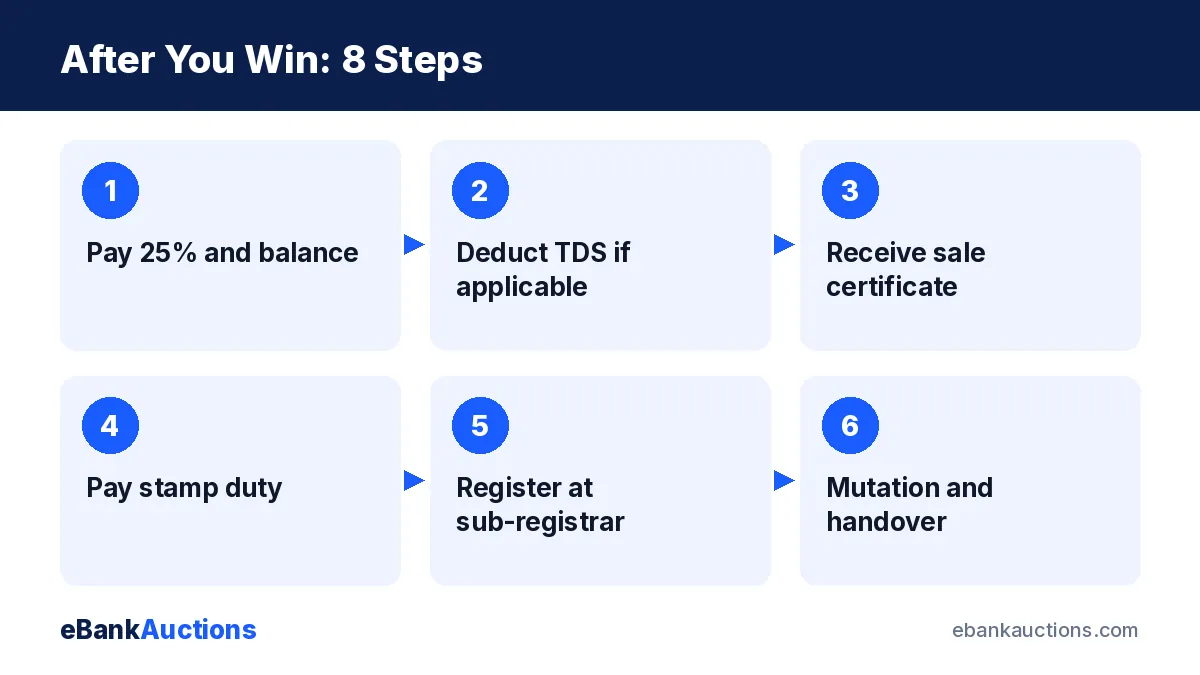
But the story does not end there. The sale certificate must usually be registered with the sub-registrar, stamp duty must be paid, TDS may have to be deducted, and revenue and municipal records must be updated. Miss a step and you may struggle to sell, mortgage or even prove ownership later. This guide explains the eight simple steps that follow a winning bid, with practical tips from buyers who have been through the process.
What is a sale certificate?
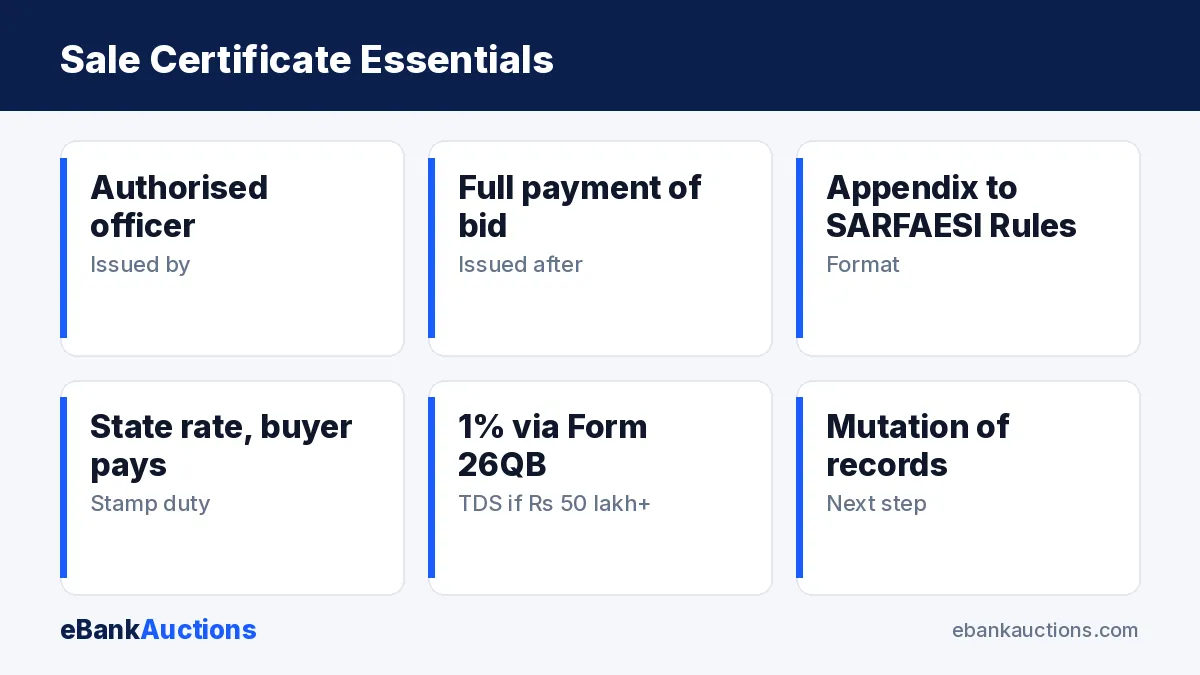
Under the Security Interest (Enforcement) Rules, 2002, the authorised officer who sells a secured immovable asset must issue a certificate of sale to the purchaser after receiving the full price. The format is prescribed in an appendix to the rules. The sale certificate names the buyer, describes the property with its boundaries and survey details, states the sale price and records that the property is sold free from the bank’s encumbrance, subject to any encumbrances specified.
In simple terms, the sale certificate plays the role that a sale deed plays in a private purchase. It is your title document. That is why it must be accurate, stamped and, in most cases, registered.
Who signs it?
The authorised officer of the bank signs the sale certificate. The borrower does not sign, because the transfer happens under the bank’s statutory power of sale under the SARFAESI Act, 2002.
Step 1: Pay the purchase price on time
The sale certificate is issued only after full payment. The usual schedule is:
- 25% of the bid amount, including the EMD already paid, immediately or by the next working day.
- The remaining 75% within 15 days of confirmation of sale, unless the bank agrees in writing to a longer period (up to three months).
Pay only into the account specified by the authorised officer, keep the UTR numbers and ask for receipts. If you are taking a loan, coordinate with your lender early. Our auction property loan guide explains how to meet these timelines.
Step 2: Deduct TDS if the price is ₹50 lakh or more
Under section 194-IA of the Income-tax Act, a buyer of immovable property (other than agricultural land) must deduct 1% TDS when the consideration is ₹50 lakh or more. In a bank auction, the seller is technically the borrower, whose property is being sold by the bank, so the PAN details used for Form 26QB need care. Ask the authorised officer which PAN to use and how the bank wants the TDS handled. Deposit the TDS using Form 26QB on the Income Tax e-filing portal and download Form 16B for the records. Read our detailed guide on TDS on auction property.
Step 3: Receive and check the sale certificate
When the bank issues the sale certificate, read it carefully before you leave the branch. Check:
- Your name exactly as on your PAN and ID.
- Property description, survey or plot number, extent and boundaries matching the sale notice.
- Sale price and date of sale.
- Encumbrances, if any, that remain.
- Signature and seal of the authorised officer.
Errors are easier to fix now than after registration. If you bought jointly, both names must appear as intended.
Step 4: Understand the stamp duty rules in your state
Stamp duty is a state subject, so rates and rules differ. In most states, stamp duty is payable on the sale certificate on the higher of the sale price or the government guideline or ready-reckoner value. Some states also have concessions for women buyers. Registration fees are charged separately, often around 1% of value, sometimes capped.
There has been legal debate over whether a sale certificate in a court or bank auction must be registered at all, because under the Registration Act a certificate of sale granted by a civil or revenue officer is exempt from compulsory registration in some cases.
However, for SARFAESI sales, most states and banks require the sale certificate to be registered and stamped, and lenders and future buyers expect a registered document. The safe practice is to pay stamp duty and register it. Ask your advocate about the rule in your state.
Step 5: Pay stamp duty and book a registration slot
Most states now allow online payment of stamp duty through e-stamping or the registration department’s portal. You will need the property details, the sale price and the valuation. Many states also let you book a registration appointment online. Keep the payment receipt and challan numbers ready for the sub-registrar.
Step 6: Register the sale certificate
Registration usually happens at the sub-registrar office with jurisdiction over the property. The authorised officer or a bank representative may need to be present, or the bank may send the sale certificate for registration under a covering letter. Procedures vary by state, so confirm in advance.
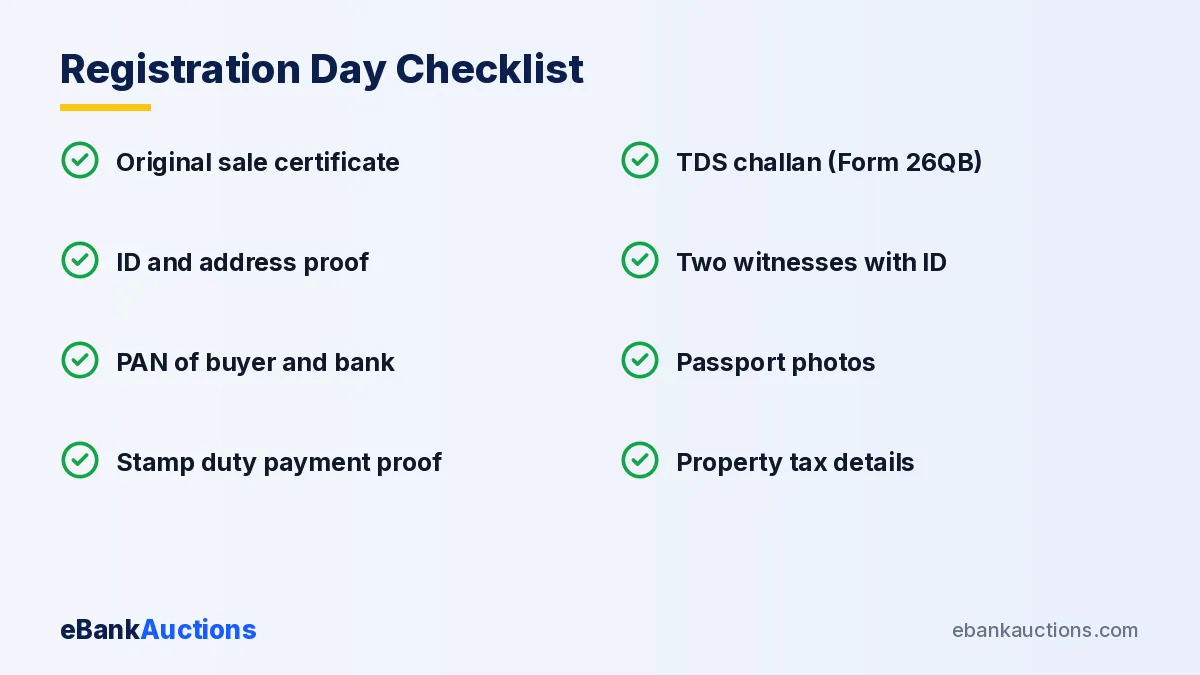
On registration day, carry:
- The original sale certificate.
- Your photo ID, address proof and PAN.
- Stamp duty and registration fee receipts.
- TDS challan and Form 16B, if applicable.
- Two witnesses with ID.
- Passport-size photographs.
After registration, the sub-registrar returns the registered sale certificate, usually the same day or within a few days.
Step 7: Mutate municipal and revenue records
Registration makes you the owner in law, but local records still show the previous owner. Apply for mutation:
- Property tax: at the municipal corporation, municipality or panchayat, to transfer the tax account.
- Revenue records: at the village or tahsil office for land records such as patta, khata, 7/12 extract or thandaper, depending on the state.
- Society: for flats, apply to the housing society for transfer of share certificate and membership.
Mutation proves your ownership in government records and is essential for future sale, loans and building permits. Some local bodies require all arrears to be cleared first.
Step 8: Take possession and transfer utilities
If the bank holds physical possession, it hands over the keys with a possession letter or handover memo. If it held only symbolic possession, follow up on the plan for physical handover, as explained in our guide to symbolic vs physical possession. Then transfer the electricity connection, water connection and gas connection to your name. Keep copies of all applications.
Registration when you cannot be present
NRIs and buyers living in another city often cannot attend the sub-registrar office. In that case, execute a power of attorney in favour of a trusted person. If you are abroad, the POA is usually signed before an Indian consular officer or notarised and apostilled, and then adjudicated for stamp duty in India within the time allowed by state law. Your advocate should draft the POA so that it clearly authorises the holder to receive the certificate, pay duties, present it for registration and apply for mutation. Read our NRI bank auction guide for the full process.
Joint ownership and nominees
If you want joint ownership with a spouse or family member, register on the auction portal jointly where the notice permits, because the certificate is issued in the name of the successful bidder. Adding a name later usually means a fresh transfer with fresh stamp duty. Decide ownership shares at the start and mention them if the bank’s format allows. For flats in housing societies, you can also file a nomination with the society after transfer.
What your lender needs after registration
If a loan funded part of the price, your lender will ask for:
- The original registered certificate for deposit as security.
- Stamp duty and registration receipts.
- An updated encumbrance certificate showing the registration.
- Mutation or application acknowledgements.
- Society NOC or transfer letter for flats.
- Property insurance naming the lender, where required.
Delivering these quickly avoids reminders and penal charges, and keeps your loan file clean for a future balance transfer.
Transferring a flat’s society membership
For apartments, the housing society must transfer the share certificate and membership to you. The usual steps are an application in the society’s format, a copy of the registered document, payment of the transfer fee as per bye-laws, and clearance of any dues that the notice placed on the buyer. Some societies ask for an indemnity or declaration. Cooperative housing societies cannot refuse transfer without valid reasons, but they can insist that arrears are settled. Start this process on the day you register.
Updating the encumbrance certificate
About a week after registration, apply for a fresh encumbrance certificate. It should now show the registration of your document. This EC, along with the old one covering 30 years, becomes the basis for any future loan or sale. Check that the entry shows your name, the property details and the document number correctly.
Costs involved after winning
| Item | Typical range | Paid to |
|---|---|---|
| Stamp duty | Varies by state, often 5–7% | State government |
| Registration fee | Often about 1% | Sub-registrar |
| TDS (if ₹50 lakh+) | 1% of price | Income Tax Department |
| Mutation fee | Nominal | Local body / revenue office |
| Society transfer fee | As per bye-laws | Housing society |
| Advocate fee | Varies | Your advocate |
| Utility transfer | Nominal | Service providers |
Common problems and how to solve them
Name spelled differently
If your name on the sale certificate differs from your ID, ask the bank to issue a corrected certificate before registration. Otherwise you may need an affidavit and a rectification later.
Wrong survey number or extent
Compare the sale certificate with the notice and title deeds. If there is a mistake, get it corrected in writing by the bank. Do not register an inaccurate document.
Bank delays issuing the sale certificate
Once full payment is made, the certificate should be issued without undue delay. Write to the authorised officer with payment proof and request a date. If delay continues, escalate to the regional office.
Sub-registrar objects to valuation
If the sub-registrar values the property higher than the sale price, stamp duty may be charged on the higher value. Some states allow an appeal. Budget for this possibility.
Why buyers must not skip registration
Some buyers delay registration to save money. This is risky. An unregistered sale certificate can be questioned, may not be accepted by lenders, and can make resale difficult. It may also expose you to penalties under the stamp law. Registration also creates public notice of your ownership, which protects you against fraudulent transactions by others. Treat registration of the sale certificate as part of the purchase price.
Mistakes to avoid after the auction
- Paying the balance late: the certificate cannot be issued, and the deposit may be forfeited.
- Using the wrong PAN in Form 26QB: correcting a TDS return is tedious; confirm details with the bank first.
- Not checking the draft: once registered, errors need a rectification deed and fresh fees.
- Skipping mutation: tax bills keep coming in the old owner’s name and future sales get delayed.
- Losing receipts: you will need them for capital gains calculations when you sell.
When a court auction is involved instead
Not every auction is a SARFAESI sale. Properties sold through a Debts Recovery Tribunal recovery officer or a civil court follow different procedures, and the certificate is issued by that officer after the sale is confirmed. The practical steps for stamp duty, registration and mutation are similar, but timelines for confirmation can be longer because objections may be heard first. Our guide on the DRT auction process explains how these sales differ.
How the sale certificate affects capital gains later
When you eventually sell the property, your cost of acquisition is the price you paid in the auction plus stamp duty, registration charges and certain improvement costs. The date on the registered sale certificate generally marks the start of your holding period. Keep invoices for major renovation work so you can include them in the cost of improvement. Good record-keeping today can reduce tax on a future sale.
Documents to preserve forever
Keep a permanent file with:
- Sale notice and terms and conditions of sale.
- EMD receipt and all payment receipts.
- Confirmation of sale letter.
- Registered sale certificate.
- Stamp duty and registration receipts.
- TDS challan and Form 16B.
- Mutation orders and new tax receipts.
- Possession letter and utility transfer letters.
- Copies of old title deeds given by the bank.
How long the whole process takes
From the auction date, most buyers complete payment within 15 days, receive the sale certificate within a week or two after that, and register it within the following few weeks. Mutation can take anywhere from two weeks to a few months depending on the local office. With physical possession, you can often move in within 30 to 60 days of the auction.
Worked example
Meera wins a flat in Bengaluru at ₹72 lakh. She pays 25% the next day and the balance through a home loan on day 13. Because the price exceeds ₹50 lakh, she deducts ₹72,000 TDS and files Form 26QB. The bank issues the sale certificate on day 20. She pays stamp duty and registration charges online, books a slot and registers the certificate on day 27 with the bank’s representative present. She applies for khata transfer and society membership the next week and gets the keys the same day she registers. Two months later, her khata is in her name and her lender holds the original registered sale certificate.
Frequently asked questions
Is a sale certificate the same as a sale deed?
Functionally, yes. It is the title document for an auction purchase. The difference is that it is issued by the bank’s authorised officer under statutory power rather than signed by the owner.
Can I get a loan against a property with only a sale certificate?
Yes, once it is registered and mutation is in process. Lenders treat the registered sale certificate as the title document.
Who pays stamp duty on the sale certificate?
The buyer pays stamp duty and registration charges unless the sale terms say otherwise.
What if I lose the original sale certificate?
Obtain a certified copy from the sub-registrar office where it is registered and file a police report. Registration is another reason not to skip this step.
How soon should I register after the bank issues it?
As soon as possible. State stamp laws set time limits for presenting documents for registration and for paying duty without penalty. Registering within a few weeks also protects you against any competing claim and lets your lender complete its security.
Can the bank refuse to attend registration?
Procedures differ, but banks are generally cooperative because the sale is complete only when the buyer’s title is secure. If a representative must attend, fix a date with the authorised officer in writing and share the stamp duty receipts beforehand.
Do I need the borrower’s signature?
No. The sale is made by the bank under its statutory power, so the borrower’s signature is not required.
Conclusion
Winning the auction is only half the journey. The sale certificate, once stamped and registered and followed by mutation, turns your winning bid into secure ownership. Follow the eight steps above, keep every receipt, and do not skip registration to save a little money. Explore more guides in our bank auction basics section and browse live bank auctions on eBankAuctions.