Bank auction villas and independent houses offer something apartments cannot: your own land, your own roof and complete control over how the home looks and grows. For buyers who want space, bank auction villas can be one of the most rewarding purchases in the auction market, because banks often price them conservatively and fewer buyers have the confidence to evaluate them. That lower competition is exactly why you need a sharper checklist.

A villa comes with land title, boundaries, construction approvals and maintenance issues that a flat buyer never faces. This guide gives you 11 expert tips to evaluate, bid on and complete the purchase of bank auction villas across India.
Why bank auction villas can be good value
When a borrower defaults on a home loan or a loan against property, the bank enforces its security under the SARFAESI Act, 2002 and sells the house through a public e-auction. Independent houses tend to be valued conservatively because valuers must account for land, building depreciation and repair needs. The result is a reserve price that can be meaningfully below what a comparable house would fetch in a private sale.
There are other reasons bank auction villas can be attractive:
- Land appreciation: the land component usually appreciates faster than a flat’s undivided share.
- Flexibility: you can extend, renovate or rebuild within local building rules.
- Lower competition: investors often prefer flats, so fewer serious bidders compete for houses.
- Rental or mixed use: in some areas a ground floor can be rented while you live above.
Who should consider them
Families wanting space and privacy, buyers planning to rebuild in a good location, and investors comfortable with land due diligence are natural buyers of bank auction villas. First-time buyers can succeed too, provided they take professional help for the land and structure.
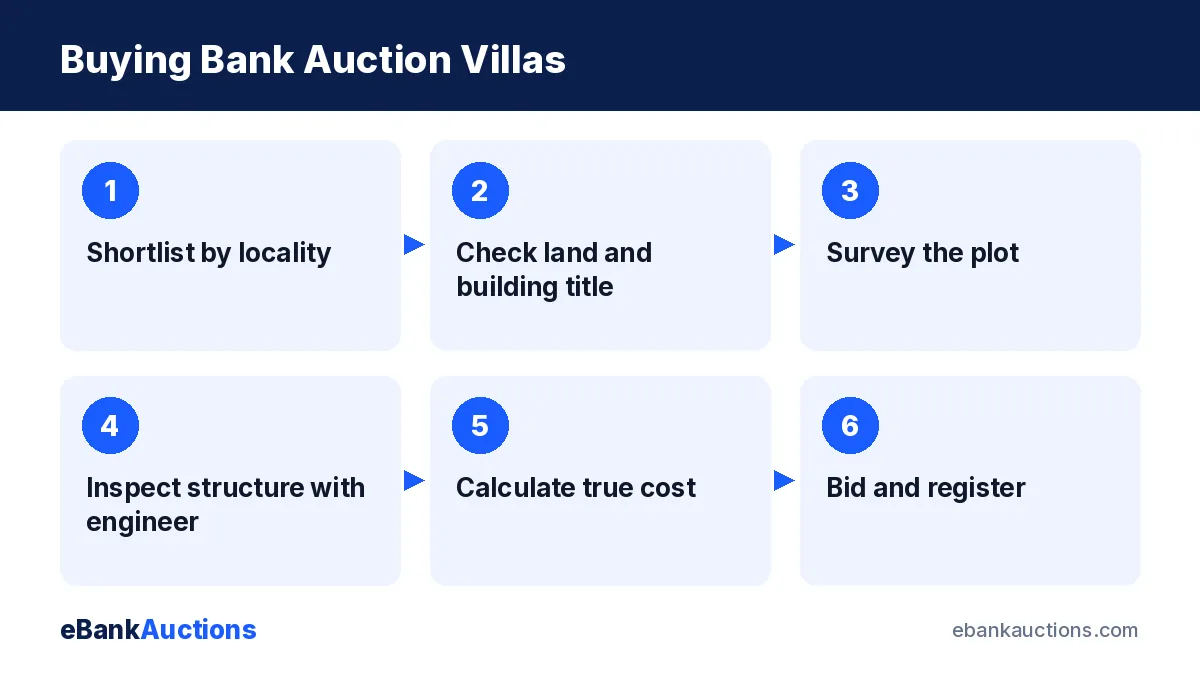
Tip 1: Start with the locality, not the building
A house can be repaired; a bad location cannot be fixed. Shortlist neighbourhoods first based on access roads, water availability, flooding history, schools and distance to work. Then look at listings in those areas. On eBankAuctions you can filter residential bank auctions by state and city and save interesting bank auction villas to compare.
Tip 2: Understand exactly what is being sold
Read the sale notice carefully. It should describe the land by survey number, plot number or door number, give its extent in cents, square feet or square metres, and list the boundaries on all four sides. It should also describe the building, including the number of floors and built-up area. If the notice describes only the land, ask whether the building is included and whether it is approved.
Tip 3: Verify land title more deeply than for a flat
With bank auction villas, you are buying land, and land title in India can be complex. Your advocate should:
- Trace the chain of title back at least 30 years.
- Check revenue records such as the record of rights, patta, khata or thandaper, depending on the state.
- Confirm mutation entries show the borrower as owner.
- Look for inheritance issues, partition deeds and power-of-attorney transfers.
- Obtain an encumbrance certificate for the full period.
Our land title verification guide explains each record in detail.
Tip 4: Get the plot surveyed
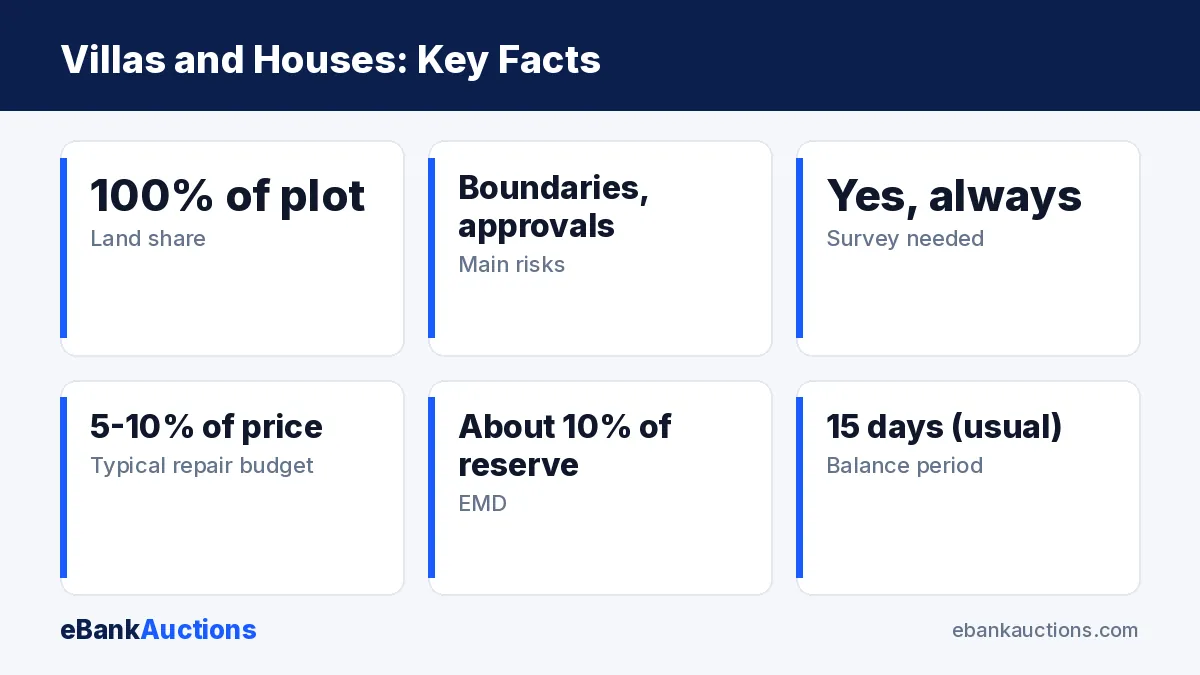
Boundaries on paper and on the ground often differ. A licensed surveyor can measure the plot, compare it with survey records and the notice, and identify encroachments by neighbours or onto public land. This is especially important for older bank auction villas where compound walls were built decades ago. Read our guide to a land survey before bidding.
Tip 5: Check building approvals and deviations
Ask whether the house has an approved building permit and plan from the local body, and whether a completion or occupancy certificate was issued. Many independent houses in India have additional floors or extensions built without approval. Minor deviations may be regularised by paying a fee under state schemes; major ones may be difficult. Unauthorised construction also affects loans and future resale of bank auction villas.
Tip 6: Inspect the structure with an engineer
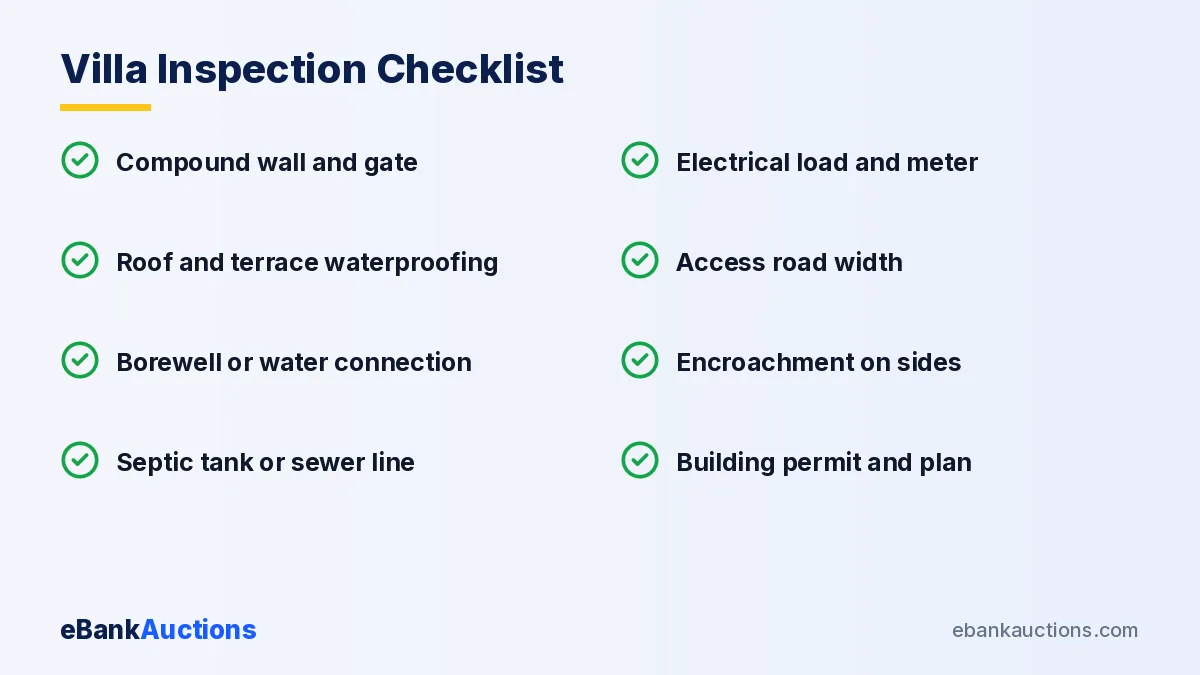
Independent houses need more maintenance than flats because the owner is responsible for everything. Bring a civil engineer during the inspection window and check:
- Foundation cracks, settlement and dampness at plinth level.
- Roof slab leakage, terrace waterproofing and parapet condition.
- Plumbing, overhead tank, sump and borewell.
- Septic tank or sewer connection.
- Electrical wiring age, earthing and sanctioned load.
- Termite damage in doors, windows and wooden ceilings.
Budget 5–10% of the price for repairs in older houses; more if the roof or plumbing needs replacement.
Tip 7: Confirm possession and occupants
Possession matters even more for bank auction villas, because families often continue living in independent houses long after default. Check whether the bank has symbolic or physical possession, visit at different times, and speak to neighbours. If someone is in occupation, read our explainer on symbolic vs physical possession before you bid.
Tip 8: Collect dues and utility records
Get property tax receipts, water connection bills and electricity bills. Houses often have tax arrears because owners in financial trouble stop paying local taxes first. Some notices put these dues on the buyer. Also check whether the water supply is municipal or from a borewell, and whether any borewell has the permissions your state requires.
Tip 9: Plan your finance around land and building
Lenders value bank auction villas as land plus depreciated building. If the building is old, the loan may be based mainly on land value, which can mean a lower loan amount than you expect. Share the notice with your lender early and read our auction property loan guide to understand eligibility and timelines.
Tip 10: Set a disciplined bidding limit
Calculate the total cost: expected winning bid, stamp duty and registration, dues, repairs, legal and survey fees, and a contingency. Compare this with recent sale prices of similar houses in the same area, and with the cost of buying a plot and building fresh. If buying and renovating is still clearly cheaper, bid up to your limit and stop there.
Tip 11: Complete registration and mutation promptly
After full payment the bank issues a sale certificate. Register it with the sub-registrar, pay stamp duty, and then apply to the local body and revenue office to mutate the property tax and land records into your name. Transfer electricity and water connections. For bank auction villas, mutation in revenue records is particularly important because it establishes your ownership for future transactions. Our guide to sale certificate registration walks through the process.
How banks value bank auction villas
The valuer appointed by the bank looks at two components: land and building. Land is valued using recent sale instances, government guideline values and the plot’s frontage, shape and road access. The building is valued at replacement cost minus depreciation for age and condition. The sum gives a fair market value, and a lower realisable value reflects a forced sale. The reserve price of bank auction villas is usually set with reference to these figures.
This method explains why older houses in prime localities can look cheap at auction: the valuer gives little credit to an old building, while you might see value in renovating it. It also explains why new houses in weak locations may not be bargains at all. Do your own comparison using both land rates and building condition before you decide.
Quick valuation check you can do yourself
- Find the current land rate per cent or per square foot from two local brokers.
- Multiply by the plot area to get the land value.
- Estimate the building value: construction cost per square foot today, multiplied by built-up area, reduced by about 1–1.5% for each year of age.
- Add both and compare with the reserve price and your bidding limit.
Mistakes buyers make with bank auction villas
- Relying on the notice’s area figure without a survey.
- Assuming a compound wall marks the legal boundary.
- Ignoring an unapproved upper floor that the lender later refuses to value.
- Underestimating repairs because the inspection was only external.
- Forgetting mutation in revenue records after registration.
- Bidding emotionally because “land never loses value”.
Each of these mistakes is avoidable with the tips above. Buyers who treat bank auction villas as a land purchase first and a house purchase second usually make the best decisions.
Independent house vs flat at auction
| Factor | Bank auction villas / houses | Bank auction flats |
|---|---|---|
| Ownership | Land plus building | Undivided share plus flat |
| Due diligence | Deeper: land records, survey | Society, OC, title |
| Maintenance | Owner bears all | Shared through society |
| Appreciation | Land-driven, often stronger | Building-driven |
| Competition | Often lower | Often higher |
| Renovation freedom | High, within rules | Limited |
Typical problems and how to handle them
Encroachment by neighbours
If a neighbour’s wall sits on your side of the boundary, resolve it before bidding by asking the bank to clarify, or factor legal costs into your bid. After purchase, a survey and a joint inspection by revenue officials may be needed.
Unapproved additional floor
Check your state’s regularisation scheme. If the floor can be regularised, add the fee to your cost. If not, you may have to use it without formal recognition or demolish it, which affects value.
Old building needing reconstruction
Sometimes the building is so old that rebuilding makes more sense. In that case, value the property as a plot, subtract demolition cost, and bid accordingly. Such bank auction villas can be excellent opportunities for buyers who planned to build anyway.
Shared access or pathway disputes
Houses inside narrow lanes may depend on a common pathway. Confirm that the access is recorded in the title documents or in a registered easement, not just used by custom.
Gated-community villas vs standalone houses
Not all bank auction villas are the same. A villa inside a gated community behaves partly like an apartment: there is an owners’ association, shared amenities, monthly maintenance and common rules. A standalone house on its own street is fully independent. Each needs a slightly different approach.
Villas in gated communities
- Ask the association for a written statement of maintenance dues, sinking fund contributions and any special levies.
- Check whether the association requires an approval or transfer fee for a new owner.
- Confirm that the villa’s plot is individually demarcated and registered, not just a share of common land.
- Review the developer’s approvals for the layout, roads and amenities.
Standalone houses
- Focus on land records, road access and boundary survey.
- Check drainage and flooding during the monsoon by speaking to neighbours.
- Verify whether the road in front is a public road or a private pathway.
- Look at nearby construction activity, which can signal rising land values.
Renovation planning after you win
Many buyers of bank auction villas plan significant work: new flooring, kitchen upgrades, waterproofing, rewiring or an extra floor. Good planning keeps costs under control.
- Get two or three contractor quotes based on the engineer’s inspection notes.
- Prioritise safety and structure first: roof, wiring, plumbing, then finishes.
- Apply for building permits if you are adding area or changing the structure.
- Keep bills and photographs; they support future valuation and resale.
- Update the property tax record if the built-up area changes.
A renovated independent house in a good locality can see its value rise well beyond the auction price, which is one of the strongest arguments for bank auction villas as an investment.
Rental and resale potential
Independent houses can earn rent from the whole building or from separate floors. In cities with demand from students, young professionals or small offices, a ground-floor unit plus an upper-floor home can generate steady income. Check local rules on commercial use in residential zones before renting to businesses.
For resale, buyers value clean documents, recent renovation, approved construction and good access roads. If you buy a house with minor deviations or missing records, fixing them during your ownership improves resale value. Keep a complete document file from the day you buy.
Documents to collect for bank auction villas
- Sale notice and terms and conditions of sale.
- Copies of all title deeds in the chain, and the mortgage documents.
- Encumbrance certificate for 30 years.
- Revenue records: record of rights, patta, khata or thandaper as applicable.
- Survey sketch or field measurement book extract.
- Building permit, approved plan, completion or occupancy certificate.
- Property tax, water and electricity receipts.
- Association dues statement for gated communities.
Regional notes
Land records and terminology differ by state. In Kerala, you will deal with thandaper, possession certificate and building tax; in Tamil Nadu, patta and chitta; in Karnataka, khata and RTC; in Maharashtra, 7/12 extract and property card. A local advocate who works in that district will know what to look for. Our Kerala bank auction houses guide covers one state in detail.
Worked example
A couple in Thrissur shortlist an eight-cent plot with a 2,000 sq ft two-storey house. The reserve price is ₹58 lakh. Nearby houses of similar size sell around ₹75 lakh. The engineer estimates ₹4 lakh for waterproofing and rewiring. Tax arrears are ₹60,000. Stamp duty and registration total about ₹6 lakh. They set a maximum bid of ₹63 lakh and win at ₹61.5 lakh. Their total cost is about ₹72 lakh, a saving of roughly ₹3 lakh against the market, plus a property they have fully inspected and verified. That is how disciplined buyers approach bank auction villas.
Frequently asked questions
Are bank auction villas harder to buy than flats?
They need more due diligence because you are buying land, but the process is the same. With a good advocate and surveyor, most buyers manage comfortably.
Can I get a loan for an old independent house?
Yes, though lenders may value the building low if it is old. The loan may be based largely on land value, so keep extra funds ready.
What if the house has no occupancy certificate?
Many older houses were built before such certificates were common. Check what the local body requires today, whether the house can be regularised, and whether your lender will finance it.
How do I know if the land extent is correct?
Compare three sources: the sale deed, the revenue records and a fresh survey by a licensed surveyor. If they differ, ask the bank which extent is being sold, and base your bid on the smallest verified figure.
Do bank auction villas in gated communities need association approval?
Some associations require new owners to register, pay a transfer fee and sign the community rules. It is not a veto over the auction, but ask for the requirements in advance so move-in is smooth.
Can I demolish and rebuild after buying?
Yes, subject to local building rules and permits. Many buyers purchase bank auction villas specifically for the land and plan a new construction.
Conclusion
Bank auction villas give you land, space and long-term value, often at a price below the private market. The extra effort lies in land title, surveys, approvals and structure. Follow these 11 tips, take professional help where it matters, and set a firm bidding limit. Browse current listings on eBankAuctions, read our auction property due diligence checklist, and subscribe to alerts so you see new houses in your area first.