The reserve price is the most visible number in any bank auction listing, and also one of the most misunderstood. Many buyers treat it as the price they will pay. Others assume it is automatically a bargain. In reality, it is simply the minimum at which the bank is willing to sell, fixed with reference to a valuation, and the final price is decided by competitive bidding. Understanding how the reserve price is set, why it changes between rounds and how to bid above it intelligently is what separates buyers who win good deals from those who either lose out or overpay.
This guide explains the reserve price from the bank’s side and yours, then gives nine smart strategies for auction day.
What is the reserve price?
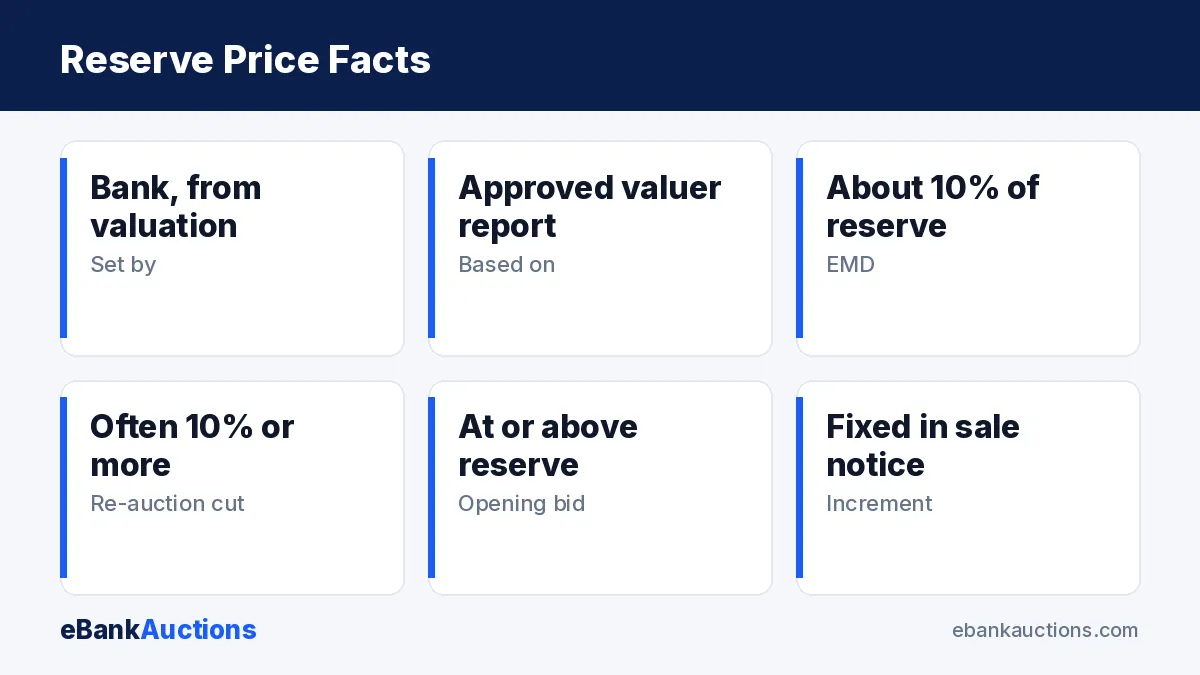
Under the Security Interest (Enforcement) Rules, 2002, the authorised officer must fix a reserve price before selling a secured asset, in consultation with the secured creditor and based on a valuation by an approved valuer. This figure is published in the sale notice along with the earnest money deposit (EMD) and the bid increment. No bid below it is accepted.
In most e-auctions, bidders must bid at least the reserve price, and each subsequent bid must exceed the current highest bid by the increment amount. The highest bid at the end of the auction, if at or above the reserve price, is declared successful subject to the bank’s confirmation.
Reserve price vs market value
The minimum price is not the market value. Valuers typically report a fair market value and a lower realisable or distress value that reflects a quick, as-is sale. Banks often fix the minimum near the realisable value to attract bidders. That is why many listings look cheaper than nearby resale asking prices. But some properties are priced close to the market, and some have problems that justify a steep discount. You must do your own comparison every time.
How banks fix the reserve price
The process usually follows these steps:
- The bank appoints an approved valuer who inspects the property, where possible, and prepares a report.
- The valuer considers recent sale instances, government guideline values, location, condition, age, legal status and marketability.
- The authorised officer fixes the reserve price with reference to this report and the bank’s recovery needs.
- The reserve price, EMD and increment are published in the sale notice, in newspapers and on portals such as BAANKNET.
Valuations are updated periodically. If the market moves or the property’s condition changes, a fresh valuation can raise or lower the next starting figure.
Why the reserve price drops in re-auctions
When no one bids, the bank must try again. For the next attempt, the authorised officer may lower the starting price, often by around 10% and sometimes more, to attract bidders. After several failed rounds, the cumulative drop can be substantial. The bank may also consider a sale by private treaty or through other methods permitted under the rules, but only after following due process.
For buyers, this creates two opportunities:
- Patience: track attractive properties that did not sell and bid in a later round when the reserve price is lower.
- Information: a property that failed several times is telling you something. Find out why before you bid.
You can save listings on eBankAuctions and watch for re-auctions of the same property.
Strategy 1: Know the real market value
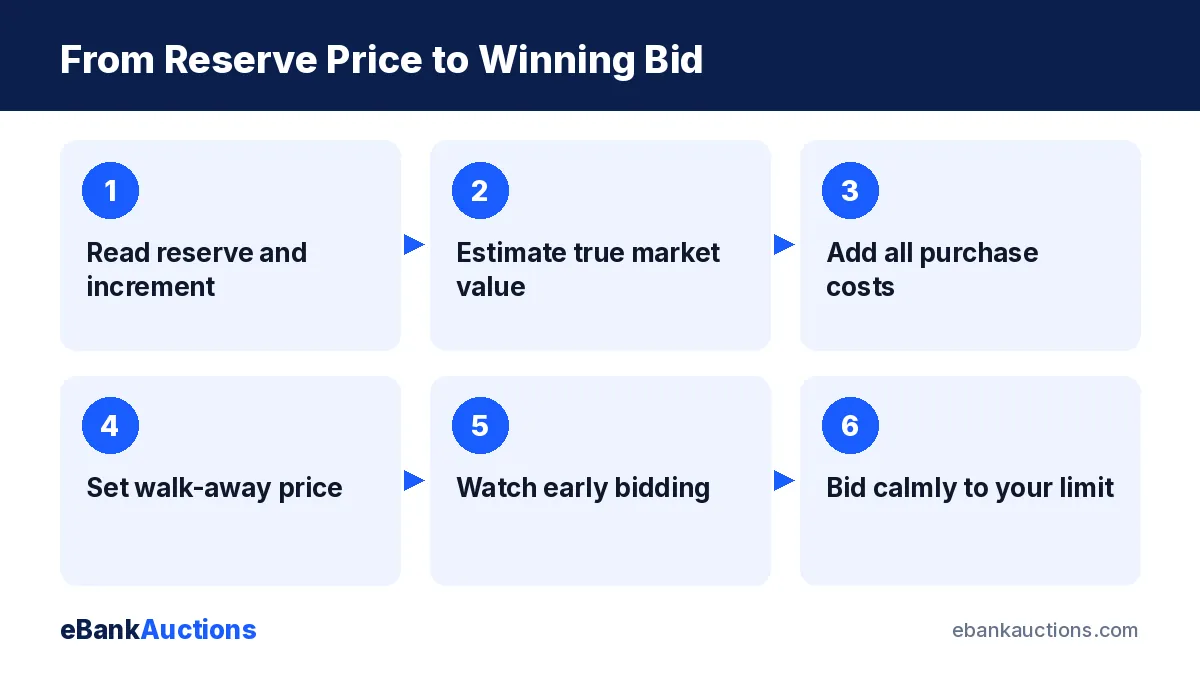
Before the auction, collect evidence of what similar properties actually sell for, not what sellers ask. Check recent registered sale values in the area if available, talk to at least two local brokers, and compare with government guideline values. Your estimate of market value is the anchor for every other decision. A starting price that is 20% below asking prices might be only 5% below real transaction prices.
Strategy 2: Add every cost to the reserve price
Your true cost is not the listed minimum or even your winning bid. Add:
- Stamp duty and registration fees.
- Pending property tax, society dues and utility arrears if payable by you.
- Repairs and renovation.
- Legal, survey and valuation fees.
- Rent and EMIs during any possession delay.
- A contingency of around 5%.
Only when these are added can you compare an auction property with a regular purchase. Our auction property due diligence checklist lists each item.
Strategy 3: Set a written walk-away price
Work backwards from market value: subtract total costs and your required discount for taking auction risk. The result is your walk-away price, the maximum you will bid. Write it down and keep it next to your screen on auction day. Buyers who skip this step often find themselves bidding far above the reserve price in the final minutes.
Strategy 4: Match your bid limit to your finance
Your walk-away price must also fit your funds. Check your loan sanction, the lender’s valuation and the loan-to-value cap. If the lender values the property below your bid, you must fund the difference yourself. Read our auction property loan guide for how lenders calculate eligibility.
Strategy 5: Understand the increment and extension rules
The sale notice specifies a bid increment, such as ₹10,000, ₹25,000 or ₹1 lakh. Many portals also have an auto-extension rule: if a bid is placed in the last few minutes, the auction extends by a set time, often five minutes. This continues until no new bid arrives within an extension. Knowing these rules helps you avoid panic. There is no benefit in rushing a bid in the final seconds, because the auction will extend anyway.
Strategy 6: Do not open with a jump bid unless you mean it
Some bidders place a large first bid well above the reserve price to discourage others. This can work when you know competition is thin and your walk-away price is high, but it also removes any chance of winning closer to the reserve price. In most cases, start at the reserve price or one increment above and let the market reveal itself.
Strategy 7: Watch the pace before committing
In the first part of the auction, observe. Are bids coming in quickly? Is the price rising in small increments or big jumps? Fast, frequent bids suggest several serious competitors. Slow, occasional bids suggest limited interest. Use this information to decide whether to bid steadily or wait.
Strategy 8: Bid in round, deliberate steps
Enter bids in exact multiples of the increment to avoid typing errors. Double-check each figure before submitting. A misplaced zero can commit you to a price you cannot pay, and bids are binding once placed.
Strategy 9: Stop at your limit, every time
The hardest strategy is the most important. When the bidding crosses your walk-away price, stop. Another auction will come. Properties re-appear, new listings are published every week, and a disciplined buyer always finds another opportunity. Overpaying turns a bank auction into an expensive purchase with extra risk.
How valuers arrive at the number
It helps to understand what the valuer actually does, because the valuation report is the foundation of every listing. A registered valuer visits the property, if access is available, and records its location, extent, construction, age and condition. The valuer then looks at comparable sales in the locality, the guideline value notified by the state, and factors that affect saleability, such as road access, legal status, occupancy and neighbourhood.
Most reports give at least two figures. The fair market value estimates what a willing buyer would pay a willing seller in a normal transaction. The realisable value, sometimes called distress or forced-sale value, is lower because it assumes a quick sale without the usual marketing time and with the buyer taking on as-is risks. Banks are guided by these figures, by internal policy and by the need to attract enough bidders to discover a fair price.
Why two similar properties can have very different starting prices
- One was valued recently; the other has an older report.
- One has physical possession; the other is occupied.
- One has complete approvals; the other has deviations.
- One is on a main road; the other depends on a narrow lane.
- One bank prefers to start conservatively; another starts close to market.
Reading the auction history of a property
If a property has been listed before, its history is valuable. Look for the dates of earlier notices, the starting figure each time and whether any bids were received. A property that has come back three times with falling prices may have a problem that buyers discovered during inspection, or it may simply be in a weak market. A property that had bids but was not confirmed may involve a borrower who settled temporarily or a legal challenge.
eBankAuctions groups notices so you can follow listings over time. Save a property and check back after each round.
Psychology on auction day
E-auctions are designed to create urgency. The countdown clock, the extensions and the sight of a rival’s bid all push you to act quickly. Experienced bidders prepare for this pressure:
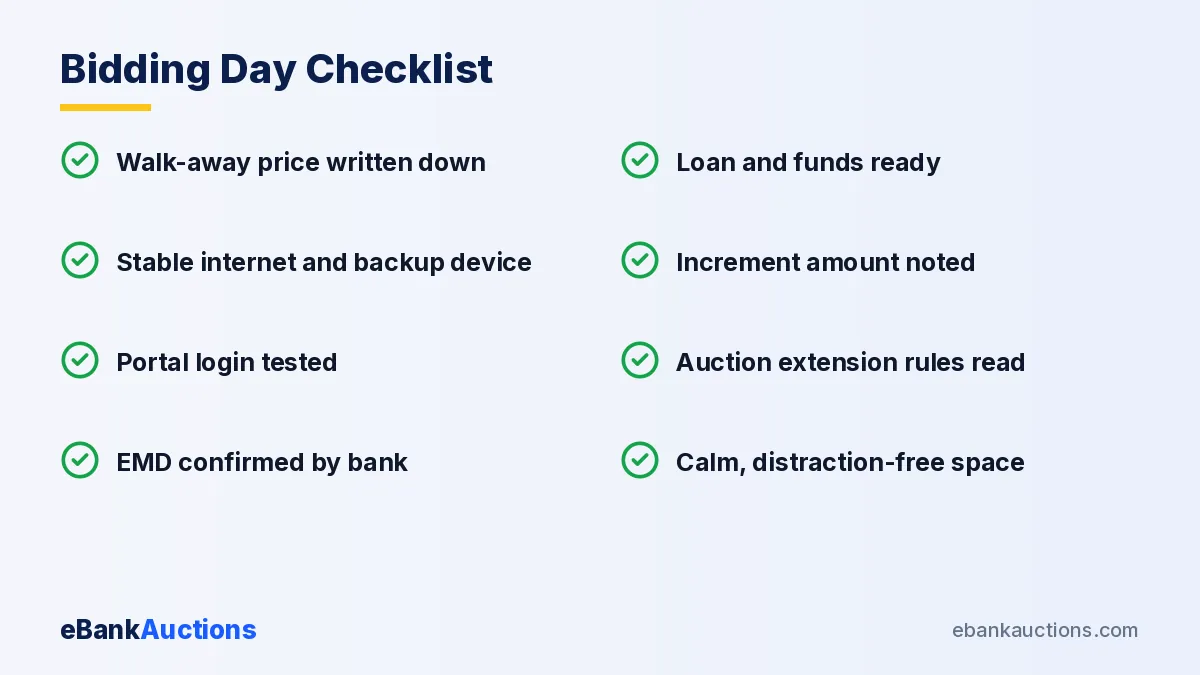
- They decide their limit the night before, not during the auction.
- They log in early and keep only the auction window open.
- They avoid discussing bids with family in real time, which can lead to emotional decisions.
- They accept that losing an auction is a normal outcome, not a failure.
A calm bidder who stops at the limit usually does better over several auctions than an aggressive bidder who wins one at the wrong price.
Technical preparation for the e-auction
Many bids are lost to technology, not to rivals. A few simple precautions prevent this:
- Log in to the portal a day before and confirm your account shows the correct property and approved EMD status.
- Check that your digital signature certificate, if required, is installed and working on the device you will use.
- Use a laptop on a wired or stable Wi-Fi connection, and keep a mobile hotspot ready as backup.
- Close other applications and disable automatic updates during the auction window.
- Note the portal’s helpdesk number in case you face a login problem.
- Keep your walk-away figure and increment written on paper beside you.
If the portal faces a technical outage, the auction may be suspended or rescheduled under the service provider’s terms. Take screenshots of any error messages as evidence and inform the authorised officer immediately.
After the auction ends
If you win, the portal and the authorised officer will communicate the result, usually by email. Read the confirmation carefully: it states the amount to be paid immediately and the deadline for the balance. If you lose, your EMD will be refunded to the account you registered, typically within a few working days. Either way, note the final price. It is valuable market data for your next bid in the same area.
Should you bid in the first round or wait?
Waiting for a re-auction can pay off when a property has obvious issues that deter others, or when the market is slow. But good properties in strong locations rarely come back. If a property scores well on possession, title, dues and location, and the starting figure already leaves you a margin, bidding in the first round is usually the better choice. If you decide to wait, keep your due diligence file ready so you can move quickly when the next notice appears.
Reserve price, EMD and increment in one table
| Term | What it means | Where to find it |
|---|---|---|
| Reserve price | Minimum price bank will accept | Sale notice |
| EMD | Deposit to qualify, often ~10% of reserve | Sale notice |
| Bid increment | Minimum step between bids | Sale notice / portal |
| Auto-extension | Extra time when late bids arrive | Portal terms |
| Confirmation | Bank’s approval of highest bid | After auction |
When a low reserve price is a warning sign
A very low reserve price compared with the area is not always good news. It can reflect:
- Symbolic possession with occupants who may resist.
- Title defects or missing documents.
- Pending litigation or tenant claims.
- Severe physical damage.
- Land use problems such as agricultural or reserved land.
Read our guide on bank auction risks before bidding on a property that looks too cheap.
Can you negotiate the reserve price?
Not directly. The bank fixes and publishes it, and you cannot negotiate it before the auction. However, if an auction fails, the bank may re-auction at a lower reserve price, and in some cases it may consider a private treaty offer as permitted under the rules and with the borrower’s notice. Such decisions follow internal and legal procedures; they are not informal bargains. Be wary of anyone who claims they can get you a property below the reserve price privately.
Worked example: bidding above the reserve price
A three-bedroom flat in Kochi has a reserve price of ₹65 lakh, an EMD of ₹6.5 lakh and an increment of ₹25,000. Similar flats sell for about ₹82 lakh. The buyer estimates stamp duty and registration at ₹6 lakh, dues at ₹80,000 and repairs at ₹2 lakh. She wants at least a 7% discount to market after costs.
Target all-in cost: 93% of ₹82 lakh = about ₹76.3 lakh. Subtract costs of ₹8.8 lakh. Walk-away bid: about ₹67.5 lakh.
On auction day, three bidders are active. Bids rise in single increments to ₹67 lakh. Another bidder places ₹67.25 lakh. She bids ₹67.5 lakh, her limit. The auction extends once; no further bids arrive. She wins at ₹67.5 lakh, just ₹2.5 lakh above the reserve price, and within her plan.
Frequently asked questions
Is the reserve price the price I will pay?
Only if no one bids higher. The final price is the highest valid bid.
Why is the reserve price lower than market value?
Banks often fix it near the realisable value to attract bidders and recover dues quickly. Some properties are also discounted because of legal or physical issues.
How much does the reserve price fall in each re-auction?
It varies. Reductions of around 10% per round are common, but the bank decides based on fresh valuation and circumstances.
Can I bid below the reserve price?
No. Bids below the reserve price are not accepted by the portal.
What happens if only one bidder participates?
If the single bidder bids at least the minimum and the bank confirms the sale, that bidder wins. Many buyers have picked up good properties this way, especially in later rounds when interest is lower.
Can the bank reject the highest bid?
The bank’s confirmation is required, and sale terms usually reserve the right to accept or reject bids. Rejection is uncommon when the process is followed and the bid is at or above the minimum, but it can happen, for example if the borrower settles the dues.
Does a higher reserve price mean a better property?
Not necessarily. It reflects the valuation, which considers location and condition. Always compare with your own market research.
Conclusion
The reserve price is your starting line, not your finish line. Know how it is fixed, why it changes, and what it hides. Then build your walk-away price from real market value and total costs, and bid calmly to that limit. Browse live bank auctions on eBankAuctions, track properties across rounds, and read our bank auction flats buying tips to prepare for your next bid.