Bank auction risks are the reason many buyers never try auctions at all, and also the reason some buyers pay far less than market price for good homes. Banks sell repossessed property under the SARFAESI Act on an “as is where is” basis, which shifts many uncertainties to you. Some risks are legal, such as defective title or pending litigation. Some are practical, such as an occupant who refuses to leave. Others are financial, like hidden dues or a loan that does not come through in time.
The good news is that almost every one of these bank auction risks can be identified before you bid and either managed or avoided. This guide lists 13 hidden dangers, explains how each one shows up, and gives proven ways to protect yourself.
Why bank auction risks are different from normal purchase risks
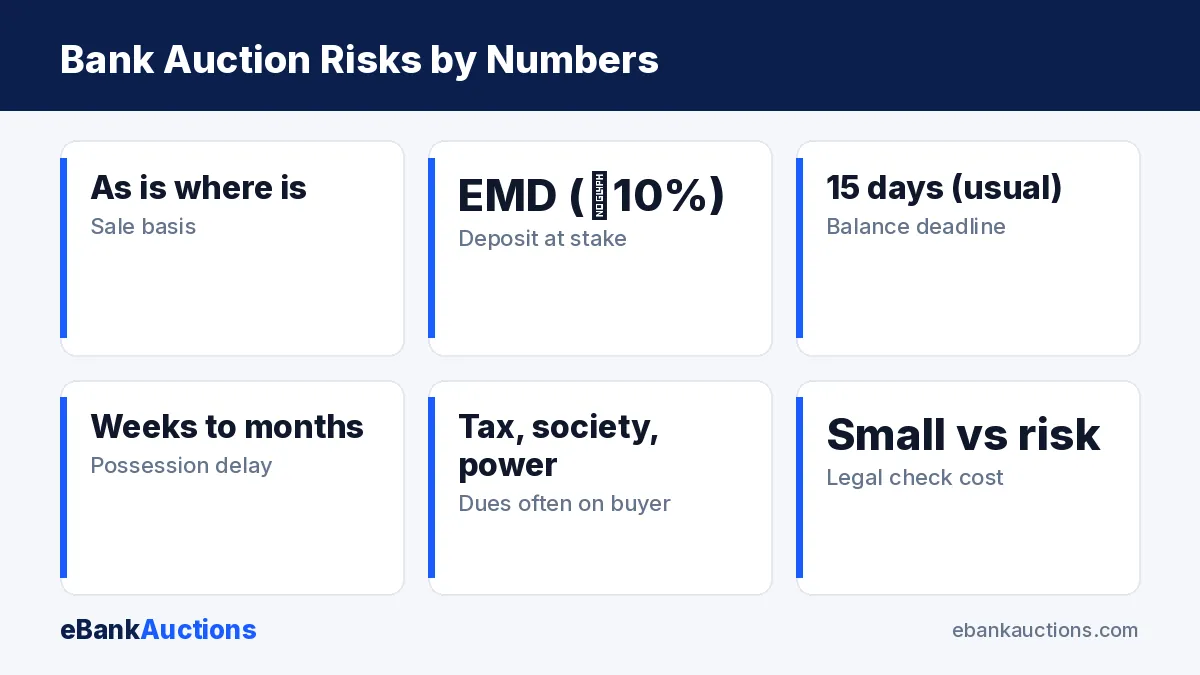
In a private sale, you negotiate with an owner who gives representations about title and condition and signs an agreement with remedies if things go wrong. In an auction under the SARFAESI Act, 2002, the authorised officer sells the borrower’s interest, usually with a clause that the bank does not warrant title, dues or condition. You also face strict payment timelines. That combination means bank auction risks must be handled before the auction, not after.
The flip side is transparency. Notices are public, prices are discovered openly, and the process is regulated. When you manage the risks, auctions can be one of the safest ways to buy below market.
The legal bank auction risks
The first group of bank auction risks concerns your title and your right to occupy the property. These are the most serious because they can take years to fix.
Risk 1: Possession is only symbolic
What it looks like: the notice says the bank has taken symbolic possession, and someone still lives in the property.
Why it matters: you may not get the keys for months, your loan may be delayed, and you may carry rent and EMI at the same time.
How to manage it: ask the authorised officer in writing whether the bank will hand over physical possession and by when; check if a Section 14 order has been passed; reduce your bid to cover the delay. Read our symbolic vs physical possession guide.
Risk 2: Defective or incomplete title
What it looks like: gaps in the chain of ownership, inheritance without partition, power-of-attorney sales, or survey number mismatches.
Why it matters: a defective title can make resale, loans and even possession difficult.
How to manage it: hire a local advocate to trace title for 30 years, compare revenue records and get a fresh encumbrance certificate. Our auction property due diligence checklist covers every document.
Risk 3: Undisclosed encumbrances
What it looks like: a second mortgage, a registered lease, or an attachment order not mentioned in the notice.
Why it matters: some encumbrances may survive the sale or lead to disputes.
How to manage it: compare the encumbrance certificate with the notice, and ask the bank in writing how each item will be dealt with. If the answer is unclear, walk away.
Risk 4: Pending litigation or a stay order
What it looks like: the borrower or a third party has approached the Debts Recovery Tribunal under Section 17, or a civil court, challenging the bank’s action.
Why it matters: a stay can freeze the sale; even without a stay, confirmation and handover may be delayed.
How to manage it: ask the bank to confirm in writing whether any case is pending; have your advocate check court records; avoid properties under a stay.
The financial bank auction risks
The second group of bank auction risks affects your budget and your ability to complete the purchase on time.
Risk 5: Hidden dues on the property
What it looks like: unpaid property tax, water charges, electricity arrears or society maintenance, often running into lakhs for flats in large complexes.
Why it matters: many notices say dues are payable by the buyer, and utilities or societies may refuse transfer until they are cleared.
How to manage it: collect written dues statements from the local body, utility providers and society before bidding, and add them to your cost.
Risk 6: Loan not sanctioned in time
What it looks like: you win, pay 25%, but your lender needs more time or declines the property.
Why it matters: if you cannot pay the balance within the deadline, the bank can forfeit your deposit and re-auction the property.
How to manage it: get in-principle approval before paying EMD, confirm that the lender will fund this specific property, and keep a buffer of own funds. See our auction property loan guide.
The physical bank auction risks
The third group of bank auction risks is about the property itself: its condition, its boundaries and how the land may be used.
Risk 7: Physical defects you could not see
What it looks like: leaking roofs, damaged wiring, missing fittings, termite damage or structural cracks discovered after purchase.
Why it matters: repair costs can wipe out your discount.
How to manage it: attend inspection with an engineer; if inspection is limited because the property is occupied, assume a larger repair budget.
Risk 8: Unauthorised construction
What it looks like: extra floors or extensions built without approval, or no occupancy certificate.
Why it matters: lenders may refuse to finance, local bodies can issue notices, and resale becomes harder.
How to manage it: verify building permits and plans; check regularisation rules in your state; price in regularisation fees or avoid the property.
Risk 9: Boundary and area disputes
What it looks like: the actual plot is smaller than the notice says, a neighbour’s wall encroaches, or access depends on a disputed pathway.
Why it matters: you pay for land you do not get, or you face a neighbour dispute.
How to manage it: get a licensed surveyor to measure and match survey records; confirm access rights in the title.
Risk 10: Land classification problems
What it looks like: the land is recorded as agricultural, paddy or forest, or is reserved for road widening in the master plan.
Why it matters: construction may be restricted, conversion may be needed, or part of the land may be acquired.
How to manage it: check revenue classification and the development plan; see our guide on land use conversion.
Risk 11: Tenant claims
What it looks like: a person claims to be a tenant with a long lease.
Why it matters: under Section 17(4A) of SARFAESI, tenancy claims can be raised before the DRT, and a genuine registered lease created before the mortgage may have to be respected.
How to manage it: ask the bank for any lease details, check the EC for registered leases, and avoid tenanted properties unless you are comfortable being a landlord.
The behavioural bank auction risks
The last group of bank auction risks comes from people, including you. Emotions and fraudsters both cost buyers money.
Risk 12: Emotional over-bidding
What it looks like: you keep matching increments in the last minutes and finish well above your plan.
Why it matters: the discount disappears and you may stretch your finances.
How to manage it: write down your walk-away price based on total cost and market value before the auction, and stop there.
Risk 13: Fraud and fake listings
What it looks like: someone offers a “bank property” at a special price, asks for money into a personal account, or claims inside influence.
Why it matters: you can lose money without ever participating in a real auction.
How to manage it: verify every listing against the bank’s official notice, pay only through the portal or the bank’s designated account, and read our guide to avoiding bank auction scams.
Bank auction risks at a glance
| Risk | Warning sign | Main safeguard |
|---|---|---|
| Symbolic possession | Occupant inside | Written handover commitment |
| Title defect | Gaps in chain | Advocate title search |
| Encumbrance | Extra entries in EC | Written clarification from bank |
| Litigation | DRT/court case | Court record search |
| Hidden dues | Old building, large society | Dues statements |
| Loan failure | Lender hesitates | Pre-approval for this property |
| Physical defects | Limited inspection | Engineer, repair buffer |
| Unauthorised construction | No OC | Permit check |
| Boundary dispute | Irregular walls | Survey |
| Land classification | Agricultural records | Revenue check |
| Tenant claim | Lease mentioned | EC and bank records |
| Over-bidding | Heated final minutes | Written bid limit |
| Fraud | Payment to individuals | Verify notice, pay bank only |
Bank auction risks by property type
The same process carries different risks depending on what you buy.
| Property type | Top bank auction risks | Extra check |
|---|---|---|
| Apartment | Society dues, parking disputes, OC | Society statement and allotment letter |
| Independent house | Occupants, unapproved floors, boundaries | Survey and building permit |
| Plot | Title chain, classification, encroachment | Revenue records and survey |
| Shop or office | Tenants, trade licences, fire NOC | Lease deeds and approvals |
| Industrial unit | Lease conditions, pollution consent, dues to industrial body | Allotment and transfer rules |
Understanding which bank auction risks dominate each type helps you focus your limited time before the auction.
How lenders look at bank auction risks
Your home loan lender runs its own risk check. If its advocate finds a title gap, or its valuer cannot enter the property, it may reduce the loan or decline. That is useful information for you. A lender’s hesitation is an independent signal that the property carries bank auction risks you may have underestimated. Ask the lender to explain its concerns and whether they can be resolved before the auction. If the lender says no, think carefully before bidding with your own money alone.
Bank auction risks for NRIs and remote buyers
Buying from another city or country adds its own layer. You rely on representatives for inspection, you manage payments across time zones, and you may not notice local warning signs such as a family still living in the house. To reduce these bank auction risks:
- Appoint a trusted representative with a registered power of attorney.
- Ask for a live video call during inspection rather than only photos.
- Keep funds in the right account type well before the EMD deadline.
- Use a local advocate who reports to you directly, not through an agent.
- Read our NRI bank auction guide for the full process.
Ten questions that cut bank auction risks
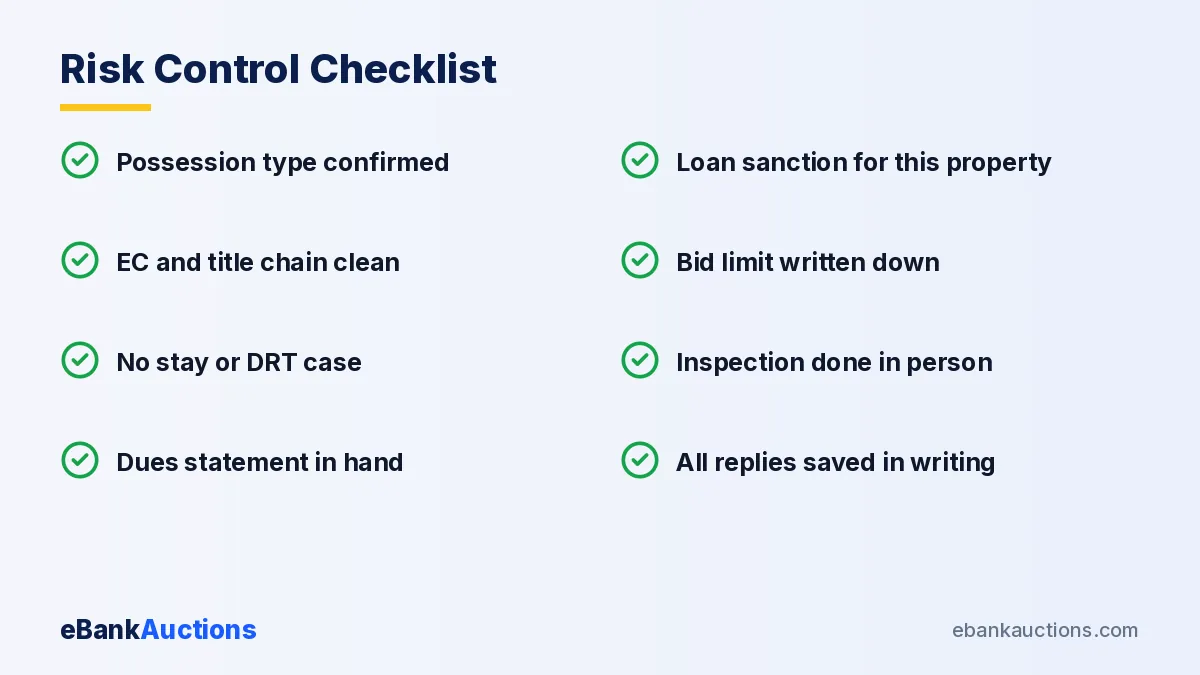
Before paying EMD, send these questions to the authorised officer and keep the replies:
- What type of possession does the bank hold, and when will it hand over vacant possession?
- Is any case pending before the DRT, a court or any authority?
- Are there any tenants or occupants?
- Which dues are known to the bank, and which will be settled from sale proceeds?
- Will original title deeds be handed over after full payment?
- Has the property been auctioned before, and why did earlier rounds fail?
- Is there any known structural or legal defect?
- What is the exact extent of land and built-up area being sold?
- Which PAN should be used for TDS if the price is ₹50 lakh or more?
- Can the balance payment period be extended if the loan is delayed?
Written answers turn many unknown bank auction risks into known, priceable facts.
How to price bank auction risks into your bid
Not every risk means you should walk away. Often the right answer is to lower your maximum bid. A simple method:
- Estimate market value from recent sales and broker quotes.
- Subtract stamp duty, registration, dues and repairs.
- Subtract a risk allowance: for example, six months of rent and EMI if possession is symbolic, or legal fees if there is a minor title gap.
- Subtract your required margin, such as 10% below market.
- The result is your maximum bid.
If the reserve price is already above this number, skip the auction and watch for a re-auction with a lower reserve.
Building a simple risk score
Some buyers find it helpful to score each shortlisted property before deciding. Give one point for each of these: physical possession, clean 30-year EC, no litigation, dues under 2% of price, approved plan with OC, lender approval for the property, and full inspection done. A property scoring six or seven is a strong candidate. A score of four or five needs a lower bid. Anything below four usually is not worth the stress, however low the reserve price looks.
Which bank auction risks are deal-breakers?
Some risks can be priced; others should end your interest in the property.
- Deal-breakers: a court stay on the sale, a serious title defect with no clear remedy, land reserved for a public purpose, and fraud indicators.
- Priceable risks: symbolic possession with a clear plan, moderate dues, repairs, minor deviations that can be regularised.
Worked example
Arjun shortlists two flats in Pune. Flat A has physical possession, clean title and ₹40,000 of dues, reserve ₹48 lakh. Flat B has symbolic possession with the borrower’s family inside, a pending DRT application without a stay and ₹2.2 lakh of dues, reserve ₹41 lakh. Market value for both is about ₹58 lakh.
For Flat A, he sets a maximum bid of ₹52 lakh. For Flat B, he adds ₹4 lakh for delay and legal fees and ₹2.2 lakh for dues, and sets a maximum of ₹44 lakh. Flat A sells at ₹53 lakh to another bidder; Arjun stops at his limit. Flat B gets only two bidders and Arjun wins at ₹42.5 lakh. Seven months later he has the keys. His disciplined handling of bank auction risks gave him a flat at roughly ₹8 lakh below market even after costs.
Frequently asked questions
What are the biggest bank auction risks for first-time buyers?
Possession delays, hidden dues and loan timing are the most common. All three can be checked before you pay EMD.
Can the bank refund my money if a problem appears later?
Generally no, because sales are on an “as is where is” basis. Remedies are limited, which is why pre-bid checks are essential.
Is it safer to buy only physical possession properties?
It is lower risk, but you may pay more because competition is higher. Symbolic possession properties can be good value if you price the risk correctly.
Do bank auction risks reduce if I buy in a re-auction?
Some do. A re-auctioned property usually has a lower reserve price and you have more time to investigate. But ask why earlier rounds failed; the reason is often one of the risks in this list.
How much should I set aside for unexpected costs?
A contingency of about 5% of the purchase price covers most surprises such as small dues, minor repairs and extra legal work. Increase it if possession is symbolic or the building is old.
Should I avoid all properties with DRT cases?
Not necessarily. A pending application without a stay may resolve quickly. Your advocate can advise on the stage and likely outcome.
Conclusion
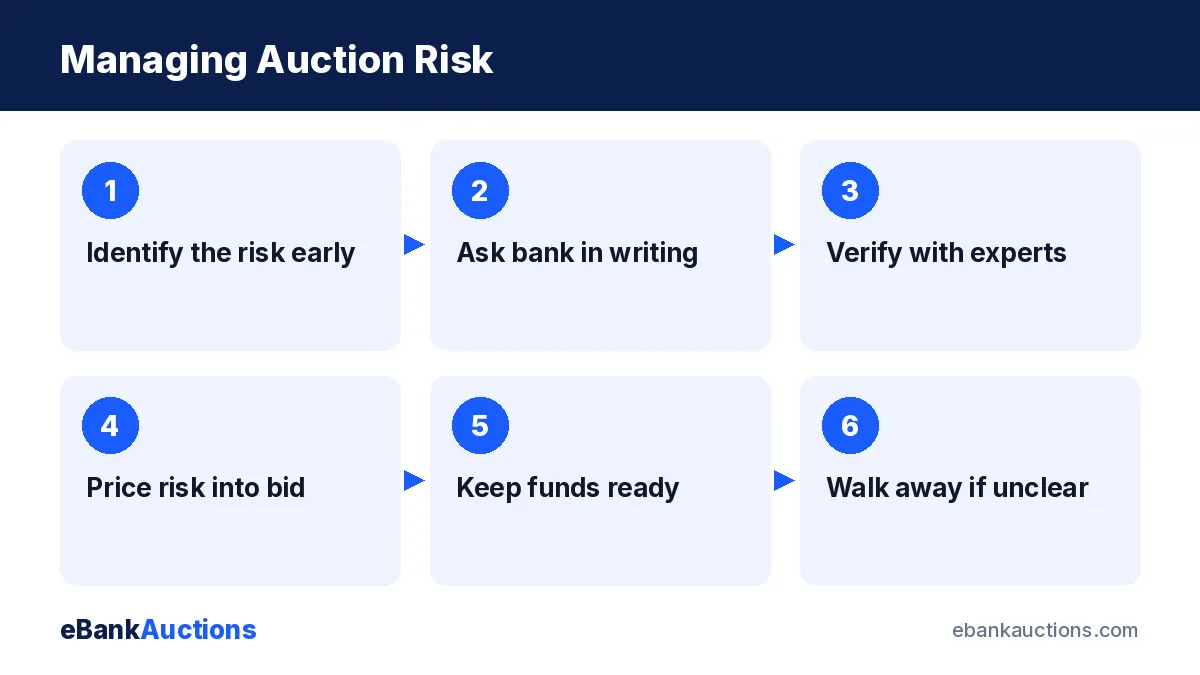
Bank auction risks are real but manageable. Identify each one early, ask the bank in writing, verify with experts, price the remaining risk into your bid and walk away when a deal-breaker appears. Buyers who follow this discipline regularly buy below market with confidence. Browse live bank auctions on eBankAuctions and read our bank auction flats buying tips before your next bid.