
Symbolic possession is one of the most misunderstood terms in Indian bank auctions, and it has a direct effect on how quickly you can move into the property you buy. When a bank takes symbolic possession, it has legally asserted its right over the secured asset, but it does not hold the keys and someone may still be living there. Physical possession, on the other hand, means the bank has actual control of the property. This guide explains seven critical differences between symbolic possession and physical possession, the legal steps between them, and how to protect yourself when bidding.
What the SARFAESI Act says about possession
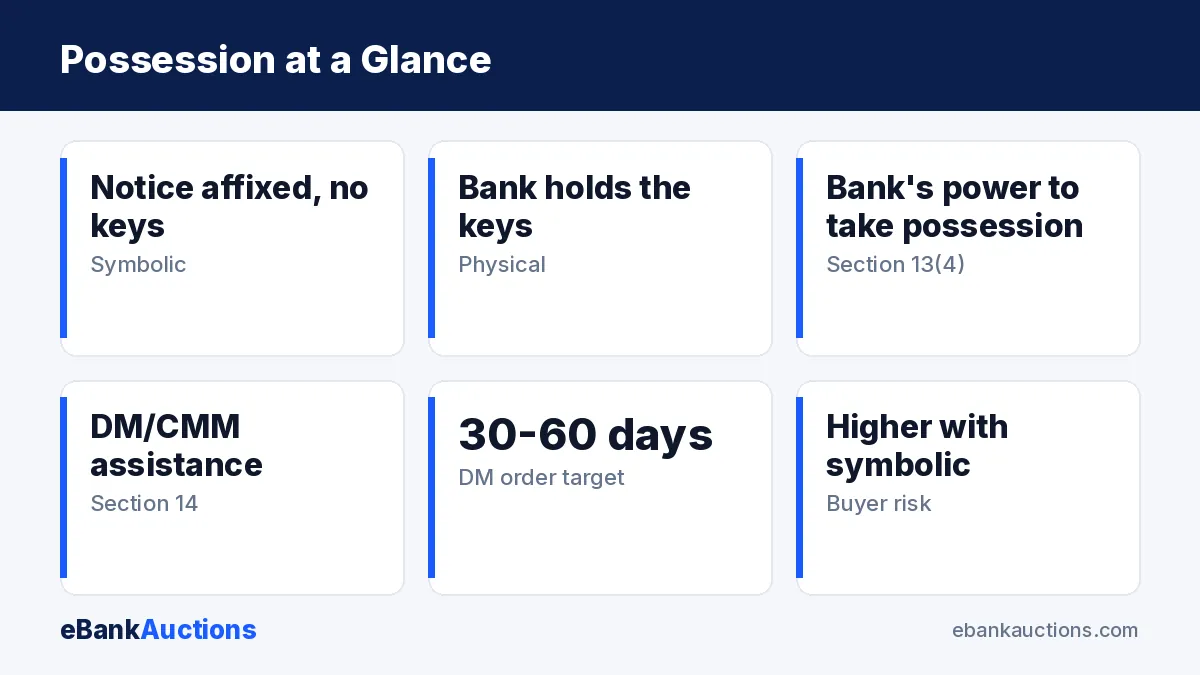
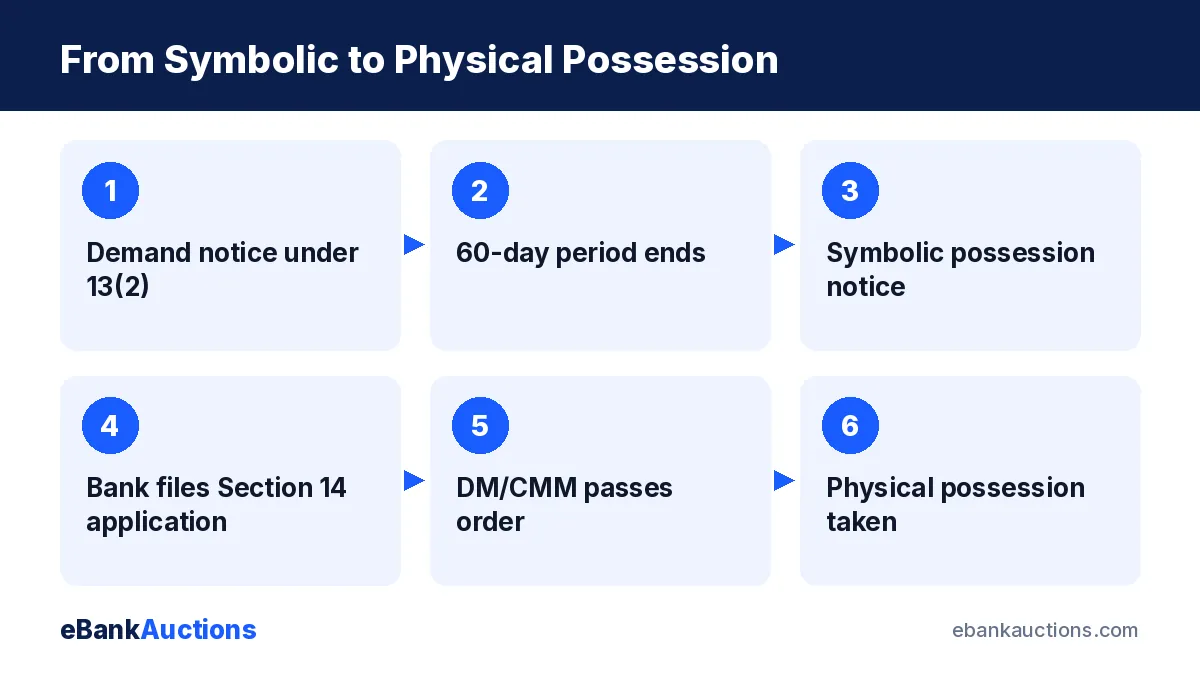
The SARFAESI Act, 2002 lets secured creditors enforce security without a court decree. After a loan becomes a non-performing asset, the bank issues a demand notice under Section 13(2), giving the borrower 60 days to repay. If the borrower does not pay, Section 13(4) allows the bank to take possession of the secured asset.
Rule 8 of the Security Interest (Enforcement) Rules, 2002 describes how possession is taken. The authorised officer delivers a possession notice to the borrower, affixes it on the property, and publishes it in two newspapers. This act of affixing and publishing is what creates symbolic possession. It is a legal act, not a physical one.
Difference 1: Who holds the keys
Under symbolic possession, the borrower, a family member or a tenant may continue to occupy the property. The bank’s right is recorded on paper and on the door, but it does not have the keys. Under physical possession, the bank has taken actual control, often changing or sealing the locks, and can let buyers inspect freely.
For a bidder, this is the most practical difference. With physical possession you can see every room, plan repairs and move in soon after the sale certificate. With symbolic possession you may not even be able to enter during inspection.
Difference 2: Legal steps still pending
Symbolic possession is often the first step. To get physical possession when the borrower resists, the bank applies to the Chief Metropolitan Magistrate or District Magistrate under Section 14 of the Act. The magistrate, after verifying the bank’s affidavit, orders the taking of possession, and officials assist the bank, sometimes with police help.
The law says the magistrate should try to pass the order within 30 days, extendable to 60 days for reasons recorded in writing. In practice, timelines vary widely between districts. Until this step is complete, symbolic possession leaves work to be done.
Difference 3: Who bears the eviction effort after the sale
Some sale notices state that the property is sold with symbolic possession and that the purchaser must obtain physical possession at their own cost. Others say the bank will deliver physical possession after completing Section 14 proceedings. This single sentence can change your costs and timeline dramatically.
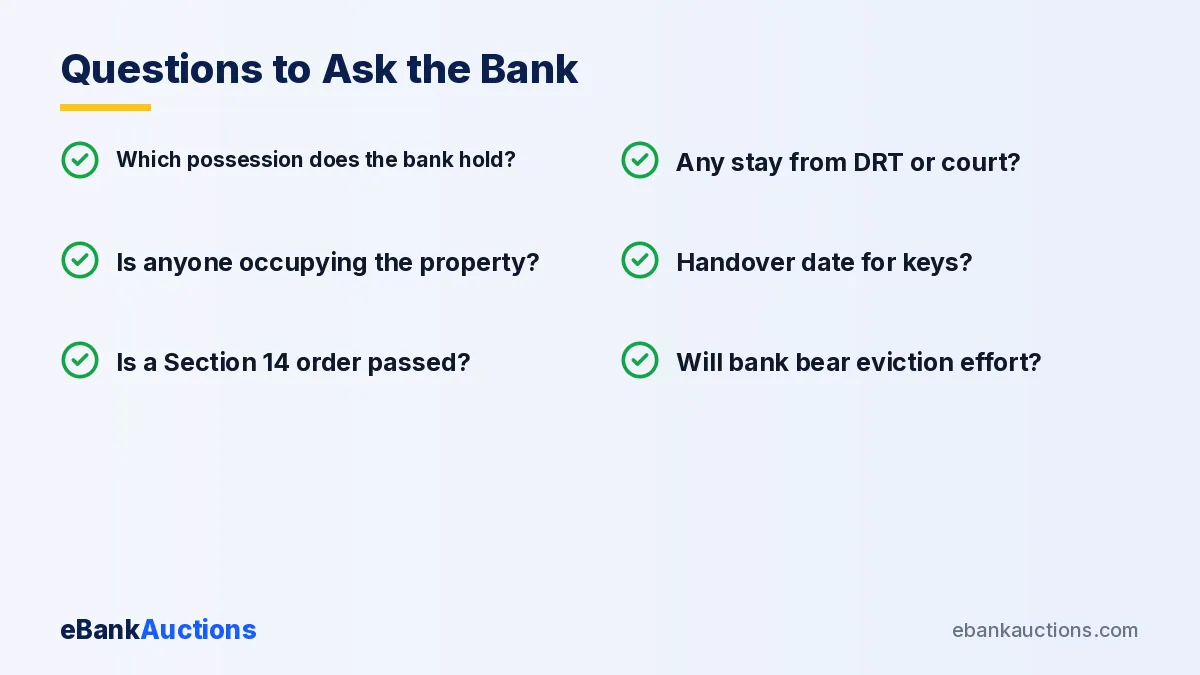
Always ask the authorised officer, in writing, whether the bank will hand over vacant physical possession and by when. If the answer is vague, factor a delay of several months into your plan, and reduce your bid accordingly.
Difference 4: Inspection quality
With physical possession, inspection is straightforward. The bank opens the property and you can check structure, fittings, water and electricity. With symbolic possession, inspection depends on the occupant’s cooperation. You may only see the exterior, which means repair estimates become guesses. Many experienced bidders simply avoid symbolic possession properties unless the discount is large.
Difference 5: Loan approval
Lenders prefer properties where the seller can hand over vacant possession, because their valuer must inspect and they want the borrower to occupy or rent the property quickly. Some lenders decline to finance symbolic possession properties, or sanction a lower loan-to-value ratio. Discuss the specific property with your lender before bidding. Our auction property loan guide explains why possession status matters to banks.
Difference 6: Price and competition
Symbolic possession properties usually attract fewer bidders. Fewer bidders mean lower final prices and more re-auctions with reduced reserve prices. That can create genuine bargains for buyers who have patience, funds and legal support. Physical possession properties in good locations draw more competition and sell closer to market value.
| Factor | Symbolic possession | Physical possession |
|---|---|---|
| Keys with bank | No | Yes |
| Occupant inside | Possible | Rare |
| Inspection | Often limited | Full access |
| Loan availability | Some lenders hesitate | Easier |
| Competition | Lower | Higher |
| Time to move in | Uncertain, can be months | Usually quick |
| Typical discount | Larger | Smaller |
Difference 7: Risk of disputes
When a property is occupied, disputes are more likely. Occupants may claim a tenancy, file objections before the Debts Recovery Tribunal under Section 17, or approach courts. A genuine tenant with a valid, registered lease may have rights that survive the sale, depending on the facts and the lease terms. Courts have examined these questions many times, and outcomes depend on details such as when the lease was created and whether it was disclosed to the bank.
With physical possession, the bank has already dealt with occupation, so the chance of such disputes after the sale is lower.
How Section 14 proceedings work in practice
Understanding the Section 14 route helps you judge how long a property may stay occupied. The bank’s authorised officer files an application before the Chief Metropolitan Magistrate (in metropolitan areas) or the District Magistrate (elsewhere). Since the 2013 amendment, the application must be supported by an affidavit in which the bank declares key facts, including:
- The total amount of financial assistance and the outstanding dues.
- That the borrower has created a security interest over the property.
- That the account has been classified as a non-performing asset.
- That a demand notice was served and the 60-day period has expired.
- That the borrower’s objections, if any, were considered and replied to.
- That the bank has complied with the rules under the Act.
The magistrate checks the affidavit and, if satisfied, passes an order directing that possession be taken. An advocate commissioner or a revenue official may be appointed to execute the order, with police assistance if necessary. The magistrate does not decide disputes about the debt itself; that is for the Debts Recovery Tribunal.
Why timelines vary so much
Some districts process Section 14 applications within weeks; others take many months because of workload. Occupants may also seek time, file objections or approach the DRT. A bank that has already obtained the order but not executed it is usually close to handover. A bank that has not even filed the application is at the start of a long road.
Tenants and third parties
The SARFAESI Act was amended in 2016 to deal specifically with tenants. Under Section 17(4A), a person claiming a tenancy or lease can raise that claim before the Debts Recovery Tribunal, which decides whether the lease is valid. Broadly, the tribunal looks at whether the lease was created before the mortgage, whether it was registered where registration is required, and whether it was a genuine arrangement rather than one created to defeat the bank.
For a bidder, the practical takeaway is simple. If a property under symbolic possession is occupied by someone other than the borrower, find out who they are and on what basis they stay. Ask the bank for any lease documents it holds, and ask your advocate to check whether a lease is registered in the encumbrance records.
The real cost of symbolic possession
Buyers often compare only the reserve price. A fair comparison adds the cost of time. If you buy a symbolic possession property, consider:
- Rent you continue to pay for your current home while you wait.
- Interest on your own funds or EMIs on a loan that has been disbursed.
- Legal fees if you need to follow up on proceedings or respond to objections.
- Repairs that may be larger than expected because you could not inspect inside.
- Opportunity cost if a better property appears in the meantime.
A simple rule of thumb used by experienced buyers is to add the cost of six to twelve months of delay to the price. If the property still looks cheap, it may be worth bidding.
Checklist for occupied properties
- Identify the occupant: borrower, family member, tenant or unknown person.
- Ask the bank for the date and copy of the possession notice.
- Confirm whether a Section 14 application has been filed and its status.
- Check for any DRT application under Section 17 by the borrower or a tenant.
- Visit at different times of day to see who lives there.
- Keep all correspondence with the bank in writing.
How to identify symbolic possession in a sale notice
Sale notices usually mention the type of possession near the property description or in the terms and conditions. Look for phrases such as:
- “The authorised officer has taken symbolic possession of the property on [date].”
- “Physical possession of the property has been taken on [date].”
- “Sale is subject to physical possession being obtained under Section 14.”
If the notice is silent, ask. Listings on eBankAuctions show the possession type wherever the notice states it, and you can browse residential bank auctions to compare.
Should you bid on a symbolic possession property?
Symbolic possession is not automatically a deal-breaker. It depends on your goals and resources.
When it can make sense
- You are an investor with time and do not need to move in quickly.
- The discount compared with market value is large enough to cover delays and legal costs.
- The bank confirms in writing that it will complete Section 14 proceedings and hand over physical possession.
- The occupant is the borrower, not a third party with a registered lease.
When to avoid it
- You need the home soon, or you are relying on a loan that requires vacant possession.
- A third party claims tenancy or ownership.
- A DRT or court case is pending with a stay order.
- The bank refuses to commit on handover.
Steps to protect yourself before bidding
- Read the notice and terms of sale for the exact possession wording.
- Write to the authorised officer asking about possession, occupants and Section 14 status.
- Visit the property and speak to neighbours about who lives there.
- Ask your advocate to check court records for pending cases.
- Confirm with your lender whether it will finance the property.
- Reduce your bidding limit to account for delay and legal costs.
These steps are part of broader auction property due diligence, and they matter most when the bank holds symbolic possession.
What happens after you buy a symbolic possession property
If the bank has agreed to deliver physical possession, it will complete Section 14 proceedings and hand over the keys once the magistrate’s order is executed. Stay in touch with the authorised officer and ask for periodic updates in writing. If the sale terms put the burden on you, your advocate may need to request the bank to pursue Section 14, since the application is filed by the secured creditor. In some cases buyers negotiate with occupants for a voluntary handover, but any payment to an occupant should be documented and legally vetted.
Timelines: what to realistically expect
| Stage | Typical time |
|---|---|
| Demand notice to symbolic possession | 60 days + processing |
| Section 14 application to order | 30–60 days by law, often longer |
| Order to actual handover | Days to weeks, depends on resistance |
| Total from auction to keys (symbolic) | Several weeks to many months |
| Total from auction to keys (physical) | Usually within weeks of full payment |
These are indicative. Local court workload, occupant resistance and legal challenges can stretch them.
Negotiating a voluntary handover
In many cases, especially where the borrower’s family still lives in the property, a voluntary handover is faster than waiting for a magistrate’s order to be executed. The bank usually leads these conversations, because it is the secured creditor and has already served notices. Families often need time to find another home, collect belongings or settle children’s schooling, and a clear, respectful timeline can resolve matters without force.
If you are the buyer and the sale terms put the burden of possession on you, speak to the authorised officer before approaching the occupant yourself. Any agreement with an occupant, such as a short time to vacate or help with shifting costs, should be written, witnessed and reviewed by your advocate. Never make cash payments without receipts, and never agree to arrangements that could later be described as a new tenancy.
Signs a handover will be smooth
- The borrower has already moved out and only belongings remain.
- The family has been cooperative during inspections.
- There is no third-party tenant and no pending legal challenge.
- The bank has a Section 14 order ready to execute if needed.
Signs it will be difficult
- The occupant denies the bank’s claim or disputes the debt.
- A tenant claims a long lease signed after the mortgage.
- The property is used for a running business.
- Local officials have been slow to execute earlier orders.
Common questions about symbolic possession
Is symbolic possession legally valid?
Yes. It is a recognised mode of taking possession under Rule 8. It gives the bank the right to sell, and the sale to you transfers the borrower’s rights.
Can the borrower sell the property after symbolic possession?
No. After the bank’s notice, the borrower cannot transfer the secured asset by sale, lease or otherwise without the bank’s consent. Such a transaction would not bind the bank.
Will I get the sale certificate before physical possession?
Usually yes. The sale certificate is issued after full payment, regardless of possession status. Handover of physical possession may follow later.
Does symbolic possession affect stamp duty or registration?
No. Stamp duty and registration are payable on the sale certificate as per state law, regardless of possession status. Plan these costs even if you cannot move in immediately.
Can the bank sell without any possession at all?
The Act requires the bank to take possession, symbolic or physical, before selling the secured asset. A sale notice should mention when possession was taken.
Can I stop paying the balance until I get physical possession?
Not unless the sale terms allow it. Payment timelines apply regardless, and non-payment can lead to forfeiture of your deposit.
A practical example
Ravi finds a two-bedroom flat in Chennai with a reserve price about 25% below nearby resale prices. The notice mentions symbolic possession. Neighbours tell him the borrower’s family still lives there. The authorised officer confirms in writing that a Section 14 application has been filed but no order has been passed yet.
Ravi’s lender agrees to finance only after physical possession is handed over. He calculates that he would need to fund the full price himself for up to six months, plus rent for his current home. He lowers his maximum bid by 8% to cover this, bids, and wins at a price still well below market. Five months later the bank executes the magistrate’s order and hands over the keys. Ravi’s patience and planning turned symbolic possession from a risk into an advantage.
Conclusion
The difference between symbolic possession and physical possession decides how soon you get the keys, whether your loan is approved and how much risk you carry. Read the notice carefully, ask the bank the right questions, and price that risk into your bid. Explore listings on eBankAuctions, read our bank auction flats buying tips, and bid only when you are comfortable with the possession status.