
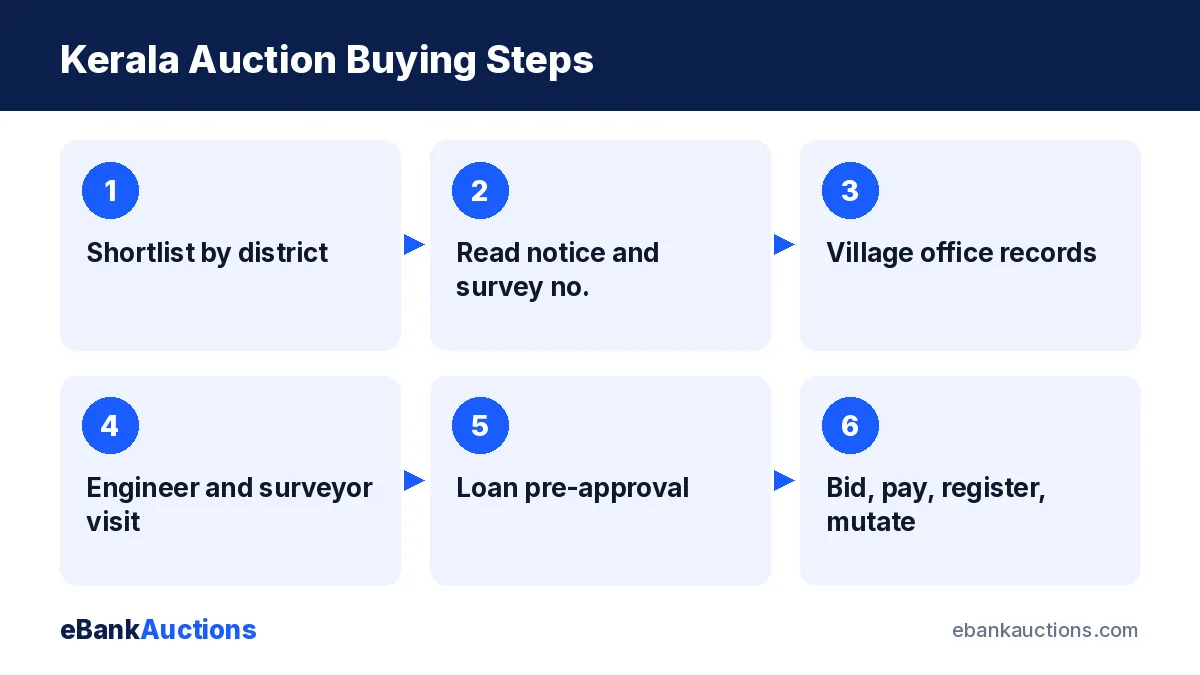
Kerala bank auction listings attract a special kind of buyer: families returning from the Gulf, young professionals in Kochi and Thiruvananthapuram, and investors who know that good land in Kerala is scarce. Every month, public sector banks, private banks, co-operative banks and housing finance companies sell repossessed houses, villas, flats and plots across the state through SARFAESI e-auctions. A Kerala bank auction can offer real savings, but the state’s land records, building rules and geography create checks that buyers elsewhere may not face. This guide shares 10 local tips for buying houses through a Kerala bank auction, from Kasaragod to Thiruvananthapuram.

Why Kerala bank auction properties are worth watching
Kerala has high property prices relative to incomes, limited land and strong demand from non-resident Keralites. At the same time, the state has a dense banking network, which means a steady flow of repossessed homes. When a borrower defaults, the lender enforces its security under the SARFAESI Act, 2002 and sells the property through an e-auction, often listed on BAANKNET for public sector banks.
A typical Kerala bank auction listing might be a two-storey house on eight cents in a Kozhikode suburb, a villa in a Kochi gated community or a small house on three cents near Thrissur town. Prices are set by bank valuations and can be below local asking rates, especially for properties with issues that scare casual buyers.
Where most listings appear
- Ernakulam district: Kochi city, Kakkanad, Aluva, Tripunithura and Angamaly.
- Thiruvananthapuram: city limits, Kazhakkoottam and Neyyattinkara.
- Kozhikode: city, Feroke, Ramanattukara and nearby panchayats.
- Thrissur and Malappuram: strong demand from NRI families.
- Kannur, Kollam, Kottayam, Palakkad and Alappuzha: steady supply of houses and plots.
You can browse all Kerala bank auctions on eBankAuctions and narrow down by city.
Tip 1: Understand Kerala land units and records
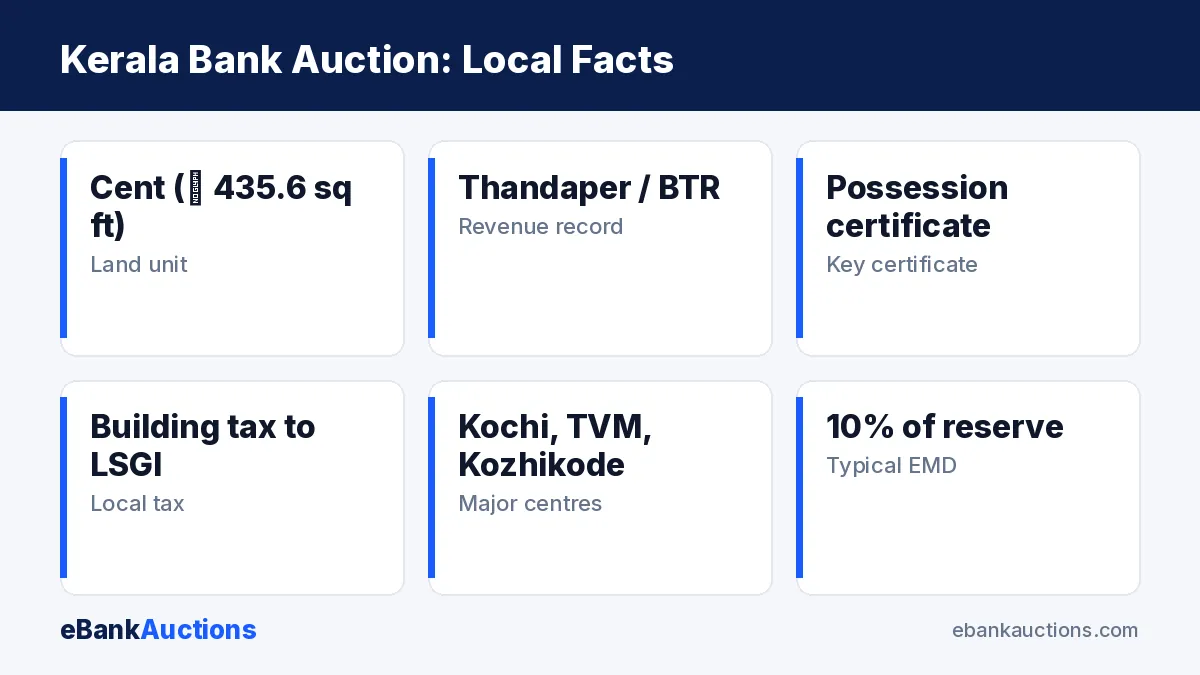
Land in Kerala is measured in cents (one cent is about 435.6 sq ft) and ares (one are is about 2.47 cents). Revenue records use terms that are unique to the state:
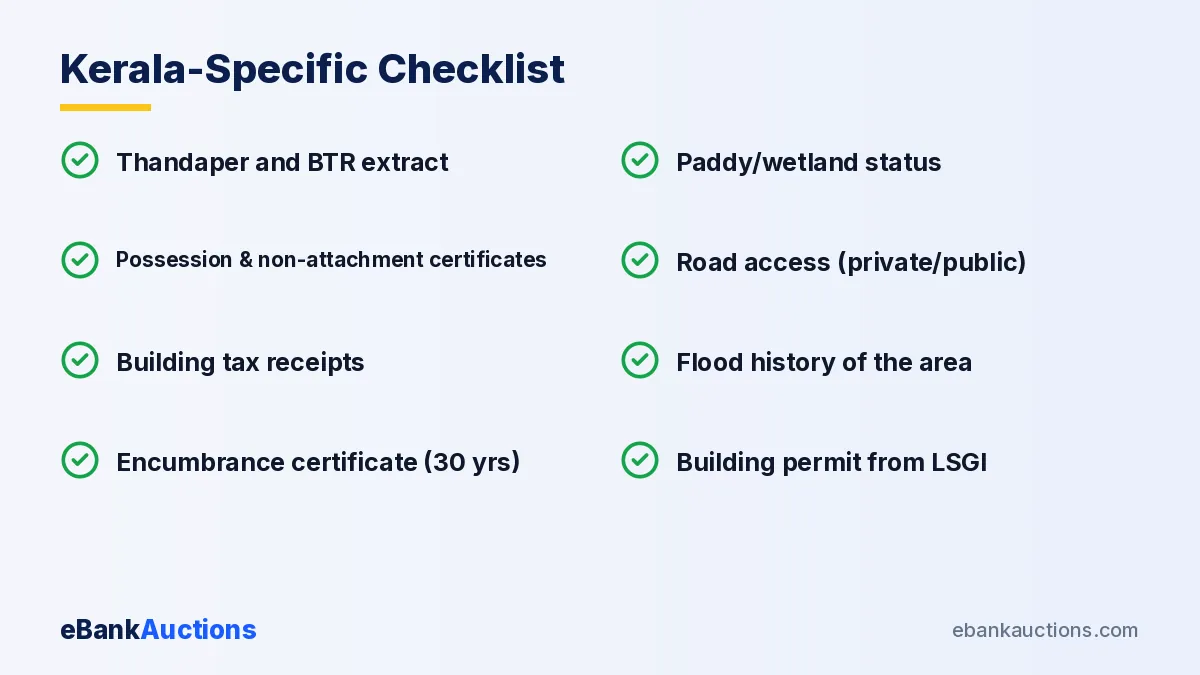
- Thandaper: the land holder’s account number in the village office.
- Basic Tax Register (BTR): the land tax register showing survey number, extent and holder.
- Possession certificate: issued by the village officer confirming possession.
- Non-attachment certificate: confirms there are no revenue attachments.
- Location sketch: shows the plot’s position in the survey map.
For any Kerala bank auction property, your advocate should compare the sale notice, title deeds and these records. Mismatches in survey numbers or extent are common and must be resolved before bidding.
Tip 2: Check the land classification
Kerala protects paddy land and wetlands under the Kerala Conservation of Paddy Land and Wetland Act, 2008. Land shown as paddy or wetland in the data bank cannot be freely converted or built upon. Some older houses sit on land that is still classified as “nilam” (paddy) in revenue records. Ask your advocate to check the land’s classification and whether any conversion order exists. This check is essential for a Kerala bank auction house or plot.
Tip 3: Verify the building permit and building tax
Houses in Kerala need a building permit from the local self-government institution (panchayat, municipality or corporation) under the Kerala Municipality or Panchayat Building Rules. After completion, the house is assessed for building tax. Ask for:
- The building permit and approved plan.
- The occupancy certificate or completion certificate.
- Building tax receipts and assessment details.
Additional floors built without permission are common. Regularisation may be possible, but it costs money and time. Unapproved construction can also block loans.
Tip 4: Read the sale notice for possession status
As elsewhere, possession is critical. Many Kerala bank auction houses are occupied by the borrower’s family, sometimes with elderly parents, which can delay handover. Check whether the bank has symbolic or physical possession and ask the authorised officer about the handover plan. Our guide to symbolic vs physical possession explains the legal steps.
Tip 5: Walk the boundaries with a surveyor
Kerala’s small, irregular plots and hilly terrain make boundary disputes common. A licensed surveyor can match the plot with the survey map and resurvey records. In areas where the digital resurvey is complete, compare the new records with old ones. Boundary walls may not match legal lines, and pathways may run through private land. Read our land survey before bidding guide for details.
Tip 6: Check road access carefully
Many Kerala houses are reached by narrow private pathways. Confirm whether the access road is a public road maintained by the local body or a private path. If private, check whether the right of way is recorded in the title deeds. Vehicle access affects value, loan eligibility and daily life, especially for villas in interior areas.
Tip 7: Consider flood and landslide risk
The 2018 and 2019 floods changed how Kerala buyers look at property. Before bidding, ask neighbours how high water rose in 2018, check whether the area is near a river, backwater or low-lying paddy field, and look at landslide susceptibility maps for hilly districts. A Kerala bank auction house that flooded once may flood again; price that risk in or walk away.
Tip 8: Know the local lenders
Kerala has a strong presence of public sector banks, private banks headquartered in the state, co-operative banks and housing finance companies. Co-operative banks may sell under their own recovery laws rather than SARFAESI in some cases, with different procedures. Always read the notice to see which law applies. Browse our bank-wise listings to see which lenders have active auctions.
Tip 9: Plan finance early, especially if you are an NRI
Many Kerala bank auction buyers are NRIs working in the Gulf. The payment timeline of 25% immediately and 75% in about 15 days does not change for them. Arrange funds in NRE or NRO accounts, appoint a trusted relative with a registered power of attorney for inspection and registration, and get loan pre-approval if needed. Read our NRI bank auction guide and auction property loan guide.
Tip 10: Complete registration and mutation
After paying in full, register the sale certificate at the sub-registrar office and pay stamp duty at Kerala’s rate on the applicable value. Then apply at the village office for mutation (pokkuvaravu) so that the thandaper is changed to your name, and at the local body for transfer of building tax. Transfer the KSEB electricity connection and Kerala Water Authority connection. Without mutation, you may face difficulties selling or mortgaging the property later.
District-by-district notes for Kerala bank auction buyers
Each part of the state has its own market logic. Keep these patterns in mind when you compare listings.
Ernakulam and Kochi
Kochi has the deepest Kerala bank auction market, with apartments in Kakkanad and Edappally, villas in gated communities, and older independent houses in Tripunithura and Aluva. Rental demand from IT and port workers is strong. Check metro and road-widening plans, which can both raise value and take away frontage.
Thiruvananthapuram
Technopark and Technocity areas drive demand for flats and villas. Many Kerala bank auction houses here sit on small plots of three to five cents inside residential lanes. Road access and parking are key value factors.
Kozhikode and Malappuram
NRI demand keeps land prices firm. Houses on larger plots in suburban panchayats appear often. Survey mismatches after resurvey and paddy land classification are common issues to check.
Thrissur, Palakkad and Kannur
Larger plots and older houses are typical. Look for well-maintained traditional houses where land value alone may justify the price, and check flood history near rivers.
Kottayam, Alappuzha and Kollam
Low-lying and backwater areas need careful flood and Coastal Regulation Zone checks. Rubber and plantation land near towns may have classification issues.
Buying a flat through a Kerala bank auction
Apartments follow the same SARFAESI process but have extra checks. Verify whether the project is registered with K-RERA if it is recent, confirm the occupancy certificate, and get the association’s statement of maintenance dues. Ask whether the car park is allotted and documented. Undivided share of land should be mentioned in the title deed. Our bank auction flats buying tips cover apartments in detail.
A realistic timeline for a Kerala bank auction purchase
| Stage | What happens | Time |
|---|---|---|
| Notice published | Newspapers, bank site, BAANKNET, eBankAuctions | Day 0 |
| Records check | Advocate reviews deeds, EC, thandaper, BTR | Days 2–10 |
| Inspection | Site visit with engineer and surveyor | Notified dates |
| Finance | Loan pre-approval or NRE/NRO fund transfer | Days 5–20 |
| EMD | Paid online before deadline | 2–5 days before auction |
| Auction | Online bidding | Day ~30 |
| Payments | 25% at once, balance in about 15 days | Days 30–45 |
| Registration | Sale certificate registered at SRO | After full payment |
| Mutation | Thandaper and building tax transferred | 2–8 weeks after |
Managing a Kerala bank auction purchase from the Gulf
Many buyers handle a Kerala bank auction entirely from abroad. The practical steps are:
- Execute a registered power of attorney in favour of a trusted relative, attested at the Indian embassy or consulate as required.
- Share scans of your passport, PAN and address proof with your advocate for portal registration.
- Ask your representative to attend the inspection with the engineer and send a video walkthrough.
- Transfer funds to your NRE or NRO account well before the EMD deadline.
- Keep a calendar alert for the auction time in IST and bid from a reliable connection.
- Plan a short trip for registration if your POA does not cover it, or confirm the POA’s scope with the advocate.
These steps turn an overseas Kerala bank auction purchase into a manageable process instead of a stressful one.
Kerala-specific costs to budget
| Cost | Notes |
|---|---|
| Stamp duty | State rate on fair value or consideration, whichever applies |
| Registration fee | Percentage of value, check current rates |
| Mutation fee | Nominal fee at village office |
| Building tax arrears | Often unpaid by defaulting owners |
| Regularisation fee | If there is unapproved construction |
| Survey and legal fees | Surveyor and advocate |
| Repairs | Monsoon damage, waterproofing, termite treatment |
Common issues in Kerala bank auction houses
Paddy land classification
A house built on land still recorded as paddy can face issues with permits, loans and resale. Check the data bank and any orders under the paddy land Act.
Survey number mismatch
Resurvey has changed survey numbers in many villages. Old deeds and new records may differ. Your advocate should link old and new numbers through the resurvey records.
Family occupation
Borrowers’ families often continue living in houses. Ask the bank about handover plans, and allow time in your plans.
Coastal regulation zone
Properties near the coast or backwaters may fall under Coastal Regulation Zone rules, which restrict construction. Check before bidding on waterfront houses.
Worked example from Kozhikode
A returning NRI couple shortlist a Kerala bank auction house on seven cents in a Kozhikode suburb, with a 1,800 sq ft two-storey house built fifteen years ago. The reserve price is ₹54 lakh; similar houses nearby are listed around ₹68 lakh. Their advocate finds that the thandaper is in the borrower’s name, the land is classified as garden land, and building tax is paid up to two years ago. The surveyor confirms seven cents with a one-foot encroachment by a neighbour’s wall, which the neighbour agrees to regularise. The bank has physical possession.
They budget ₹6 lakh for stamp duty and registration, ₹2.5 lakh for repairs and ₹40,000 for tax arrears and fees. They set a limit of ₹60 lakh and win at ₹58.2 lakh. Total cost is about ₹67 lakh, with verified title and immediate possession. This is how a careful Kerala bank auction purchase looks.
Mistakes Kerala buyers commonly make
- Trusting the compound wall: in Kerala, walls often enclose a bit more or less than the recorded extent. Always survey.
- Ignoring land classification: a lovely house on land recorded as paddy may be hard to finance or sell.
- Skipping the village office: thandaper, BTR and possession certificate checks take a day but save months of trouble.
- Underestimating monsoon damage: roofs, sunshades and compound walls take a beating; budget for waterproofing.
- Assuming building tax is paid: defaulting owners often stop paying local taxes, and arrears can hold up mutation.
- Bidding without a loan decision: local lenders may be cautious about properties with access or classification issues.
Rental yields and resale in Kerala
Rental yields on residential property in Kerala are modest, often in the range of 2–3% a year in cities, so most Kerala bank auction buyers are end users or long-term investors banking on land appreciation. Houses near IT parks, medical colleges and transport hubs rent more easily. For resale, Kerala buyers value clear thandaper, building permits, good road access and freedom from flood history. If you fix documentation gaps during your ownership, you improve both resale value and loan eligibility for your future buyer.
How eBankAuctions helps Kerala buyers
eBankAuctions lists Kerala properties from public sector banks, private banks and other lenders in one place, organised by district and city. You can see reserve price, EMD, auction date and possession status at a glance, save listings, and follow them across re-auctions. Subscribe to alerts for your city to see new Kerala bank auction notices as soon as they are listed.
Frequently asked questions
Is buying a Kerala bank auction house safe for NRIs?
Yes, with proper due diligence. Appoint a reliable representative, use a local advocate and keep funds ready for the tight payment schedule.
What is thandaper and why does it matter?
Thandaper is the land holder’s account number in the village office. After buying, you must get the thandaper changed to your name through mutation, which proves your ownership in revenue records.
Can I build on land bought in a Kerala bank auction?
Yes, if the land is not classified as paddy or wetland and building rules permit it. Always check the land classification first.
How much is stamp duty on a Kerala bank auction purchase?
Stamp duty and registration fees are set by the state and applied on the sale certificate, usually on the higher of the consideration or the fair value notified for the land. Check the current rates with your advocate or the sub-registrar office before bidding, because they change from time to time.
Can I inspect a Kerala bank auction house before the notified dates?
Generally only on the dates announced by the bank. If the property is occupied, you may see only the exterior. Neighbours, the ward member and the village office can still give you a lot of useful information in advance.
Where can I find Kerala bank auction notices?
Notices appear in Malayalam and English newspapers, on bank websites and e-auction portals. eBankAuctions brings them together so you can browse Kerala listings by city in one place.
Do co-operative bank auctions follow SARFAESI?
Many do, but some follow state co-operative laws with different procedures. Read the notice carefully.
Conclusion
A Kerala bank auction can be a smart route to a home in a state where land is precious. The keys are local: understand cents and thandaper, check paddy land status, verify permits and building tax, survey the plot and consider flood risk. Browse current Kerala auction listings, read our auction property due diligence checklist, and bid only when every local check is complete.