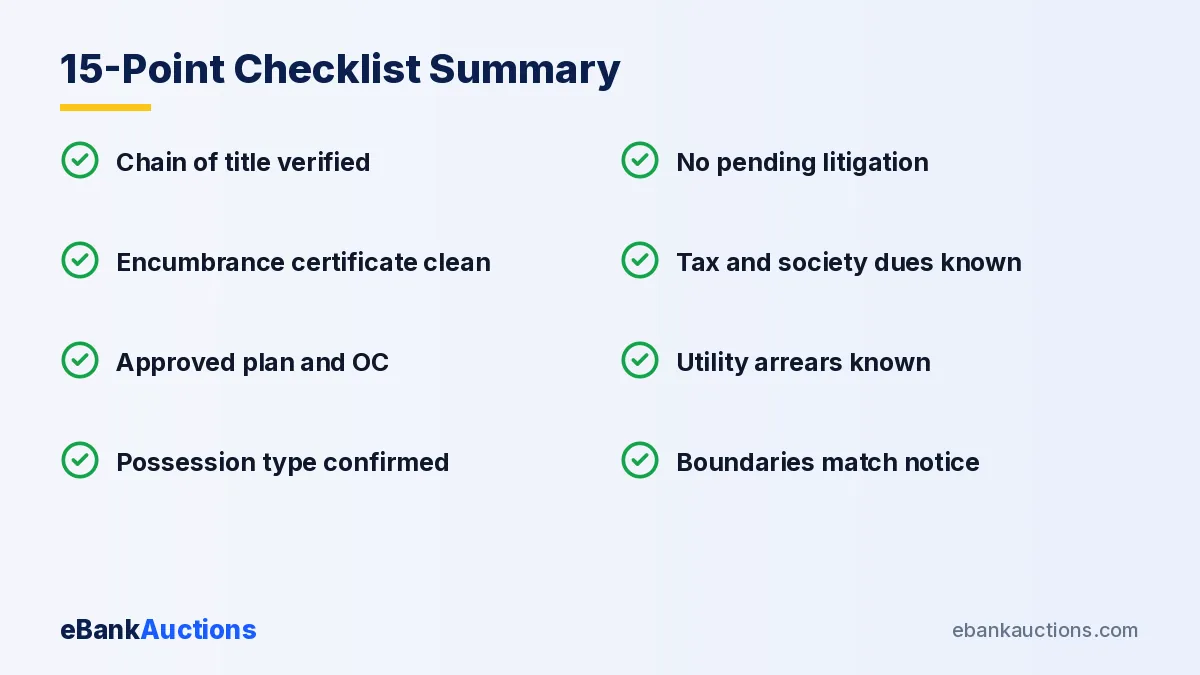
Auction property due diligence is the difference between buying a bargain and inheriting someone else’s problems. Banks sell repossessed homes and commercial units on an “as is where is, as is what is and whatever there is” basis, which means the buyer, not the bank, carries the risk of anything that is not disclosed. Good auction property due diligence covers three areas: the legal title, the physical condition and possession, and the money you will actually spend. This guide gives you 15 essential checks, grouped in the order you should do them, so you can bid with confidence and walk away when something is wrong.
Why auction property due diligence matters more than in a normal purchase
In a regular resale, the seller signs an agreement, gives warranties about title, and you can hold back part of the payment until problems are fixed. In a bank auction, the authorised officer sells under the SARFAESI Act, 2002, and the terms of sale usually state that the bank does not guarantee title, dues or condition beyond what the notice discloses. Once you win and pay, your options are limited. That is why auction property due diligence must be finished before you pay the earnest money deposit.
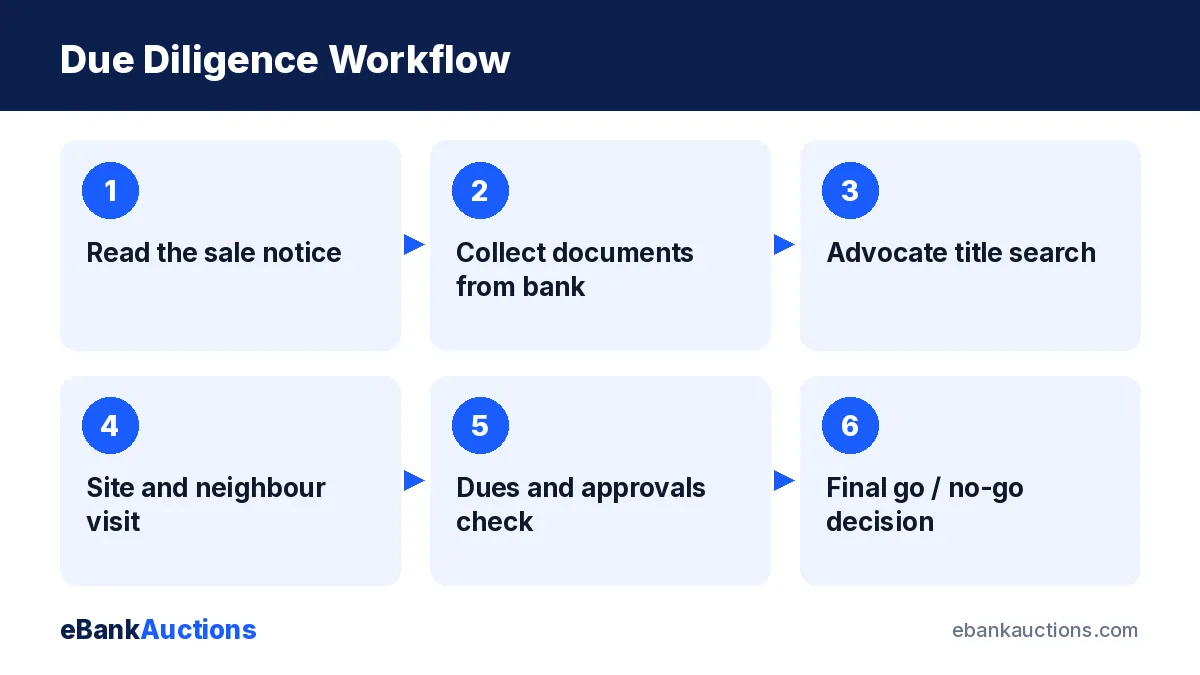
The good news: the process is not complicated. It needs a disciplined checklist, a competent local advocate and a few site visits. The cost is small compared with the amount at stake.
Part A: Legal auction property due diligence
Legal auction property due diligence answers one question: will you get a clean, marketable title that you can live in, rent out, mortgage or sell later?
Check 1: Read the sale notice and terms of sale in full
Start with the notice. Note the property description, survey or plot numbers, boundaries, area, the borrower and guarantor names, the amount due, the reserve price, the EMD, and the list of known encumbrances. Read the separate terms and conditions document too; it often contains clauses about dues, taxes and handover that are not in the newspaper notice.
Check 2: Get copies of title documents from the bank
The bank holds the original documents deposited by the borrower when the loan was sanctioned. Ask the authorised officer for photocopies or allow inspection. Typically you should see the borrower’s sale deed, prior deeds in the chain, the loan’s mortgage documents and any previous encumbrance certificates.
Check 3: Have an advocate trace the chain of title
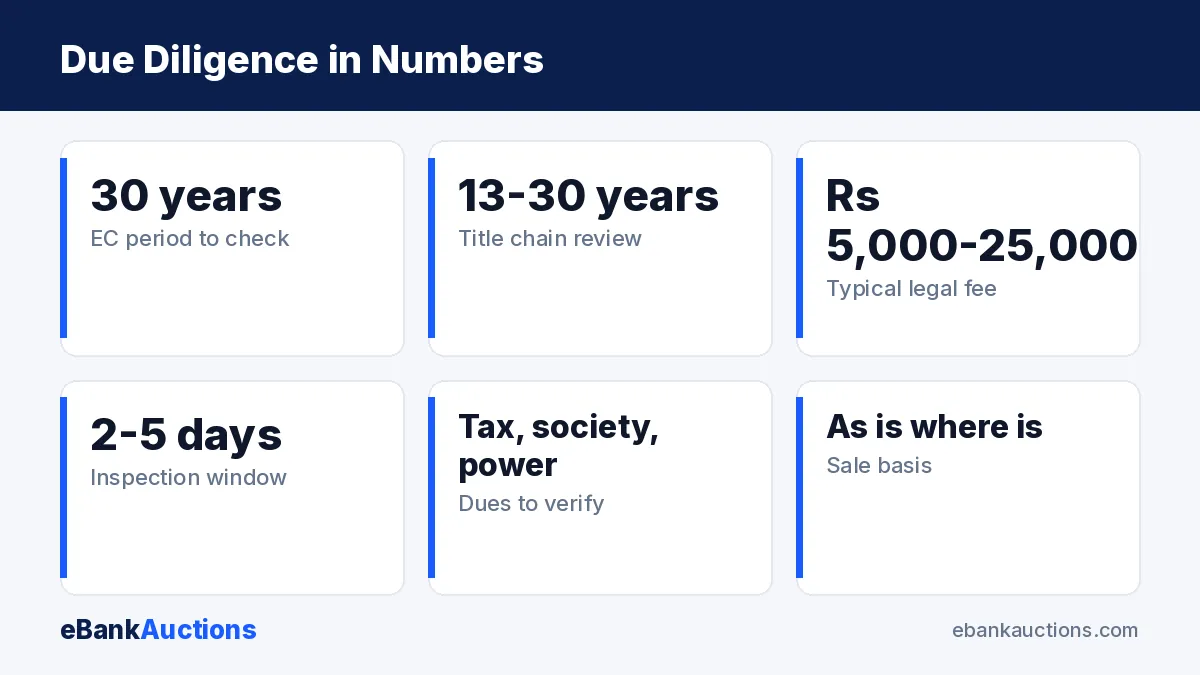
Your advocate should trace ownership back at least 13 years and preferably 30 years, confirming each transfer was valid, stamped and registered. Look for gaps, inheritance without proper partition, power-of-attorney sales and mismatched survey numbers. A broken chain is a red flag in any auction property due diligence exercise.
Check 4: Obtain a fresh encumbrance certificate
An encumbrance certificate (EC) from the sub-registrar’s office lists registered transactions on the property, including sales, mortgages and leases. Get a fresh EC for 30 years. Compare it with what the bank disclosed. If you see a second mortgage or a lease you were not told about, ask questions before bidding. Our guide to the encumbrance certificate for auction property explains how to read one.
Check 5: Search for litigation
Ask the authorised officer, in writing, whether any case is pending before the Debts Recovery Tribunal, a civil court or a consumer forum regarding the property. Your advocate can also search online court records by borrower name and property details. A pending securitisation application under Section 17 of SARFAESI does not always stop a sale, but it can delay confirmation.
Check 6: Verify building approvals
For flats and houses, check the approved building plan, completion certificate and occupancy certificate. For flats, also check whether the builder has registered the project with the state RERA if it is recent. Unauthorised floors or deviations can create problems with loans and resale.
Check 7: Confirm land use and zoning
Make sure the land use is residential for a home, or commercial for a shop. In many states, agricultural land cannot be used for construction without conversion. Check the master plan or development plan for road widening or reservations that may affect the plot.
Part B: Physical auction property due diligence and possession
The second pillar of auction property due diligence is what you can see and touch.
Check 8: Confirm the type of possession
The notice should state whether the bank has symbolic or physical possession. With physical possession the bank has the keys; with symbolic possession someone may still be inside. Getting vacant possession later may need a District Magistrate order under Section 14 of SARFAESI, which takes time. Our explainer on symbolic vs physical possession covers what to ask the bank.
Check 9: Inspect on the notified dates
Visit the property during the inspection window, ideally twice. Check the structure, walls, roof, plumbing, electrical wiring, doors and windows. For older buildings, bring a civil engineer. Photograph everything. Note what repairs you would need and estimate their cost.
Check 10: Walk the boundaries and measure
Compare the actual boundaries with the notice and title documents. Measure the built-up area roughly. For plots and houses, ask a licensed surveyor to confirm the extent against survey records, especially in areas where encroachment is common. Our guide to a land survey before bidding explains the process.
Check 11: Talk to neighbours and the society
Neighbours and the housing society secretary are excellent sources. They know whether the borrower still lives there, whether tenants are present, and whether there are disputes. The society office can also confirm maintenance dues, parking allotment and any pending special assessments for repairs.
Part C: Financial auction property due diligence
The third pillar of auction property due diligence is calculating your true cost.
Check 12: Get dues in writing
Collect written statements for property tax, water charges, electricity arrears and society maintenance. Many notices say that such dues are payable by the purchaser. Some local bodies will not transfer the tax record until arrears are paid, so this is not optional.
Check 13: Estimate stamp duty and registration
Stamp duty is generally payable on the sale certificate. In several states it is calculated on the higher of the auction price or the government guideline value. Registration fees apply on top. Check your state’s rates and budget for them. Our guide to sale certificate registration explains the process.
Check 14: Confirm your loan eligibility for this specific property
Share the notice with your lender before bidding and ask whether it will finance this property. Some lenders will not fund properties with symbolic possession, missing approvals or litigation. Read our auction property loan guide for details.
Check 15: Calculate a walk-away price
Add the likely winning bid, stamp duty, registration, dues, repairs, legal fees and a contingency of 5%. Compare this total with the market value of similar properties. The difference is your margin. Set the maximum bid at which the margin still justifies the risk, and do not cross it.
Auction property due diligence: quick reference table
| Area | What to check | Who helps |
|---|---|---|
| Title | Chain of deeds, mortgage, EC | Advocate |
| Litigation | DRT, civil suits, disputes | Advocate, bank letter |
| Approvals | Plan, OC, RERA, zoning | Advocate, local body |
| Possession | Symbolic or physical, occupants | Bank, site visit |
| Condition | Structure, services, repairs | Engineer |
| Boundaries | Extent, encroachment | Surveyor |
| Dues | Tax, society, utilities | Local body, society |
| Costs | Stamp duty, fees, repairs | Advocate, contractor |
Building your auction property due diligence team
You do not need a large team, but you do need the right people. For most buyers, auction property due diligence involves four roles:
- A local advocate who handles title, encumbrance and litigation searches and knows the sub-registrar’s office.
- A civil engineer or experienced contractor who inspects the structure and estimates repairs.
- A licensed surveyor for plots, independent houses and any property where boundaries are unclear.
- Your lender’s representative who confirms early whether the property is financeable.
Brief all four with the same information: a copy of the sale notice, the property ID, photographs from your visit and the auction timeline. Ask each for a short written note. When their notes agree, you can bid with confidence. When they disagree, dig deeper or step back.
Auction property due diligence by property type
Different properties need different emphasis. Use this table to prioritise your time.
| Property type | Highest-risk area | Extra documents |
|---|---|---|
| Apartment | Society dues, OC, parking | Society NOC, share certificate, maintenance statement |
| Independent house | Boundaries, approvals, occupants | Building permit, tax receipts, survey sketch |
| Residential plot | Title chain, layout approval | Layout sanction, mutation record, conversion order |
| Shop or office | Tenancy, trade licences | Lease deed, fire NOC, commercial tax records |
| Industrial shed | Lease terms from industrial body | Allotment letter, transfer permission, pollution consent |
Two buyers, two outcomes
Consider two buyers bidding in the same week for similar flats in Hyderabad.
The first buyer skipped auction property due diligence because the reserve price looked low and the photographs were good. After winning, he discovered ₹3.8 lakh of pending maintenance, a disputed parking slot and a tenant who refused to leave. It took eight months and legal fees to get possession. His “discount” disappeared.
The second buyer spent ₹18,000 on an advocate and an engineer. The EC showed a second charge registered by a cooperative society, which the notice had not mentioned. She asked the authorised officer, received a written reply that the charge would be satisfied from sale proceeds, and bid only after the bank confirmed it in writing. She got the keys within three weeks of paying.
The difference between these outcomes is not luck. It is disciplined auction property due diligence done before the EMD is paid.
Questions to send the authorised officer
Writing to the bank is part of good auction property due diligence because the replies create a record. Useful questions include:
- Does the bank have physical possession, and will vacant possession be handed over on full payment?
- Are there any cases pending before the DRT, a civil court or any authority concerning this property?
- What dues are known to the bank, and which of them will be paid from the sale proceeds?
- Will the original title documents be handed over to the buyer or the buyer’s lender?
- Are there any tenants or occupants, and do they have registered leases?
Keep the replies with your file. If the bank declines to answer an important question, factor that uncertainty into your bidding limit.
How long auction property due diligence takes
With a notice period of about 30 days before the sale, you have limited time. A practical schedule is:
- Days 1–3: read the notice, contact the authorised officer, request documents.
- Days 4–10: advocate reviews title and EC; you apply for loan pre-approval.
- Inspection days: site visit with an engineer; meet neighbours and society.
- Days 11–20: dues statements, surveyor visit if needed, lender feedback.
- Before EMD deadline: final go or no-go decision and bidding limit.
If the auction is too close to complete these steps, it is usually wiser to skip it and track the property in case it comes back in a re-auction.
Red flags in auction property due diligence
- The bank cannot share any title documents.
- The EC shows a mortgage or sale that the notice does not mention.
- Someone is in occupation and the bank has only symbolic possession, with no clear handover plan.
- A court has granted a stay on the sale.
- The property is on land reserved for a public purpose or road widening.
- Dues are unknown and the notice says all dues are on the buyer.
Good auction property due diligence is as much about saying no as about saying yes.
Special notes for plots and commercial property
For plots, pay extra attention to land records such as record of rights, mutation entries, survey sketch and conversion orders. For commercial property, check trade licences, fire safety approvals, lift licences and whether any tenant has a registered lease that survives the sale. Commercial buyers should read our commercial property auction guide.
Common myths about auction property due diligence
“The bank has already checked everything”
The bank checked title when it gave the loan, possibly many years ago. Since then, dues may have piled up, occupants may have moved in, and disputes may have arisen. The bank’s sale terms deliberately put that risk on you.
“An auction sale wipes out all claims”
A properly conducted sale transfers the borrower’s rights to you free from the bank’s mortgage. It does not automatically cancel statutory dues, third-party ownership claims or valid tenancies. That is why auction property due diligence must look beyond the bank.
“Checks are expensive”
A title search and EC usually cost a few thousand rupees. A surveyor and engineer cost a little more. Compared with the risk of losing lakhs, this is the best money you will spend.
Documents to keep after the purchase
Once you complete the purchase, keep a file with the sale notice, terms of sale, EMD receipt, bid confirmation, payment receipts, sale certificate, registration receipt, EC, title copies, dues clearance letters and handover memo. These papers prove your ownership and help when you sell or mortgage the property later.
Frequently asked questions
Can I do auction property due diligence without an advocate?
You can do the physical and financial checks yourself, but title and litigation checks need a local advocate who knows land records and registration practices in that state.
What if the bank refuses to share documents?
Banks usually allow inspection of documents on request. If an authorised officer refuses without reason, treat it as a warning sign and consider skipping the auction.
Is an encumbrance certificate enough?
No. An EC shows registered transactions only. Unregistered agreements, family disputes and statutory dues do not appear, so combine it with other checks.
Should I repeat auction property due diligence if the property is re-auctioned?
Yes, at least partly. If a property returns in a later round, ask why the earlier auction failed. Get a fresh EC to catch any new registration, re-check dues because they keep growing, and confirm the possession status again. Your earlier title work usually remains valid, which makes the second round faster and cheaper.
Can the bank cancel the auction after I pay EMD?
Yes. The terms of sale usually reserve the bank’s right to postpone or cancel the auction, for example if the borrower settles the dues before the sale or a court orders a stay. In that case the EMD is refunded. This is another reason to keep your auction property due diligence costs proportionate until you know the auction will go ahead.
How much should I budget for due diligence?
For most residential properties, ₹10,000 to ₹40,000 covers the advocate, EC fees, surveyor and engineer. Complex or high-value properties may cost more.
Conclusion
Treat auction property due diligence as a fixed part of your buying process, not an optional extra. Legal checks protect your title, physical checks protect your comfort and your timeline, and financial checks protect your budget. Browse current bank auctions across India on eBankAuctions, shortlist properties early so you have time for these 15 checks, and use our Help Center whenever you need clarity.