An auction property loan is a home loan or property loan used to buy a flat, house, plot or commercial unit that a bank is selling through a public auction. The concept sounds simple, but the timelines are unforgiving: once you win, you typically have to pay 25% of the bid almost immediately and the remaining 75% within about 15 days. If your loan is not ready by then, you risk losing your earnest money deposit. This guide explains nine essential rules to get an auction property loan sanctioned and disbursed on time, what lenders look for, and how to avoid the most common delays.

How an auction property loan differs from a normal home loan
In a normal purchase, the buyer and seller agree on a timeline, and the lender takes a few weeks to verify title, value the property and disburse. With an auction property loan, the seller is a bank acting under the SARFAESI Act, 2002, the price is fixed by bidding, and the payment schedule is set by the Security Interest (Enforcement) Rules. There is no room to renegotiate dates because your lender is slow.
Three features make an auction property loan different:
- Speed: the lender has to complete legal and technical checks within days, not weeks.
- Documentation: instead of a sale agreement, the lender relies on the sale notice, the bid confirmation or acceptance letter, and later the sale certificate.
- Risk view: some lenders are cautious about properties with symbolic possession, pending litigation or unclear dues.
Who offers an auction property loan?
Most public sector banks, private banks and housing finance companies consider such loans. The auctioning bank itself is often the fastest option because it already holds the original title deeds and has a recent valuation. That said, you are free to borrow from any lender. Compare interest rates, processing fees and, above all, turnaround time.
Rule 1: Start before you pay EMD
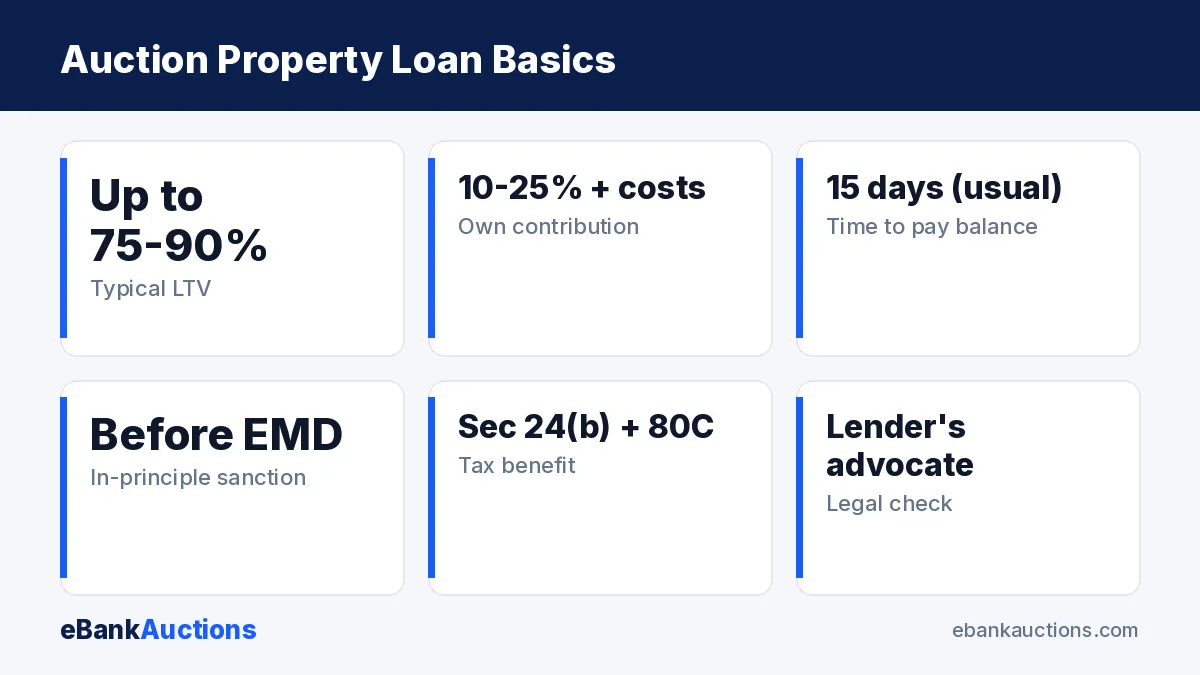
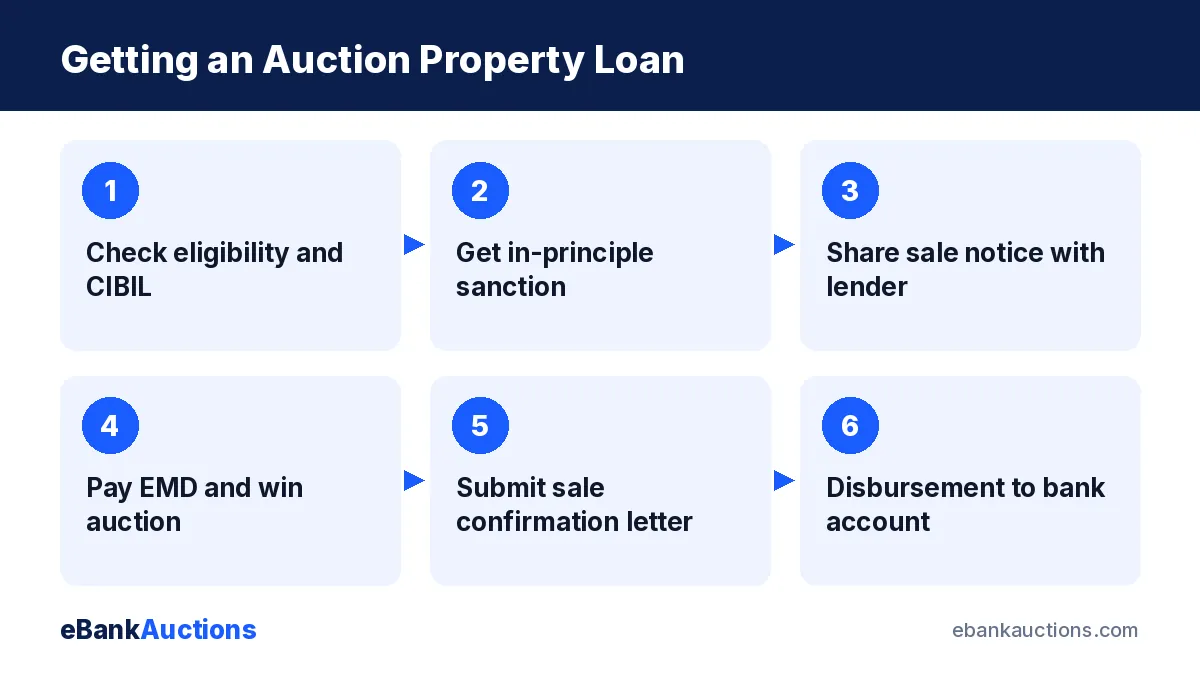
The biggest mistake buyers make is applying for an auction property loan after winning. By then the clock is running. Instead, apply as soon as you shortlist a property. Ask for an in-principle sanction based on your income, credit score and the reserve price. This tells you how much you can borrow and lets the lender begin legal scrutiny from the sale notice.
A strong application at this stage includes the full sale notice, the property ID, photographs from inspection, and any title documents the auctioning branch has shared. The more the lender knows early, the faster the final sanction.
Rule 2: Know your loan-to-value limit
The Reserve Bank of India caps the loan-to-value (LTV) ratio for housing loans by loan size. Broadly, loans up to ₹30 lakh can go up to 90% of property value, loans between ₹30 lakh and ₹75 lakh up to 80%, and loans above ₹75 lakh up to 75%. Lenders calculate LTV on the lower of the purchase price and their own valuation. For an auction property loan, the purchase price is your winning bid.
Stamp duty and registration charges are generally not financed as part of property value for LTV purposes. Plan your own contribution to cover:
- The EMD (usually 10% of reserve price) paid before the auction.
- The gap between the bid and the loan amount.
- Stamp duty, registration and legal costs.
- Pending dues and repairs.
Rule 3: Check your credit score and existing EMIs
Lenders decide eligibility from your income, age, existing obligations and credit history. A CIBIL score above 750 usually gets faster approval and better rates. If you have high credit card balances or several personal loans, clearing some of them before applying can raise your eligible amount. Self-employed applicants should keep two to three years of income tax returns, audited financials and GST returns ready.
Rule 4: Choose a property the lender will finance
Not every auction listing is loan-friendly. Before bidding, ask your lender whether it will fund the specific property. Lenders commonly hesitate when:
- The bank holds only symbolic possession and the property is occupied.
- A case is pending before the Debts Recovery Tribunal or a civil court.
- The building lacks an approved plan or occupancy certificate.
- The land is leasehold with restrictions on transfer.
- The property is very old, damaged or located in a non-approved layout.
If your lender declines, it is better to find out before paying EMD. See our guide on symbolic vs physical possession to understand why possession matters so much for an auction property loan.
Rule 5: Line up documents in advance
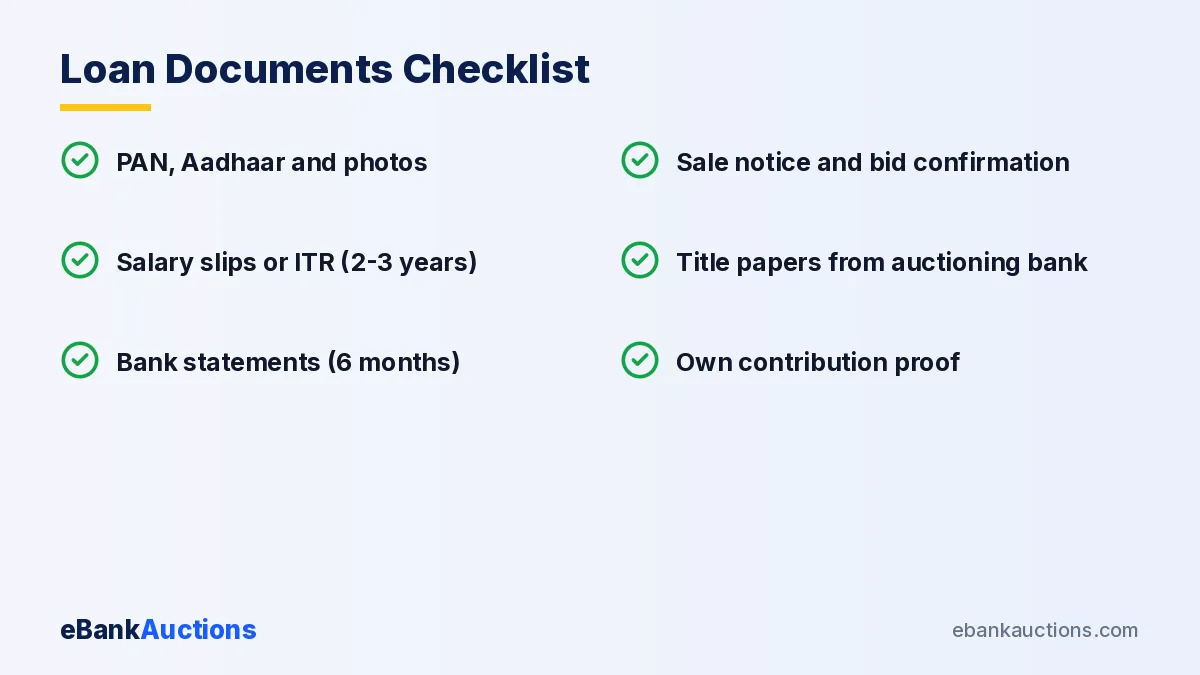
The document list for an auction property loan is similar to a regular home loan, with a few additions from the auction process:
- KYC: PAN, Aadhaar or passport, photographs.
- Income: salary slips, Form 16, ITRs, business financials.
- Bank statements for the last six months.
- The sale notice and terms and conditions of sale.
- Bid confirmation or sale acceptance letter from the authorised officer.
- Copies of title documents made available by the auctioning bank.
- Proof of your own contribution, including the EMD payment receipt.
Keep scanned copies in one folder. A missing document is the most common reason disbursement slips past the deadline.
Rule 6: Ask the authorised officer for a letter
After you win, request a letter from the authorised officer confirming you as the successful bidder, stating the amount received and the balance due, and naming the account for payment. Most lenders need this letter to release funds. Some also ask the auctioning bank for a no-objection or a confirmation that the original title documents will be handed over on full payment.
Rule 7: Request an extension only in writing
The rules allow the balance to be paid within 15 days, and the period can be extended up to three months by written agreement between the bank and the buyer. Extensions are not automatic. If your auction property loan is delayed for reasons outside your control, write to the authorised officer before the deadline, attach proof that the loan is sanctioned and in process, and request a specific new date. Do not rely on verbal assurances.
Rule 8: Understand how disbursement works
For an auction property loan, the lender pays the balance directly to the auctioning bank’s account mentioned in the sale letter. Your own contribution is paid first. Once the full price is received, the auctioning bank issues the sale certificate. Your lender will then register the sale certificate (or ensure you do) and create its mortgage, usually by deposit of title deeds. Stamp duty and registration are paid by you.
Typical disbursement sequence
- You pay 25% of the bid, including EMD, from your own funds.
- The lender completes legal and technical checks.
- Loan agreement is signed and the lender issues a cheque or RTGS to the auctioning bank.
- The auctioning bank confirms receipt and issues the sale certificate.
- Sale certificate is registered; original documents move to your lender.
Rule 9: Claim your tax benefits correctly
Interest on an auction property loan for a self-occupied home is deductible under Section 24(b) of the Income-tax Act, up to ₹2 lakh a year under the old regime, and principal repayment qualifies under Section 80C within its overall limit. Stamp duty and registration charges are also eligible under 80C in the year of payment. For let-out property the rules differ. Check the latest provisions on the Income Tax Department website or with a tax adviser, because the new regime removes many of these deductions.
Costs to budget beyond the loan
| Cost | Who pays | Notes |
|---|---|---|
| EMD | Buyer | About 10% of reserve price, before auction |
| Margin money | Buyer | Bid minus loan amount |
| Processing fee | Buyer | Usually 0.25–1% of loan, varies by lender |
| Legal and valuation charges | Buyer | Charged by lender |
| Stamp duty and registration | Buyer | Based on state rules |
| TDS under 194-IA | Buyer deducts | 1% if price is ₹50 lakh or more |
| Pending dues | Buyer | If notice says dues are on purchaser |
Common reasons an auction property loan gets delayed
Most delays come from avoidable issues:
- The buyer applies only after winning.
- The lender’s valuation is lower than the bid, increasing the margin required.
- Title documents are incomplete, such as a missing link deed in the chain.
- The property has no occupancy certificate or has deviations from plan.
- The applicant’s income papers are not updated.
Anticipate these. If your lender’s valuation is likely to be below your maximum bid, keep extra funds ready or lower your bidding limit.
A worked example: how much can you borrow?
Suppose Anita, a salaried professional in Pune, earns ₹1.2 lakh a month and has a car loan EMI of ₹12,000. Most lenders allow total EMIs of about 50–60% of net monthly income for this salary level. At 55%, her total EMI capacity is ₹66,000, which leaves ₹54,000 for a new home loan EMI after the car loan. At an interest rate of about 8.5% for 20 years, that supports a loan of roughly ₹62 lakh.
She shortlists a flat with a reserve price of ₹70 lakh and wins it at ₹74 lakh. The lender’s valuation comes to ₹76 lakh, so LTV is calculated on ₹74 lakh. Because the loan exceeds ₹30 lakh but is below ₹75 lakh, the cap is 80%, or ₹59.2 lakh. Her income supports ₹62 lakh, so the eligible auction property loan is the lower figure: ₹59.2 lakh. Her own funds must cover ₹14.8 lakh of the price plus stamp duty, registration and dues, roughly ₹20 lakh in all.
The lesson is simple: your eligible amount is the lowest of three limits—income-based eligibility, the LTV cap and the lender’s valuation. Calculate all three before you bid.
What the lender’s legal team checks
Lenders assign an empanelled advocate to review the documents. For an auction property loan, the advocate typically looks at:
- The mortgage documents under which the auctioning bank holds the property.
- The chain of title for at least 13 to 30 years, depending on the lender’s policy.
- Encumbrance certificates and any other charges registered on the property.
- The sale notice, terms of sale and compliance with SARFAESI notice periods.
- Approvals such as building plan sanction and occupancy certificate.
- Any litigation disclosed in the notice or found in court records.
The lender’s technical team, in parallel, visits the property to confirm its location, construction stage, age and market value. If the valuer cannot enter because the property is locked or occupied, the valuation may be based on external inspection, which some lenders accept only with a lower LTV.
Joint borrowers and co-applicants
Adding a spouse or parent as a co-applicant increases the combined income and therefore the eligible auction property loan. Women co-owners also enjoy lower stamp duty in several states. Remember that co-applicants must usually be co-owners on the sale certificate, so decide the names before you register on the auction portal. Each co-applicant needs KYC and income documents, and all must sign the loan agreement.
Balance transfer after the purchase
Speed matters more than the last few basis points of interest when you are racing a 15-day deadline. Some buyers therefore take the fastest available auction property loan and, after six to twelve months, move the loan to another lender offering a lower rate. A balance transfer involves fresh processing and legal charges, so compare the savings over the remaining tenure before switching.
Should you use a top-up, personal loan or loan against property?
Sometimes buyers consider a personal loan or a top-up on an existing home loan to meet the margin. This can work for small gaps, but personal loans carry high interest. A loan against another property you own may be cheaper but takes time to sanction. Plan the structure early. The ideal auction property loan is a regular home loan sized so that your own savings cover EMD, margin and costs.
How auction property loan interest rates compare
Interest rates for an auction property loan are generally the same as a regular home loan from the same lender, linked to an external benchmark such as the repo rate. Some lenders apply a small premium for resale or auction properties, or for self-employed borrowers. Negotiate on processing fees and ask about pre-payment rules; floating rate home loans to individuals usually carry no pre-payment penalty.
Fixed vs floating
Most home loans in India are floating. A fixed rate may be available for a few years before switching to floating. For a long-tenure auction property loan, floating rates are usually more economical, but choose based on your risk comfort.
Special cases: plots, commercial property and NRIs
- Plots: many lenders finance residential plots only if you commit to construct within a period. LTV may be lower.
- Commercial property: you will need a loan against commercial property or a business loan, with lower LTV and higher rates.
- NRIs: NRI home loans are available with EMIs paid from NRE/NRO accounts, but documentation takes longer. Start even earlier. See our NRI bank auction guide.
Working with your lender: a practical timeline
Knowing what happens each day helps you manage an auction property loan without panic. A realistic plan for a salaried buyer looks like this:
| When | What you do |
|---|---|
| As soon as you shortlist | Share sale notice with lender, apply for in-principle sanction |
| During inspection week | Lender’s valuer and advocate review the notice and documents |
| 3–4 days before EMD deadline | Confirm sanction amount and final bidding limit |
| Auction day | Bid within the sanctioned limit |
| Next working day | Pay 25% from own funds; obtain confirmation letter |
| Days 2–10 | Sign loan agreement, complete legal formalities |
| Before day 15 | Lender pays balance directly to auctioning bank |
If your lender cannot commit to this timeline, choose another one. Speed is the single most valuable feature of an auction property loan.
Frequently asked questions
Can I get an auction property loan from the same bank that is auctioning?
Yes, and it is often the quickest route because the bank already holds the documents and valuation. It is still a separate credit decision.
How much of the bid can be financed?
It depends on the LTV slab and the lender’s valuation. For most buyers, 75–90% of the lower of bid price or valuation is available, subject to income eligibility.
What if my loan is rejected after I win?
You may lose your EMD if you cannot pay the balance on time. That is why an in-principle sanction and a lender’s written view on the specific property are essential before bidding.
Does the lender need the sale certificate before disbursing?
Usually not. Most lenders disburse against the auctioning bank’s confirmation letter and then ensure the sale certificate is issued and registered, with the original documents deposited with them. Ask your lender to confirm its exact procedure at the sanction stage so there are no surprises.
Will a low CIBIL score block my application?
A score below about 650 makes approval difficult with most banks. Some housing finance companies consider lower scores with higher interest rates. Improve your score, or add a co-applicant with a strong credit history, before you apply.
Is an auction property loan available for commercial units?
Yes, through loans against commercial property or business loans, but LTV is lower and processing can take longer.
Conclusion
An auction property loan is entirely achievable if you treat time as your biggest constraint. Get pre-approved, pick loan-friendly properties, keep documents ready, and coordinate closely with both the auctioning bank and your lender. Browse the latest residential bank auctions on eBankAuctions, read our bank auction flats buying tips, and bid with confidence knowing your finance is in place.