An office space auction gives businesses and investors a way to buy commercial offices from banks, often at prices well below what sellers ask in the open market. When companies or individuals default on loans secured against office units, lenders sell them under the SARFAESI Act through public e-auctions. A good office space auction purchase can become your company’s permanent address or a steady source of rental income from corporate tenants.
Offices, however, are not like flats or shops. Their value depends heavily on the building’s quality, management, occupancy and connectivity, and on how the area is measured and loaded. This guide covers nine essential checks that experienced buyers make before bidding, plus practical advice on finance, leasing and exit.
Why an office space auction can be a smart buy
Office rents in Indian cities are driven by demand from IT, financial services, consulting, start-ups and small businesses. In the open market, office units are priced on yield, and sellers rarely offer discounts in good buildings. In an office space auction, the reserve price follows the bank’s valuation and the bank’s need to recover dues, so buyers who understand the building can pick up units below market.
Key advantages:
- Corporate tenants: leases with companies tend to be longer and more formal than retail or residential leases.
- Predictable costs: many leases put maintenance and utilities on tenants.
- Own-use savings: businesses convert monthly rent into ownership and gain stability.
- Appreciation: offices in growing business districts gain value as demand rises.
Where office auctions appear
Listings include units in commercial complexes in city centres, floors in IT parks, small offices above shops in mixed-use buildings, and entire standalone office buildings. You can browse commercial property auctions on eBankAuctions and filter by city.
Nine essential office space auction checks
Every office space auction is different, but the same nine checks apply. Work through them in order and keep notes for each shortlisted unit.
Check 1: The building matters more than the unit
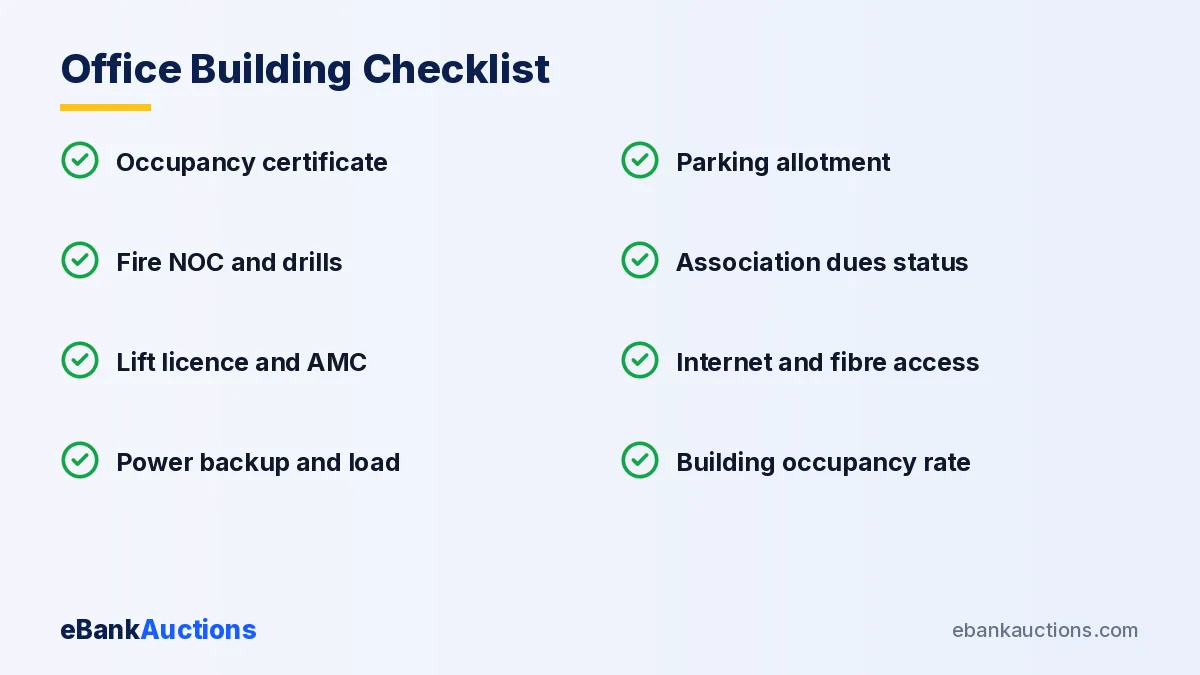
Tenants choose buildings first and units second. Before looking at the unit in an office space auction, assess:
- The developer and the building’s age.
- Occupancy: how many floors are leased and to whom.
- Facility management: cleanliness, security, lifts and common areas.
- Power backup, air-conditioning systems and water supply.
- Parking availability for employees and visitors.
- Connectivity: metro, bus routes, main roads.
Walk through the lobby at 10 a.m. on a weekday. A busy, well-kept lobby is a strong sign. An empty building with closed units is a warning, however attractive the price looks.
Check 2: Understand carpet, built-up and super built-up area
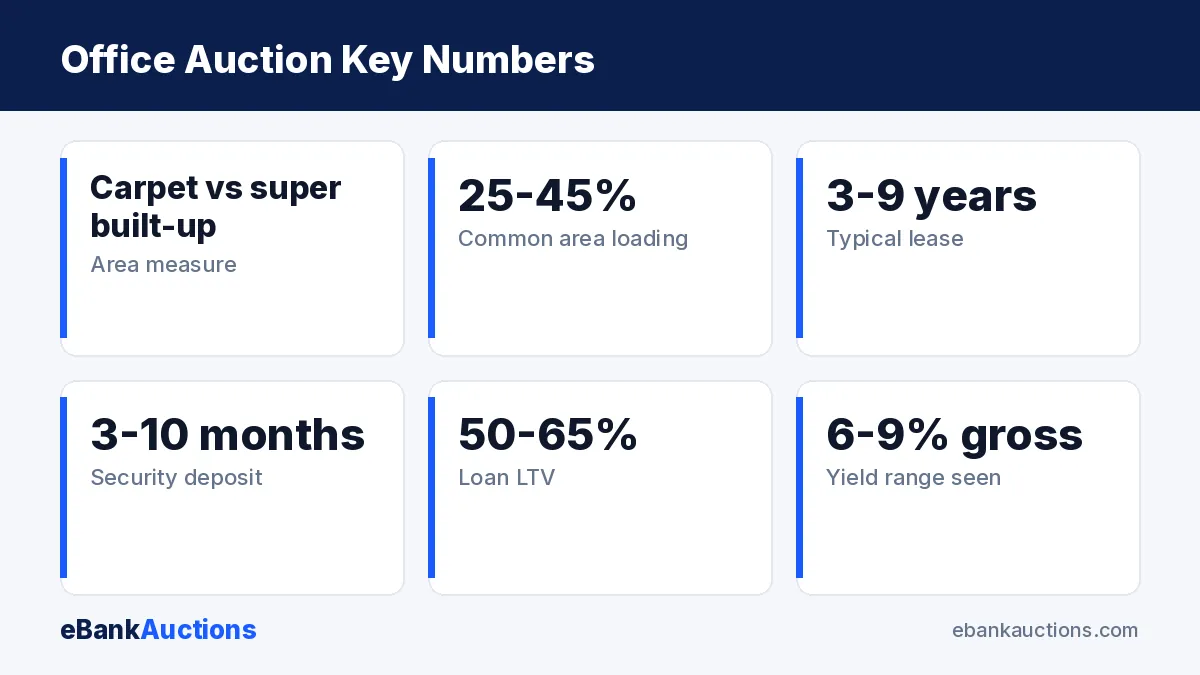
Office space is often sold on super built-up area, which includes a share of lobbies, corridors, lifts and common facilities. The ratio between super built-up and carpet area is called loading and can range from 25% to 45% or more. Tenants increasingly compare rents on carpet area. When evaluating an office space auction, calculate your price and expected rent on the same basis. A low price per super built-up square foot may not be cheap if loading is very high.
Check 3: Verify title, approvals and occupancy certificate
Your advocate should trace the title and get an encumbrance certificate. For offices, also check:
- The approved building plan and that the unit is sanctioned for commercial or office use.
- Occupancy certificate for the building.
- Fire NOC, which large office buildings must renew periodically.
- Lift licences and maintenance contracts.
- Any regularisation of deviations such as extra floors.
Without these, corporate tenants may refuse to lease, and lenders may refuse to finance. Our guide to commercial building due diligence explains each approval.
Check 4: Review existing leases carefully
Many units in an office space auction are already leased. Ask the bank for the lease deed and check:
- Tenant name and business.
- Rent, deposit, escalation and lock-in period.
- Registration of the lease and its date relative to the mortgage.
- Whether rent is being paid, and to whom.
- Who holds the security deposit, and whether you will have to refund it at the end of the lease.
A strong tenant on a registered lease is an asset. A related-party tenant at a low rent created after default is a risk. Read our pre-leased property auction guide.
Check 5: Collect maintenance and tax dues
Office buildings often have high common area maintenance (CAM) charges, plus property tax at commercial rates, common electricity and sometimes sinking fund contributions. Owners in default often stop paying. Get a written statement from the association or facility manager and the local body. Some buildings disconnect services until dues are cleared.
Check 6: Check possession and handover
If the bank holds physical possession, you can inspect fully and take over soon after payment. If the borrower’s company still operates from the unit, possession may take time. Ask the authorised officer about the status and visit during office hours.
Check 7: Estimate achievable rent and vacancy
Office rents vary widely within a city. Get estimates from brokers who specialise in commercial leasing, check listings on property portals, and ask the facility manager about recent deals in the building. Also estimate how long it might take to find a tenant. For small units in mixed buildings, vacancy can be long. For quality buildings in strong districts, it can be short.
Check 8: Build a yield-based bid limit
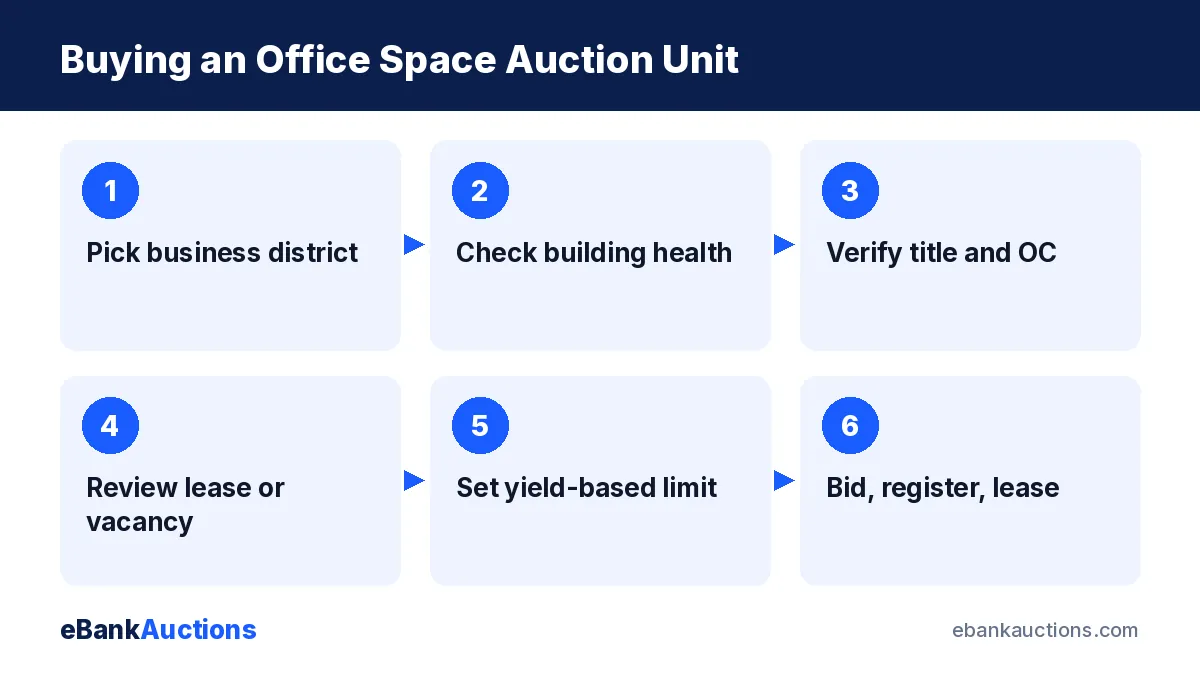
Use your rent estimate to set a maximum bid:
- Annual rent minus property tax, CAM (if you pay it), insurance and vacancy allowance gives net income.
- Choose a target net yield based on risk, for example 7–8%.
- Net income divided by target yield gives your maximum all-in cost.
- Subtract stamp duty, registration, dues, fit-out and legal costs to get your maximum bid.
Our guide to auction property rental yield shows this method in detail.
Check 9: Arrange commercial finance early
Lenders usually fund 50–65% of an office unit’s value, through a loan against property, commercial purchase loan or lease rental discounting if the unit is leased. Lease rental discounting lets a bank lend against future rent from a strong tenant. Get in-principle approval before paying EMD, as the 25% immediate payment and balance within about 15 days still apply. Read our commercial auction loan guide.
Office space auction for own use
Businesses buying for their own use should also consider:
- Whether the layout suits their team size and growth.
- Fit-out costs for workstations, cabins, cabling and air-conditioning.
- Proximity to employees’ homes and public transport.
- Brand image of the building.
- The EMI compared with current rent plus the value of stability.
A company that buys through an office space auction can often justify paying a little more than an investor, because it saves rent immediately and avoids relocation risk.
Office space auction for investors
Investors should think about:
- Tenant demand from the sectors active in that district.
- The building’s ability to meet modern tenant expectations: power backup, fibre connectivity, fire safety and parking.
- Lease terms typical in the city.
- Resale liquidity: can you sell the unit to another investor or user later?
Where to find office space auction listings
Office units are listed by public sector banks on BAANKNET, by private banks and NBFCs on their own e-auction partners’ sites, and in newspaper notices. Because notices are scattered, many buyers miss good opportunities. eBankAuctions collects them so you can review every office space auction in your city in one place, compare reserve prices per square foot and follow re-auctions of units that did not sell.
Reading an office space auction notice
Look for these details in the notice:
- Exact unit number, floor and building name.
- Area and whether it is carpet, built-up or super built-up.
- Car parking slots included, if any.
- Undivided share of land, if mentioned.
- Tenancy status and any lease details.
- Dues that will be the buyer’s responsibility.
If the notice gives only super built-up area, ask the association for the carpet area from the building’s records.
Office space auction in IT parks and SEZs
Units in IT parks and special economic zones (SEZs) come with extra rules. SEZ units may only be leased to approved SEZ units, and transfers may need approval from the development commissioner. Some IT parks are on land leased from state industrial bodies, which may charge transfer fees or restrict use. Check these conditions before you bid, because they affect who can occupy the office and what it is worth. An office space auction in an SEZ can still be attractive, but the pool of tenants is narrower.
Timeline for an office space auction purchase
| Stage | Timing |
|---|---|
| Shortlist and building visit | Days 1–7 |
| Legal, approvals and lease review | Days 3–15 |
| Broker rent survey | Days 5–12 |
| Loan pre-approval | Days 5–20 |
| Inspection | As notified |
| EMD payment | Before deadline |
| E-auction | Around day 30 |
| 25% and balance payments | Days 30–45 |
| Registration, mutation, association transfer | Weeks after payment |
Start early. Office checks involve more parties—association, facility manager, tenants and approvals—than a typical flat.
Grade A, Grade B and small offices
| Type | Typical buyer | Tenant profile | Risk |
|---|---|---|---|
| Grade A in IT park | Institutional, HNI | Large corporates | Low vacancy, high price |
| Grade B commercial complex | Small investors | SMEs, professionals | Moderate vacancy |
| Small office above shops | Local investors | Consultants, small firms | Higher vacancy, lower rent |
| Standalone building | Experienced investors | Single or multiple tenants | Concentration risk |
Most office space auction listings fall in the Grade B and small office categories, where due diligence on building quality is essential.
Comparing two office space auction listings
Suppose you are choosing between two units in the same city. Unit A is in a busy Grade B complex near a metro station, 1,000 sq ft super built-up with 30% loading, reserve ₹70 lakh. Unit B is in a quieter mixed-use building, 1,200 sq ft super built-up with 45% loading, reserve ₹72 lakh.
On paper, Unit B looks cheaper per square foot. On carpet area, Unit A offers about 770 sq ft and Unit B about 830 sq ft, so the gap narrows.
Add occupancy—Unit A’s building is 90% leased, Unit B’s is 55%—and Unit A becomes the clear winner for an investor, even at a higher price per carpet square foot. This kind of comparison is the heart of a smart office space auction decision.
Mistakes to avoid in an office space auction
- Ignoring loading and overpaying per usable square foot.
- Buying in a building with no occupancy certificate or fire NOC.
- Assuming an existing low-rent lease can be ended quickly.
- Underestimating CAM arrears and fit-out costs.
- Bidding without checking the building’s occupancy and management.
Tax and GST points
Deduct 1% TDS under section 194-IA if the price is ₹50 lakh or more. Commercial rent may attract GST if your turnover crosses the registration threshold; details are on the GST portal. Rental income for individuals is taxed as income from house property, with a standard deduction and interest deduction as per rules. Companies can claim depreciation on the building. Read our guide on auction property tax and consult your chartered accountant.
How to inspect an office unit properly
During the notified inspection, go beyond the unit’s four walls:
- Check the unit’s condition: false ceiling, flooring, washrooms, pantry and electrical panels.
- Test whether the unit has individual meters for power and air-conditioning.
- Walk the fire escape and check extinguishers and alarms on the floor.
- Ask the facility manager for the building’s fire drill and lift maintenance records.
- Look at the parking area and confirm which slots, if any, belong to the unit.
- Check mobile network strength and whether fibre internet providers serve the building.
Take notes and photos, and get a fit-out contractor’s estimate if the unit needs work.
Handing over and association formalities
After registration, write to the association or facility manager with a copy of the registered sale certificate and request transfer of membership, access cards and parking stickers. Clear any dues that the notice placed on you and get a no-dues letter. Update the electricity account and any separate air-conditioning meter to your name. These steps make it possible for your tenant or your own team to move in without friction.
Leasing after an office space auction
Once you own the unit, lease it professionally:
- Refresh the unit with paint, lighting and basic cleaning.
- List it with two or three commercial brokers and online portals.
- Offer flexible options such as bare shell or warm shell to attract different tenants.
- Negotiate a lock-in, security deposit, annual escalation or escalation per term, and clarity on CAM.
- Register the lease deed and verify the tenant’s credentials.
A well-leased office unit becomes much easier to finance and sell. Many investors refinance through lease rental discounting once a strong tenant is in place.
Worked example
A Chennai-based consultancy rents a 1,200 sq ft super built-up office at ₹90,000 a month. It finds an office space auction listing in a Grade B building nearby: 1,400 sq ft super built-up, reserve price ₹84 lakh, with physical possession and CAM arrears of ₹1.6 lakh. The building is 85% occupied and well maintained.
The company estimates fit-out at ₹8 lakh, stamp duty and registration at ₹7 lakh and legal costs at ₹50,000. It obtains a loan against property for 60% and sets a maximum bid of ₹90 lakh. It wins at ₹87 lakh. The EMI on the loan is close to its current rent, but it now owns a larger office and builds equity. Five years later, the area’s office values have risen and the company has the option to sell or lease the unit if it moves.
Frequently asked questions
Is an office space auction good for small investors?
Yes, if you pick buildings with good occupancy and management. Small units in weak buildings can remain vacant for long periods.
What is lease rental discounting?
It is a loan given against the future rent from a lease, typically with a strong tenant. It can help investors refinance after buying and leasing an office.
Can I use an office unit in a residential building?
Only if the use is approved or regularised. Otherwise authorities can take action and tenants may not accept the unit.
How long does it take to lease an auctioned office?
It depends on the building and area. In active business districts, a few weeks to a few months; in weak locations, longer.
Can I bid on an office space auction through my company?
Yes. Register on the portal in the company’s name with its PAN and a board resolution authorising the signatory. The sale certificate will be issued to the company.
Do I have to refund the old tenant’s security deposit?
If the lease is valid and continues, the deposit obligation may pass to the new owner depending on the terms and law. Clarify with the bank what deposit it holds and factor this into your bid.
Conclusion
An office space auction can be one of the most rewarding commercial purchases if you focus on the building, the lease and the numbers. Check approvals, understand loading, collect dues, estimate realistic rent and bid within a yield-based limit. Browse commercial listings on eBankAuctions, read our commercial property auction guide, and subscribe to alerts for new office auctions in your city.